Rosmarinus officinalis
Rosemary
Generally recognised as safeOther names: Rosemary
Needle-like aromatic leaves; hardy in milder regions.
Upright branches, strongly aromatic leaves.
- Family
- Lamiaceae
- Plant type
- Subshrub
What the safety levels mean (expand legend)
- Generally recognised as safe. Often a common herb with reasonable harvest and use; still read the specific warnings on the card.
- Information. Primarily informational — details in the text and warnings below matter most.
- Caution. Needs extra care (dose, duration, sensitive groups, interactions).
- Risky. Significant risks — verify sources, contraindications and professional guidance.
- Not for home experimentation. Not suitable to experiment with at home without knowledge and certainty.
- High risk for internal use. Particular risk with internal use (e.g. alkaloids); avoid prolonged or irresponsible dosing.
- Not specified. Level not filled in yet — rely on individual warnings and links below.
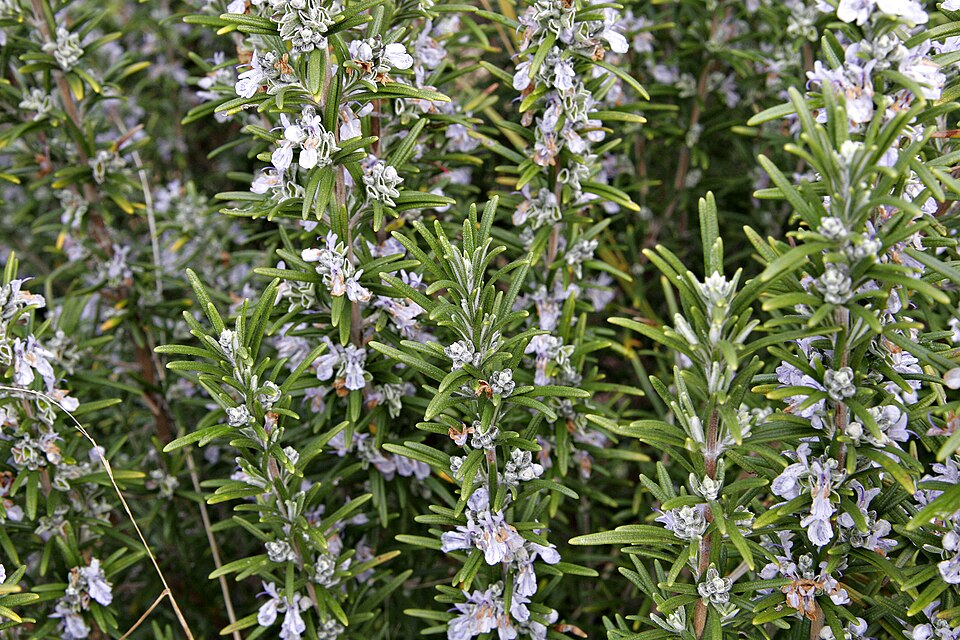
Photograph on Wikimedia Commons (GFDL 1.2).
Plant habit
Quick overview
A practical summary; details are in the sections below.
- Safety grade
- Generally recognised as safe details
- Scientific sources on the card
- Yes — sources are listed with claims Science section
- When and what to harvest
- Leaf — May–September
- Processing methods
Herbal infusion (tea), Herbal oil, Honey macerate
All methods and recipes on the card- Topics and symptoms
Anxiety & inner restlessness, Circulation comfort (folk), Complexion and local blemishes…
Topics section, Symptoms overview
Identification and mix-ups
Erect aromatic evergreen subshrub in Lamiaceae with leathery, linear to needle-like leaves with revolute margins; upper surface dark green and glossy, lower surface densely white-tomentose. Flowers two-lipped, blue-violet (rarely white or pink), arranged in short axillary clusters. Whole plant with a pronounced balsamic-camphoraceous scent.
Possible mix-ups and risks
Vegetatively, rosemary is most reliably distinguished from other Lamiaceae by the combination of needle-like leaves with white-tomentose undersides and its characteristic camphor-balsamic scent. Confusion with lavender (Lavandula angustifolia) is possible in the vegetative state; lavender has less leathery, shorter leaves that are hairy on both surfaces, and an entirely different scent (linalool-dominant, without camphor). Rosemary bears no resemblance to toxic conifers.
Similar herbs
No related herbs are linked yet.
Topics and symptoms
More topics are in the symptoms and topics overview.
- Anxiety & inner restlessnessTraditional· Traditional / cultural framing
- Circulation comfort (folk)Traditional· Traditional / cultural framing
- Complexion and local blemishesTraditional· Traditional / cultural framing
- Fatigue and low energyTraditional· Traditional / cultural framing
- Focus and attentionTraditional· Traditional / cultural framing
- IrritabilityTraditional· Traditional / cultural framing
- Liver & bile (folk framing)Traditional· Traditional / cultural framing
- Mood swingsTraditional· Traditional / cultural framing
- Mouth and gumsTraditional· Traditional / cultural framing
- Muscles after exertionTraditional· Traditional / cultural framing
- Sadness and melancholyTraditional· Traditional / cultural framing
- Scalp & hairTraditional· Traditional / cultural framing
- Seasonal allergiesTraditional· Traditional / cultural framing
- Space clearing (ritual)Spiritual· Symbolic / cultural framing
- Stuffy nose & coldsTraditional· Traditional / cultural framing
- TopicTraditional· Traditional / cultural framing
Drug interactions and photosensitivity
Information on the card — not a substitute for professional medical care or individual assessment.
Drug interactions
Preparations of rosemary at doses exceeding culinary amounts are contraindicated in pregnancy due to camphor content and potentially uterostimulant activity (EMA HMPC monograph rosmarini folium, section 4.3). Preparations containing rosemary essential oil are also contraindicated in patients with epilepsy (section 4.3 of the rosmarini aetheroleum monograph). These restrictions do not apply to culinary use of rosemary in normal food quantities.
Sources
Identification
Confusion risk
Drug interactions
Geographic occurrence
Czechia
Common (expected wild occurrence in the region)
Widespread or commonly cultivated in the Czech Republic, depending on habitat or garden context.
Austria
Occasional (garden, cultivation, or fringe of the range)
Germany
Occasional (garden, cultivation, or fringe of the range)
Hungary
Occasional (garden, cultivation, or fringe of the range)
Poland
Occasional (garden, cultivation, or fringe of the range)
Slovakia
Occasional (garden, cultivation, or fringe of the range)
France
Occasional (garden, cultivation, or fringe of the range)
Morocco
Occasional (garden, cultivation, or fringe of the range)
South Africa
Occasional (garden, cultivation, or fringe of the range)
Harvest
- LeafMay–September
léto
Region: CzechiaNotes: Aerial parts or leaf in dry weather; clean sites.
Storage
- Drying(Leaf)
Keep dried plant material in a sealed container.
- Light:
- Out of direct UV.
- Moisture:
- Low relative humidity.
Processing methods on this herb card
Infusion or brief extraction in hot water; usually without long boiling.
Full method description (from the catalogue)
In the narrow sense, "tea" often means an infusion: you pour water just off the boil over the dried plant matter and let it steep for a few minutes. Temperature, steep time, and the herb-to-water ratio change both flavour and what dissolves into the liquid.
Compared with a decoction, heat exposure is shorter and gentler; tender leaves and flowers are often better as an infusion than with prolonged simmering. For each herb, always follow the plant card for suitable plant part, preparation, and safety notes — general rules never replace species-level judgement.
Traditional context for this method: yes·Scientific context for this method: no
Rosmarinus officinalis — Herbal infusion (tea) (Leaf)
About 8 minBeginnerScience profile
Macerating herbs in a vegetable oil (cold or with gentle heat).
Full method description (from the catalogue)
Herbal oil is made by steeping dried or fresh material in oil (e.g. olive, sunflower) over time, sometimes with gentle warming. The result is not steam-distilled essential oil — it is a different extract type and usage (often topical or culinary per recipe).
Temperature, light, and material moisture affect shelf life; rancid oil must be discarded.
Traditional context for this method: yes·Scientific context for this method: no
Macerating plant material in honey (a honey conserve).
Full method description (from the catalogue)
Honey as a maceration medium creates a viscous mixture with its own biochemistry: water activity, acidity, and enzymes influence shelf life and flavour. Traditionally it is used with delicate flowers or herbs when you want aroma bound into honey.
Infant botulism guidance for honey and honey safety in general sit outside a single herb page; maceration time, ratios, and storage must follow a vetted recipe and source, not this general overview alone.
Traditional context for this method: yes·Scientific context for this method: no
Traditional / spiritual use
Kept separate from science — entries are cultural or symbolic, not medical advice.
Related guides in the library
Traditional folk context
General
The herb appears in older folk customs referenced on Czech cards. This note is cultural memory and seasonal storytelling — not a dosing guide, clinical indication, or substitute for the safety section.
- Form:
- různé
- Claim strength:
- Tradition
- Source note:
- Cultural framing only.
Scientific notes
Each claim lists a study type and a source (URL or DOI) where available. Dose notes from the literature are informational only.
How to read evidence strength and study type labels
Labels summarise how the catalogue entry is tagged — they are not a medical verdict on efficacy. For every row, read the summary, limitations and source link.
Evidence strength
- Evidence level not specified
- The author did not grade the record; judge from the summary, limitations and source link.
- Narrative / orientational literature
- Descriptive or expert literature without controlled group comparison — context rather than proof of effect.
- Weak evidence
- Study or conclusion with major methodological limits; treat only as a pointer for further reading.
- Preliminary findings
- First or smaller studies — interesting direction, not the final word on efficacy or safety.
- Moderate strength of evidence
- Moderate strength by study design; sample and context limits still apply.
- Stronger evidence
- Stronger design or consistency of results within the study's stated limits.
- Review article
- A review summarises multiple sources; quality depends on review method and field.
Study type
- Narrative / expert text
- Expert text or overview without a classical study design.
- In vitro study
- Cell culture or test-tube experiment — does not show an effect in the body.
- Animal study
- Animal model — transfer to humans is not automatic.
- Observational study
- Observing groups without random treatment assignment; confounding is possible.
- Clinical trial
- Human clinical trial; sample size and control group matter.
- Randomised controlled trial
- Randomised controlled trials are among the stronger designs when well conducted.
- Review study
- A review aggregates multiple papers — quality depends on selection rules.
- Systematic review
- Systematic review with explicit search and selection methodology.
- Meta-analysis
- Statistical pooling of studies; outcome depends on input data and heterogeneity.
- Regulatory assessment / monograph (EMA, WHO…)
- Regulatory body summary for a herbal product — different context from a single RCT; often about products, not home tea.
- Expert monograph (herbal preparations)
- Structured literature summary for a plant or drug — quality depends on author and edition year.
Scientific literature discusses effects and safety; this entry is an overview and does not replace professional care.
Evidence level not specifiedNarrative / expert textThe EMA HMPC monograph for rosemary leaf (and oil); a leaf tea is a close traditional form but not identical to the extracts in the document.
Review articleRegulatory assessment / monograph (EMA, WHO…)Year: 2024Preparation form in the study: infusion
Active compound / focus: rosmarinic acid, essential oil (per the document)
Limitations: Caution in pregnancy, children, and liver conditions per the document.
Dose note (from literature): See the PDF for preparations.
EMA Committee on Herbal Medicinal Products (HMPC) — European Medicines Agency
EMA: Final assessment report on Rosmarinus officinalis L., folium and aetheroleum (revision 1)
Images
The main photo is in the card header. More images will appear here when available.
Safety
What the warning types mean
The type on each warning helps group themes — it does not replace the separate severity badge.
- Internal use
- Risks from swallowing, extracts, duration of use or concentration for internal use.
- Interactions / medicines
- Possible effect on medicines or concurrent treatment — check sources and a professional.
- Raw plant parts
- Raw, unripe or poorly prepared plant parts can be dangerous.
- Toxins and regulation
- Toxic constituents or regulated compounds (e.g. in distillates).
- Contact with the plant
- Skin or mucosa irritation from contact with fresh plant or sap.
- Allergy
- Allergic reactions, often linked to family sensitisation.
- Harvesting and contamination
- Contamination, species mix-ups or harvesting from unsuitable places.
No structured safety records yet.