Capsicum annuum
Chili pepper
Generally recognised as safeOther names: Chili pepper
A Mexican pepper species that includes both sweet and hot cultivars.
An annual to short-lived perennial with white flowers and hollow fruits; cultivars range from sweet bell pepper to fiery chili.
- Family
- Solanaceae
- Plant type
- Annual herb
What the safety levels mean (expand legend)
- Generally recognised as safe. Often a common herb with reasonable harvest and use; still read the specific warnings on the card.
- Information. Primarily informational — details in the text and warnings below matter most.
- Caution. Needs extra care (dose, duration, sensitive groups, interactions).
- Risky. Significant risks — verify sources, contraindications and professional guidance.
- Not for home experimentation. Not suitable to experiment with at home without knowledge and certainty.
- High risk for internal use. Particular risk with internal use (e.g. alkaloids); avoid prolonged or irresponsible dosing.
- Not specified. Level not filled in yet — rely on individual warnings and links below.
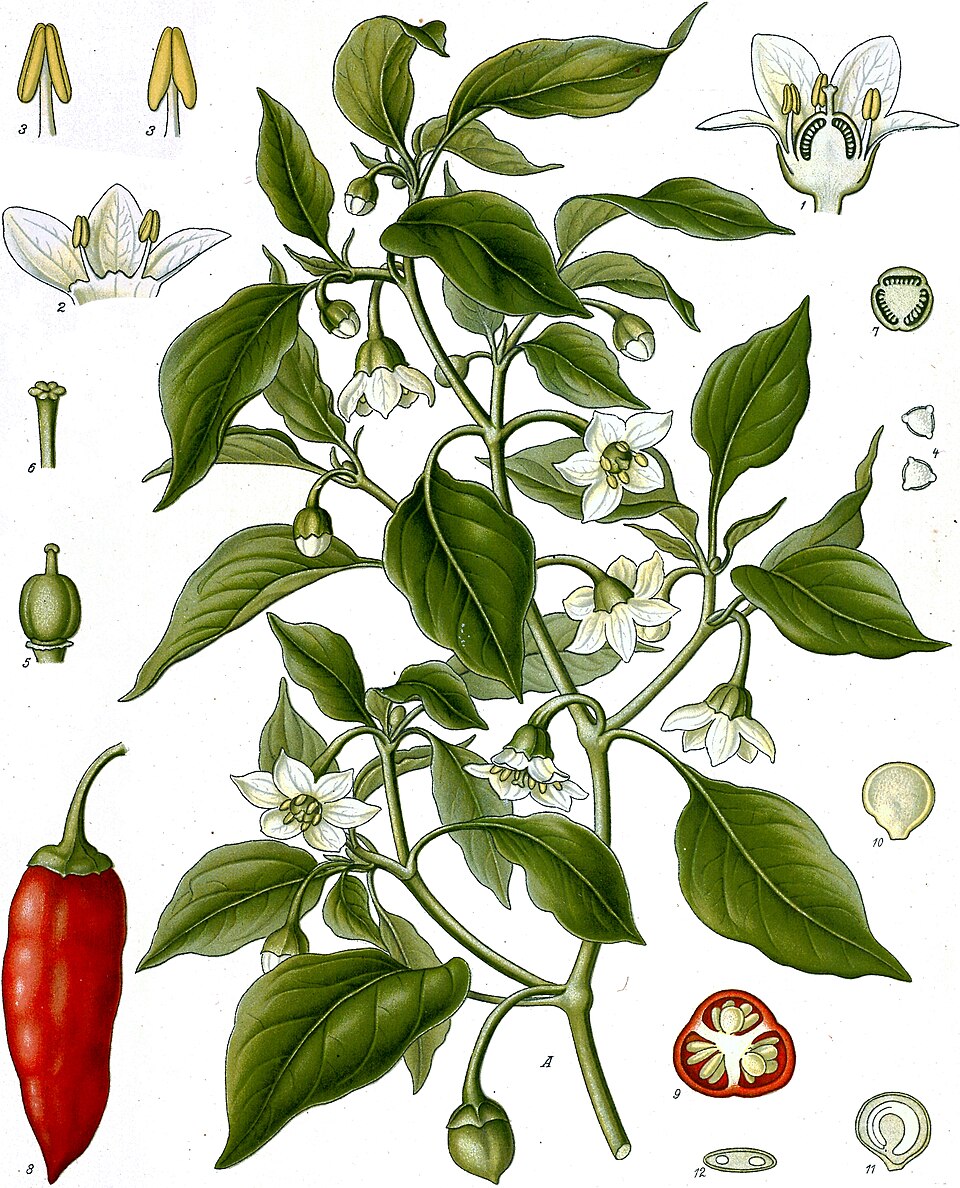
Photograph on Wikimedia Commons (Public domain).
Plant habit
Safety — read before use
For this herb it is important to check warnings, mix-ups and cautions. Start with the Safety section.
Quick overview
A practical summary; details are in the sections below.
- Safety grade
- Generally recognised as safe details
- Scientific sources on the card
- Yes — sources are listed with claims Science section
- When and what to harvest
- Fruit — July–October
- Processing methods
Culinary use, Herbal oil, Salve / ointment
All methods and recipes on the card- Topics and symptoms
Fatigue and low energy, Fire element (symbolism), Joints & mobility…
Topics section, Symptoms overview
Identification and mix-ups
Annual herb to subshrub in Solanaceae reaching 0.3–1.2 m. Leaves solitary or paired, ovate to ovate-lanceolate, glossy, 4–13 × 1.5–4 cm, entire, acute to acuminate. Flowers usually solitary at the nodes, white (rarely violet), star- to bell-shaped, with 5–6 corolla lobes; filaments not purple. Fruit a many-seeded berry of variable shape, ripening red, orange or yellow, up to 15 cm.
Possible mix-ups and risks
Confused with other edible peppers — Capsicum chinense and Capsicum frutescens (non-toxic). Distinguishing features: Capsicum annuum has a single flower per node, a white corolla and non-purple filaments, whereas C. chinense tends to have several flowers per node and an often pale-green corolla. The morphology overlaps and reliable separation can be difficult.
Similar herbs
No related herbs are linked yet.
Topics and symptoms
More topics are in the symptoms and topics overview.
- Fatigue and low energyTraditional· Traditional / cultural framing
- Fire element (symbolism)Traditional· Traditional / cultural framing
- Joints & mobilityTraditional· Traditional / cultural framing
- Muscles after exertionScientific· moderateTraditional· Traditional / cultural framing
Sources
Identification
Confusion risk
Geographic occurrence
Mexico
Common (expected wild occurrence in the region)
Harvest
- FruitJuly–October
summer
Region: MexicoNotes: Fruits fully coloured according to the cultivar (green, red, yellow).
Storage
- Drying(Fruit)
Whole dried pods keep 12 months in a closed container, ground chilli and paprika 6 months; after that colour and heat fade.
- Light:
- Pigments fade — out of light.
- Moisture:
- Damp pods mould (aflatoxin risk) — dry thoroughly.
- Safety:
- Gloves when cutting hot varieties; keep hands away from eyes.
Processing methods on this herb card
Cooking, baking, seasoning as food — general category without therapeutic claims.
Full method description (from the catalogue)
Culinary use covers herbs as ingredients in dishes, drinks, or spice mixes. This overview does not evaluate medicinal effects — only reminds you about species intent, allergies, and heat treatment where needed (e.g. some fruits or plant parts).
Combining with alcohol, sugar, or long cooking changes outcomes; verify culinary sources.
Traditional context for this method: yes·Scientific context for this method: no
Macerating herbs in a vegetable oil (cold or with gentle heat).
Full method description (from the catalogue)
Herbal oil is made by steeping dried or fresh material in oil (e.g. olive, sunflower) over time, sometimes with gentle warming. The result is not steam-distilled essential oil — it is a different extract type and usage (often topical or culinary per recipe).
Temperature, light, and material moisture affect shelf life; rancid oil must be discarded.
Traditional context for this method: yes·Scientific context for this method: no
Solid base (wax, fat) with herbal extract or macerate; usually topical.
Full method description (from the catalogue)
Salves combine extracted or finely ground herb with fat and often beeswax. Consistency depends on ratios; protective or emollient salves aim for a skin film with slow release.
Clean work reduces microbial contamination; refrigerated storage may extend life per recipe.
Traditional context for this method: yes·Scientific context for this method: yes
Capsaicin plasters and creams are registered medicinal products with dosing; a home 'chilli salve' has no concentration control and easily burns the skin.
Traditional / spiritual use
Kept separate from science — entries are cultural or symbolic, not medical advice.
Chīlli — tribute, punishment and everyone's food
General
Historical mentionFolk useHerbal loreSuperstitionChilli is one of Mexico's oldest domesticated plants (finds over 6,000 years old) and appears in the Codex Mendoza both as tribute and as punishment: a disobedient child was held over the smoke of burning chillies. An Aztec fast meant giving up salt and chilli, and folk belief still hangs bunches of chillies in doorways against the evil eye. A record of history and superstition, not effect.
- Form:
- daily food, tribute, punishment by smoke, protection
- Claim strength:
- Historical mention
- Source note:
- Codex Mendoza (fol. 60r, child-rearing; tribute lists); Mesoamerican archaeobotany (Tehuacán, Guilá Naquitz).
Scientific notes
Each claim lists a study type and a source (URL or DOI) where available. Dose notes from the literature are informational only.
How to read evidence strength and study type labels
Labels summarise how the catalogue entry is tagged — they are not a medical verdict on efficacy. For every row, read the summary, limitations and source link.
Evidence strength
- Evidence level not specified
- The author did not grade the record; judge from the summary, limitations and source link.
- Narrative / orientational literature
- Descriptive or expert literature without controlled group comparison — context rather than proof of effect.
- Weak evidence
- Study or conclusion with major methodological limits; treat only as a pointer for further reading.
- Preliminary findings
- First or smaller studies — interesting direction, not the final word on efficacy or safety.
- Moderate strength of evidence
- Moderate strength by study design; sample and context limits still apply.
- Stronger evidence
- Stronger design or consistency of results within the study's stated limits.
- Review article
- A review summarises multiple sources; quality depends on review method and field.
Study type
- Narrative / expert text
- Expert text or overview without a classical study design.
- In vitro study
- Cell culture or test-tube experiment — does not show an effect in the body.
- Animal study
- Animal model — transfer to humans is not automatic.
- Observational study
- Observing groups without random treatment assignment; confounding is possible.
- Clinical trial
- Human clinical trial; sample size and control group matter.
- Randomised controlled trial
- Randomised controlled trials are among the stronger designs when well conducted.
- Review study
- A review aggregates multiple papers — quality depends on selection rules.
- Systematic review
- Systematic review with explicit search and selection methodology.
- Meta-analysis
- Statistical pooling of studies; outcome depends on input data and heterogeneity.
- Regulatory assessment / monograph (EMA, WHO…)
- Regulatory body summary for a herbal product — different context from a single RCT; often about products, not home tea.
- Expert monograph (herbal preparations)
- Structured literature summary for a plant or drug — quality depends on author and edition year.
The HMPC recognised as 'well-established use' external capsicum fruit preparations (plasters, creams with standardised capsaicin) for relief of muscle pain including low back pain in adults, on the basis of placebo-controlled clinical studies; for at most 3 weeks, then a 2-week break.
Moderate strength of evidenceRegulatory assessment / monograph (EMA, WHO…)Year: 2015Limitations: Applies to registered external products with a defined capsaicin content, not to food or home salves. Burning and skin redness are common adverse effects.
EMA Committee on Herbal Medicinal Products (HMPC)
The Cochrane review of 8 trials (2,488 participants) reports that a single application of an 8 % capsaicin patch gave a proportion of patients with postherpetic neuralgia and HIV neuropathy substantial pain relief at 8–12 weeks compared with a low-concentration control patch.
Moderate strength of evidenceSystematic reviewYear: 2017Limitations: Moderate to low quality of evidence, small absolute benefit (roughly 1 in 10 patients extra); application only in a clinical setting. It says nothing about chilli in food.
Derry S, Rice ASC, Cole P, Tan T, Moore RA — Cochrane Database of Systematic Reviews
Topical capsaicin (high concentration) for chronic neuropathic pain in adults
Images
The main photo is in the card header. More images will appear here when available.
Safety
What the warning types mean
The type on each warning helps group themes — it does not replace the separate severity badge.
- Internal use
- Risks from swallowing, extracts, duration of use or concentration for internal use.
- Interactions / medicines
- Possible effect on medicines or concurrent treatment — check sources and a professional.
- Raw plant parts
- Raw, unripe or poorly prepared plant parts can be dangerous.
- Toxins and regulation
- Toxic constituents or regulated compounds (e.g. in distillates).
- Contact with the plant
- Skin or mucosa irritation from contact with fresh plant or sap.
- Allergy
- Allergic reactions, often linked to family sensitisation.
- Harvesting and contamination
- Contamination, species mix-ups or harvesting from unsuitable places.
- Skin and mucous-membrane contactModerate severityContact with the plant
Capsaicin from fresh chili and concentrated topicals burns strongly on skin and eyes; wash hands with soap after handling.
- Capsaicin on skin and in eyesLow severityContact with the plant
Capsaicin irritates skin and mucous membranes — the EMA monograph lists burning and redness for external products and limits application to 3 weeks. Wear gloves when cutting hot chillies and keep hands from your eyes; contaminated skin is washed with milk or oil, not water.