Citrus hystrix
Makrut lime
Generally recognised as safeOther names: Thai lime, Makrut lime leaf
A tropical citrus with knobby fruits; the aromatic leaves star in Thai cooking.
An evergreen thorny shrub to small tree with distinctively winged leaves and small rough fruits; Thai and Indonesian cooking uses mainly the glossy fragrant leaves and the fruit zest.
- Family
- Rutaceae
- Plant type
- Evergreen shrub/tree
What the safety levels mean (expand legend)
- Generally recognised as safe. Often a common herb with reasonable harvest and use; still read the specific warnings on the card.
- Information. Primarily informational — details in the text and warnings below matter most.
- Caution. Needs extra care (dose, duration, sensitive groups, interactions).
- Risky. Significant risks — verify sources, contraindications and professional guidance.
- Not for home experimentation. Not suitable to experiment with at home without knowledge and certainty.
- High risk for internal use. Particular risk with internal use (e.g. alkaloids); avoid prolonged or irresponsible dosing.
- Not specified. Level not filled in yet — rely on individual warnings and links below.
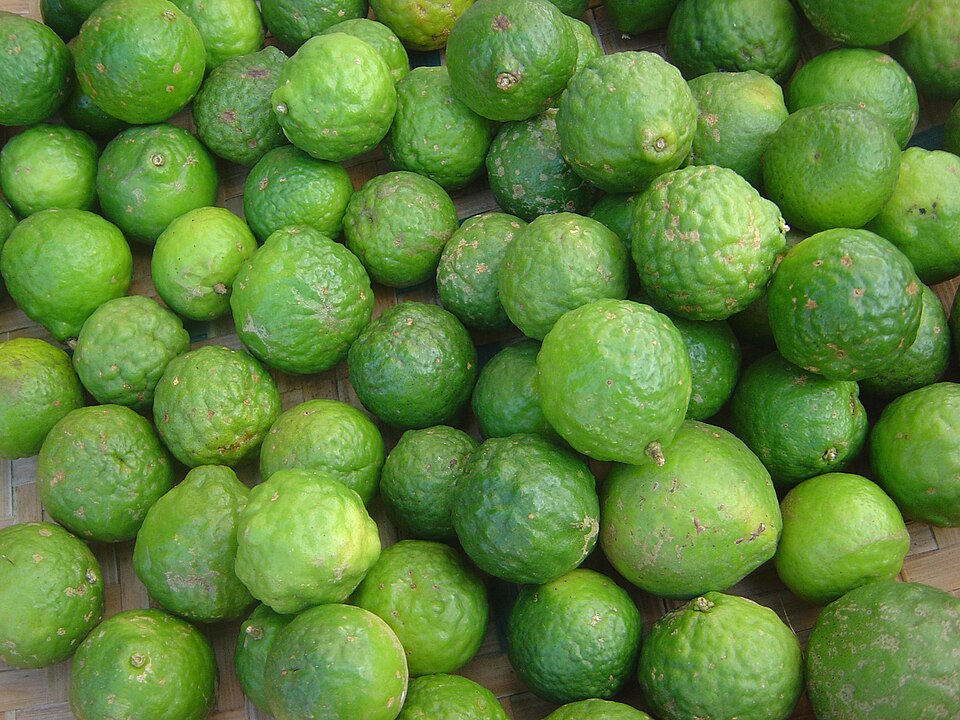
Photograph on Wikimedia Commons (CC BY-SA 3.0).
Plant habit
Quick overview
A practical summary; details are in the sections below.
- Safety grade
- Generally recognised as safe details
- Scientific sources on the card
- Yes — sources are listed with claims Science section
- When and what to harvest
- Leaf — January–December
- Fruit — January–December
- Processing methods
Culinary use, Essential oil and more
All methods and recipes on the card- Topics and symptoms
Creativity & inspiration, Digestion, Scalp & hair…
Topics section, Symptoms overview
Identification and mix-ups
Spiny shrub to tree in Rutaceae about 3–6 m, with spines on the branchlets. The leaves are diagnostic: glossy dark-green, double (hourglass-shaped), formed of a blade plus a broad winged petiole nearly the size of the blade; highly aromatic. Fruit small (about 5–7 cm), with a distinctly warty, knobby rind, thick, green ripening yellow; juice scant and very acidic.
Possible mix-ups and risks
Confused with Citrus micrantha (Philippine papeda), a close relative possibly conspecific; the genomic distinction is not definitively resolved. Other papeda-group species also have winged petioles but lack the combination of heavily warty fruit and figure-eight leaf. It is not toxic.
Similar herbs
No related herbs are linked yet.
Topics and symptoms
More topics are in the symptoms and topics overview.
- Creativity & inspirationTraditional· Traditional / cultural framing
- DigestionTraditional· Traditional / cultural framing
- Scalp & hairCosmetic· Traditional / cultural framing
- Space clearing (ritual)Spiritual· Traditional / cultural framing
Sources
Identification
Confusion risk
Geographic occurrence
Thailand
Common (expected wild occurrence in the region)
Harvest
- LeafJanuary–December
year-round
Region: ThailandNotes: Glossy fragrant leaves and the rough zest of ripe fruits.
- FruitJanuary–December
year-round
Region: ThailandNotes: The knobbly fruits are picked all year in the tropics, most in the rainy season; they are taken green, when the rind holds the most oil. The pulp is sour and bitter; the rind and juice are used.
Storage
- Refrigeration(Leaf)
Fresh leaves keep 2 weeks in the fridge in a bag; frozen 6 months without losing scent — freezing beats drying, dried leaves smell faint. Fruits 2 weeks in the fridge, grated rind frozen.
- Moisture:
- Pat dry before storing.
Processing methods on this herb card
Cooking, baking, seasoning as food — general category without therapeutic claims.
Full method description (from the catalogue)
Culinary use covers herbs as ingredients in dishes, drinks, or spice mixes. This overview does not evaluate medicinal effects — only reminds you about species intent, allergies, and heat treatment where needed (e.g. some fruits or plant parts).
Combining with alcohol, sugar, or long cooking changes outcomes; verify culinary sources.
Traditional context for this method: yes·Scientific context for this method: no
A concentrated aromatic plant product; use depends on the specific product.
Full method description (from the catalogue)
Essential oil is a concentrated plant product obtained, for example, by steam distillation or pressing. A general drop count or dilution ratio does not establish safe use.
Choose a finished product intended for your purpose and follow its directions. Do not apply it to skin or swallow it unless the manufacturer explicitly allows that use. This overview is not a recipe for home dilution.
Traditional context for this method: no·Scientific context for this method: no
The oil from the leaves (citronellal) and from the rind is distilled industrially for the fragrance industry. Dilute on the skin; citrus rind oils can irritate.
Traditional / spiritual use
Kept separate from science — entries are cultural or symbolic, not medical advice.
The fruit that washes away bad luck
General
Spiritual useFolk useRitualSuperstitionIn Thailand makrut limes are cut into water that a monk or a family elder blesses (nam mon), and a person washes with it after an accident, a funeral or a run of bad luck — the sour juice and strong scent are meant to carry off ill influences. The same juice has served for centuries as a shampoo and hair rinse against dandruff, and in Malay tradition the fruit goes into a newborn's bath. A record of ritual and folk practice.
- Form:
- fruit in blessed water; juice as a traditional shampoo
- Claim strength:
- Tradition
- Source note:
- Agouillal F et al. (2017), Biosci Biotechnol Res Asia 14:285–305 (ethnobotany); Thai folk practice (sadoh khro, nam mon).
Scientific notes
Each claim lists a study type and a source (URL or DOI) where available. Dose notes from the literature are informational only.
How to read evidence strength and study type labels
Labels summarise how the catalogue entry is tagged — they are not a medical verdict on efficacy. For every row, read the summary, limitations and source link.
Evidence strength
- Evidence level not specified
- The author did not grade the record; judge from the summary, limitations and source link.
- Narrative / orientational literature
- Descriptive or expert literature without controlled group comparison — context rather than proof of effect.
- Weak evidence
- Study or conclusion with major methodological limits; treat only as a pointer for further reading.
- Preliminary findings
- First or smaller studies — interesting direction, not the final word on efficacy or safety.
- Moderate strength of evidence
- Moderate strength by study design; sample and context limits still apply.
- Stronger evidence
- Stronger design or consistency of results within the study's stated limits.
- Review article
- A review summarises multiple sources; quality depends on review method and field.
Study type
- Narrative / expert text
- Expert text or overview without a classical study design.
- In vitro study
- Cell culture or test-tube experiment — does not show an effect in the body.
- Animal study
- Animal model — transfer to humans is not automatic.
- Observational study
- Observing groups without random treatment assignment; confounding is possible.
- Clinical trial
- Human clinical trial; sample size and control group matter.
- Randomised controlled trial
- Randomised controlled trials are among the stronger designs when well conducted.
- Review study
- A review aggregates multiple papers — quality depends on selection rules.
- Systematic review
- Systematic review with explicit search and selection methodology.
- Meta-analysis
- Statistical pooling of studies; outcome depends on input data and heterogeneity.
- Regulatory assessment / monograph (EMA, WHO…)
- Regulatory body summary for a herbal product — different context from a single RCT; often about products, not home tea.
- Expert monograph (herbal preparations)
- Structured literature summary for a plant or drug — quality depends on author and edition year.
The review summarises the taxonomy, the composition of the leaf oil (citronellal, citronellol, linalool) and rind oil (beta-pinene, sabinene, limonene), coumarins and flavonoids, and laboratory data on antimicrobial, antioxidant and insecticidal activity; clinical trials are lacking.
Narrative / orientational literatureReview studyYear: 2017Limitations: Preclinical data; a journal with weaker quality control.
Agouillal F, Taher ZM, Moghrani H, Nasrallah N, El Enshasy H — Biosciences Biotechnology Research Asia
A Review of Genetic Taxonomy, Biomolecules Chemistry and Bioactivities of Citrus hystrix DC
DOI: 10.13005/bbra/2446
Images
The main photo is in the card header. More images will appear here when available.
Safety
What the warning types mean
The type on each warning helps group themes — it does not replace the separate severity badge.
- Internal use
- Risks from swallowing, extracts, duration of use or concentration for internal use.
- Interactions / medicines
- Possible effect on medicines or concurrent treatment — check sources and a professional.
- Raw plant parts
- Raw, unripe or poorly prepared plant parts can be dangerous.
- Toxins and regulation
- Toxic constituents or regulated compounds (e.g. in distillates).
- Contact with the plant
- Skin or mucosa irritation from contact with fresh plant or sap.
- Allergy
- Allergic reactions, often linked to family sensitisation.
- Harvesting and contamination
- Contamination, species mix-ups or harvesting from unsuitable places.
No structured safety records yet.