Pistacia lentiscus
Mastic tree
Generally recognised as safeOther names: Mastic gum
A Mediterranean shrub; the dried resin (mastic) is the source of chewable gum.
An evergreen shrub of Mediterranean scrub; bark cuts release an aromatic resin ('mastic') that is harvested and dried on the Greek island of Chios.
- Family
- Anacardiaceae
- Plant type
- Evergreen shrub
What the safety levels mean (expand legend)
- Generally recognised as safe. Often a common herb with reasonable harvest and use; still read the specific warnings on the card.
- Information. Primarily informational — details in the text and warnings below matter most.
- Caution. Needs extra care (dose, duration, sensitive groups, interactions).
- Risky. Significant risks — verify sources, contraindications and professional guidance.
- Not for home experimentation. Not suitable to experiment with at home without knowledge and certainty.
- High risk for internal use. Particular risk with internal use (e.g. alkaloids); avoid prolonged or irresponsible dosing.
- Not specified. Level not filled in yet — rely on individual warnings and links below.
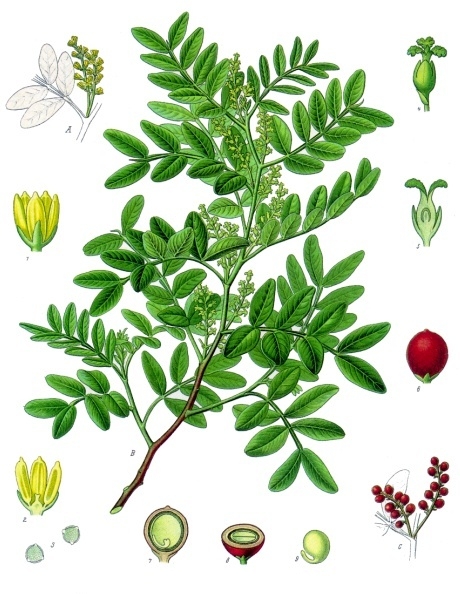
Photograph on Wikimedia Commons (Public domain).
Plant habit
Quick overview
A practical summary; details are in the sections below.
- Safety grade
- Generally recognised as safe details
- Scientific sources on the card
- Yes — sources are listed with claims Science section
- When and what to harvest
- Leaf — July–October
- Processing methods
Culinary use, Capsules, Herbal liqueur, Herbal oil
All methods and recipes on the card- Topics and symptoms
Digestion, Heavy digestion, Mouth and gums
Topics section, Symptoms overview
Identification and mix-ups
Dioecious evergreen shrub to small tree in Anacardiaceae to about 4 m. Leaves alternate, leathery, paripinnate (no terminal leaflet) with 5–6 pairs of deep-green leaflets and a distinctively winged (flattened) rachis. Small apetalous reddish flowers in clusters; fruit a small drupe about 4 mm, red ripening to black; the plant exudes an aromatic ivory resin (mastic).
Possible mix-ups and risks
Confusion with terebinth (Pistacia terebinthus): mastic has a winged rachis and an even (paripinnate) evergreen leaf, whereas P. terebinthus has a non-winged rachis, an odd terminal leaflet (imparipinnate) and deciduous leaves. P. terebinthus is not toxic (it also yields a resin), so this is an identity/quality distinction rather than a poisoning risk.
Similar herbs
No related herbs are linked yet.
Topics and symptoms
More topics are in the symptoms and topics overview.
- DigestionTraditional· Traditional / cultural framing
- Heavy digestionScientific· moderate
- Mouth and gumsTraditional· Traditional / cultural framing
Sources
Identification
Confusion risk
Geographic occurrence
No occurrence data yet.
Harvest
- LeafJuly–October
summer
Region: GreeceNotes: Resin (mastic) — bark incisions induce 'tears'; the drops are collected from cleaned ground under the tree.
Storage
- Airtight storage(Leaf)
Resin tears (mastic) keep for years in a closed jar in the cool and dry; in warmth they soften and stick, so in summer they go in the fridge. Dried leaves for decoction a year.
- Light:
- Out of light; the resin yellows in light.
- Moisture:
- Protect from moisture and dust — the resin picks up dirt.
Processing methods on this herb card
Cooking, baking, seasoning as food — general category without therapeutic claims.
Full method description (from the catalogue)
Culinary use covers herbs as ingredients in dishes, drinks, or spice mixes. This overview does not evaluate medicinal effects — only reminds you about species intent, allergies, and heat treatment where needed (e.g. some fruits or plant parts).
Combining with alcohol, sugar, or long cooking changes outcomes; verify culinary sources.
Traditional context for this method: yes·Scientific context for this method: no
Filling capsules with dried herb or powder; home and industrial variants.
Full method description (from the catalogue)
A capsule is a container; it may hold plant powder or a dry extract. Equal fill weights do not mean equal constituent levels or effects. Filling capsules with powder at home is therefore not equivalent to a standardized extract.
The word "standardized" alone does not guarantee product quality. A product sold in capsules may differ from the preparation used in a study.
This page is a guide to processing forms, not a universal dosing procedure. For each herb, distinguish the plant part, powder and extract; the list below does not by itself establish suitability for home filling.
Traditional context for this method: yes·Scientific context for this method: yes
Clinical trials (Dabos et al. 2010) used pure Chios mastic 350 mg three times daily; against Helicobacter pylori mastic alone did not achieve eradication in most patients in a pilot trial and does not replace antibiotic treatment.
Sweet alcoholic macerate with herbs; sugar and ethanol drive the outcome.
Full method description (from the catalogue)
A liqueur combines herbs, spirit, and sweetener into a strongly aromatic mixture. Home batches differ from commercial products in law and in how strength is controlled.
Follow the recipe for dosing and storage; maceration time changes colour and flavour.
Traditional context for this method: yes·Scientific context for this method: no
Macerating herbs in a vegetable oil (cold or with gentle heat).
Full method description (from the catalogue)
Herbal oil is made by steeping dried or fresh material in oil (e.g. olive, sunflower) over time, sometimes with gentle warming. The result is not steam-distilled essential oil — it is a different extract type and usage (often topical or culinary per recipe).
Temperature, light, and material moisture affect shelf life; rancid oil must be discarded.
Traditional context for this method: yes·Scientific context for this method: no
Traditional / spiritual use
Kept separate from science — entries are cultural or symbolic, not medical advice.
Tears of the tree that wept for a martyr
Symbolism
Spiritual useFolk useMythologyRitualSymbolismOnly the mastic tree of the south of the island of Chios yields the resin — Chios mastic, today a protected designation of origin. Legend has it the trees began weeping resin tears when the Romans dragged the martyred Saint Isidore across the island in 250; to this day tappers score the trunks in summer and the tears fall onto white clay spread under the tree (kentos). Byzantium and the Ottomans held a monopoly on mastic and the mastichochoria villages were fortified; in 2014 UNESCO inscribed mastic cultivation on its intangible heritage list. A record of legend and tradition.
- Form:
- tears of Chios; legend of Saint Isidore; UNESCO 2014
- Claim strength:
- Tradition
- Source note:
- Paraschos S et al. (2012), Curr Med Chem 19:2292–2302 (historical introduction); UNESCO — Know-how of cultivating mastic on the island of Chios (2014); the legend of Saint Isidore of Chios.
Scientific notes
Each claim lists a study type and a source (URL or DOI) where available. Dose notes from the literature are informational only.
How to read evidence strength and study type labels
Labels summarise how the catalogue entry is tagged — they are not a medical verdict on efficacy. For every row, read the summary, limitations and source link.
Evidence strength
- Evidence level not specified
- The author did not grade the record; judge from the summary, limitations and source link.
- Narrative / orientational literature
- Descriptive or expert literature without controlled group comparison — context rather than proof of effect.
- Weak evidence
- Study or conclusion with major methodological limits; treat only as a pointer for further reading.
- Preliminary findings
- First or smaller studies — interesting direction, not the final word on efficacy or safety.
- Moderate strength of evidence
- Moderate strength by study design; sample and context limits still apply.
- Stronger evidence
- Stronger design or consistency of results within the study's stated limits.
- Review article
- A review summarises multiple sources; quality depends on review method and field.
Study type
- Narrative / expert text
- Expert text or overview without a classical study design.
- In vitro study
- Cell culture or test-tube experiment — does not show an effect in the body.
- Animal study
- Animal model — transfer to humans is not automatic.
- Observational study
- Observing groups without random treatment assignment; confounding is possible.
- Clinical trial
- Human clinical trial; sample size and control group matter.
- Randomised controlled trial
- Randomised controlled trials are among the stronger designs when well conducted.
- Review study
- A review aggregates multiple papers — quality depends on selection rules.
- Systematic review
- Systematic review with explicit search and selection methodology.
- Meta-analysis
- Statistical pooling of studies; outcome depends on input data and heterogeneity.
- Regulatory assessment / monograph (EMA, WHO…)
- Regulatory body summary for a herbal product — different context from a single RCT; often about products, not home tea.
- Expert monograph (herbal preparations)
- Structured literature summary for a plant or drug — quality depends on author and edition year.
The EMA HMPC monograph for Chios mastic describes traditional use for mild dyspeptic complaints and in oral hygiene.
Review articleRegulatory assessment / monograph (EMA, WHO…)Year: 2015Preparation form in the study: chewing resin
Active compound / focus: mastic resin (triterpenoid acids)
Limitations: The chewing resin has a different profile from an aqueous extract; short-term use only, not a prolonged regimen.
Dose note (from literature): See the PDF for approved preparations.
A double-blind trial in 148 patients with functional dyspepsia: 350 mg of Chios mastic three times daily for 3 weeks lowered the symptom score (Hong Kong index of dyspepsia) more than placebo, and more patients rated the treatment effective; no adverse effects were reported.
Moderate strength of evidenceClinical trialYear: 2010Limitations: Short trial from a single Greek centre, subjective outcome measures; the only RCT of its kind.
Dabos KJ, Sfika E, Vlatta LJ, Frantzi D, Amygdalos GI, Giannikopoulos G — Journal of Ethnopharmacology
A randomised pilot trial in 52 patients with Helicobacter pylori infection: mastic alone (350 mg or 1,050 mg three times daily for 14 days) achieved eradication in only 4 of 13 and 5 of 13 patients, while standard antibiotic triple therapy did so in 10 of 13; mastic therefore does not replace antibiotic treatment.
Preliminary findingsClinical trialYear: 2010Limitations: Very small groups; a pilot trial without a statistically significant effect of mastic.
Dabos KJ, Sfika E, Vlatta LJ, Giannikopoulos G — Phytomedicine
The effect of mastic gum on Helicobacter pylori: A randomized pilot study
The review summarises the composition of Chios mastic (triterpenic acids, the polymer cis-1,4-poly-beta-myrcene, an oil rich in alpha-pinene) and laboratory, animal and a few small clinical studies of antimicrobial, anti-inflammatory, gastroprotective and lipid-lowering activity.
Narrative / orientational literatureReview studyYear: 2012Limitations: Mostly preclinical data; clinical trials small; authors from Greek research tied to producers.
Paraschos S, Mitakou S, Skaltsounis AL — Current Medicinal Chemistry
Images
The main photo is in the card header. More images will appear here when available.
Safety
What the warning types mean
The type on each warning helps group themes — it does not replace the separate severity badge.
- Internal use
- Risks from swallowing, extracts, duration of use or concentration for internal use.
- Interactions / medicines
- Possible effect on medicines or concurrent treatment — check sources and a professional.
- Raw plant parts
- Raw, unripe or poorly prepared plant parts can be dangerous.
- Toxins and regulation
- Toxic constituents or regulated compounds (e.g. in distillates).
- Contact with the plant
- Skin or mucosa irritation from contact with fresh plant or sap.
- Allergy
- Allergic reactions, often linked to family sensitisation.
- Harvesting and contamination
- Contamination, species mix-ups or harvesting from unsuitable places.
No structured safety records yet.