Morinda citrifolia
Noni
CautionOther names: Indian mulberry
Noni fruit in tropical tradition; distribution includes Myanmar region.
Evergreen shrub with large opposite leaves.
- Family
- Rubiaceae
- Plant type
- Shrub / small tree
What the safety levels mean (expand legend)
- Generally recognised as safe. Often a common herb with reasonable harvest and use; still read the specific warnings on the card.
- Information. Primarily informational — details in the text and warnings below matter most.
- Caution. Needs extra care (dose, duration, sensitive groups, interactions).
- Risky. Significant risks — verify sources, contraindications and professional guidance.
- Not for home experimentation. Not suitable to experiment with at home without knowledge and certainty.
- High risk for internal use. Particular risk with internal use (e.g. alkaloids); avoid prolonged or irresponsible dosing.
- Not specified. Level not filled in yet — rely on individual warnings and links below.
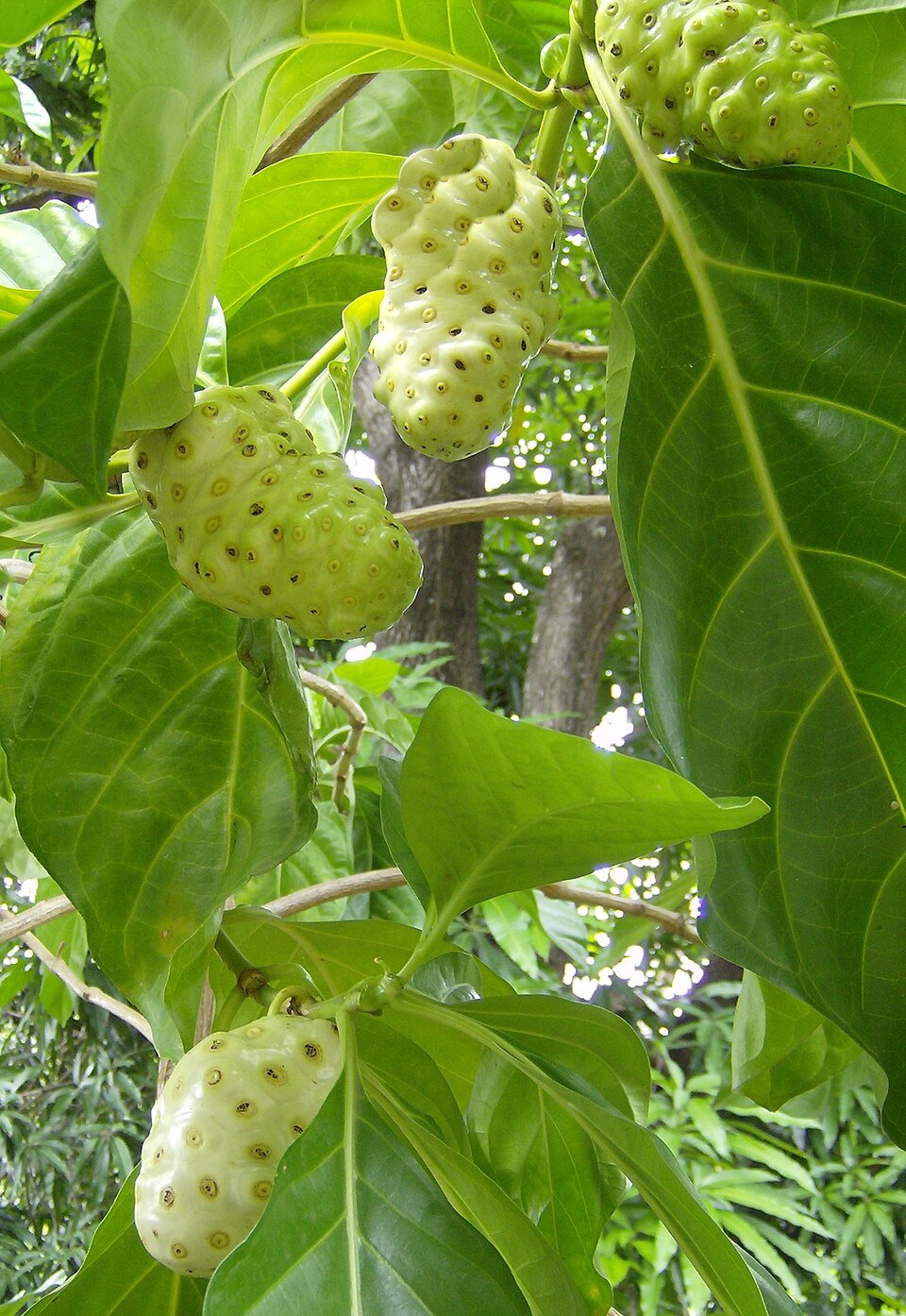
Photograph on Wikimedia Commons (CC0).
Plant habit
Safety — read before use
For this herb it is important to check warnings, mix-ups and cautions. Start with the Safety section.
Quick overview
A practical summary; details are in the sections below.
- Safety grade
- Caution details
- Scientific sources on the card
- Yes — sources are listed with claims Science section
- When and what to harvest
- Fruit — January–December
- Processing methods
Fermentation, Culinary use
All methods and recipes on the card- Topics and symptoms
Immunity - informational context
Topics section, Symptoms overview
Identification and mix-ups
Typical fruits—do not gather if uncertain.
Possible mix-ups and risks
Other Morinda species.
Similar herbs
No related herbs are linked yet.
Topics and symptoms
More topics are in the symptoms and topics overview.
- Immunity - informational contextTraditional· Traditional / cultural framing
Geographic occurrence
Myanmar
Occasional (garden, cultivation, or fringe of the range)
Brazil
Occasional (garden, cultivation, or fringe of the range)
India
Occasional (garden, cultivation, or fringe of the range)
Indonesia
Occasional (garden, cultivation, or fringe of the range)
Thailand
Occasional (garden, cultivation, or fringe of the range)
Viet Nam
Occasional (garden, cultivation, or fringe of the range)
Harvest
- FruitJanuary–December
celoročně
Region: IndonesiaNotes: The tree fruits all year; fruits are picked yellowish white, firm to soft depending on purpose. A ripe fruit smells of cheese and breaks down fast — process the same day.
Storage
- Refrigeration(Fruit)
Firm fruits keep 2–3 days in the fridge; soft ones must be processed at once, they ripen within hours.
- Moisture:
- They ferment and rot very quickly.
- Airtight storage(Fruit)
Traditionally fermented juice keeps several months in a closed jar in the cold; pasteurised commercial juice 1–2 years.
- Light:
- Dark glass.
- Safety:
- A home ferment without controlled fermentation is a risk; discard if it smells spoiled.
Processing methods on this herb card
Microbial processing (fermentation) of plant material for drinks or foods.
Full method description (from the catalogue)
Fermentation changes sugars, flavour, and microbial composition (e.g. herbal ferments, oxymels combining honey and vinegar per tradition). Hygiene, temperature, and time are critical for a safe outcome.
Home ferments should not smell "rotten"; when in doubt, discard.
Traditional context for this method: yes·Scientific context for this method: no
The Polynesian method: fruits ferment for weeks in a closed vessel in the sun and the juice is collected. Hygiene decides safety.
Cooking, baking, seasoning as food — general category without therapeutic claims.
Full method description (from the catalogue)
Culinary use covers herbs as ingredients in dishes, drinks, or spice mixes. This overview does not evaluate medicinal effects — only reminds you about species intent, allergies, and heat treatment where needed (e.g. some fruits or plant parts).
Combining with alcohol, sugar, or long cooking changes outcomes; verify culinary sources.
Traditional context for this method: yes·Scientific context for this method: no
Traditional / spiritual use
Kept separate from science — entries are cultural or symbolic, not medical advice.
Noni — a Polynesian canoe plant
General
Traditional useFolk remediesFolk useHerbal loreNoni is one of the 'canoe plants' that Polynesians carried across the Pacific in their canoes together with taro and breadfruit. In the Hawaiian healing tradition lāʻau lapaʻau the fruits and leaves were used externally on wounds and swellings and the wood gave a yellow dye; today's image of a 'miracle juice' is 1990s marketing, not tradition. A record of folk use.
- Form:
- „kánoová rostlina“, součást polynéské lidové medicíny
- Claim strength:
- Tradition
- Source note:
- Hawaiian and Polynesian ethnobotany (canoe plants, lāʻau lapaʻau); contrast with commercial noni since the 1990s.
Scientific notes
Each claim lists a study type and a source (URL or DOI) where available. Dose notes from the literature are informational only.
How to read evidence strength and study type labels
Labels summarise how the catalogue entry is tagged — they are not a medical verdict on efficacy. For every row, read the summary, limitations and source link.
Evidence strength
- Evidence level not specified
- The author did not grade the record; judge from the summary, limitations and source link.
- Narrative / orientational literature
- Descriptive or expert literature without controlled group comparison — context rather than proof of effect.
- Weak evidence
- Study or conclusion with major methodological limits; treat only as a pointer for further reading.
- Preliminary findings
- First or smaller studies — interesting direction, not the final word on efficacy or safety.
- Moderate strength of evidence
- Moderate strength by study design; sample and context limits still apply.
- Stronger evidence
- Stronger design or consistency of results within the study's stated limits.
- Review article
- A review summarises multiple sources; quality depends on review method and field.
Study type
- Narrative / expert text
- Expert text or overview without a classical study design.
- In vitro study
- Cell culture or test-tube experiment — does not show an effect in the body.
- Animal study
- Animal model — transfer to humans is not automatic.
- Observational study
- Observing groups without random treatment assignment; confounding is possible.
- Clinical trial
- Human clinical trial; sample size and control group matter.
- Randomised controlled trial
- Randomised controlled trials are among the stronger designs when well conducted.
- Review study
- A review aggregates multiple papers — quality depends on selection rules.
- Systematic review
- Systematic review with explicit search and selection methodology.
- Meta-analysis
- Statistical pooling of studies; outcome depends on input data and heterogeneity.
- Regulatory assessment / monograph (EMA, WHO…)
- Regulatory body summary for a herbal product — different context from a single RCT; often about products, not home tea.
- Expert monograph (herbal preparations)
- Structured literature summary for a plant or drug — quality depends on author and edition year.
EFSA assessed noni juice and puree as a novel food: at ordinary intake it is safe. The panel also reviewed reported cases of liver injury in noni juice consumers and found no convincing evidence of causation, but recommended monitoring.
Review articleRegulatory assessment / monograph (EMA, WHO…)Year: 2009Limitations: A safety assessment of a commercial pasteurised product, not of efficacy and not of home ferments. EFSA accepted no health claims.
EFSA Panel on Dietetic Products, Nutrition and Allergies (NDA) — EFSA Journal
Images
The main photo is in the card header. More images will appear here when available.
Safety
What the warning types mean
The type on each warning helps group themes — it does not replace the separate severity badge.
- Internal use
- Risks from swallowing, extracts, duration of use or concentration for internal use.
- Interactions / medicines
- Possible effect on medicines or concurrent treatment — check sources and a professional.
- Raw plant parts
- Raw, unripe or poorly prepared plant parts can be dangerous.
- Toxins and regulation
- Toxic constituents or regulated compounds (e.g. in distillates).
- Contact with the plant
- Skin or mucosa irritation from contact with fresh plant or sap.
- Allergy
- Allergic reactions, often linked to family sensitisation.
- Harvesting and contamination
- Contamination, species mix-ups or harvesting from unsuitable places.
- Potassium and kidney diseaseModerate severityInternal use
Noni juice contains about 56 mmol of potassium per litre, similar to orange juice; a case report in the American Journal of Kidney Diseases described hyperkalaemia in a patient with chronic kidney disease who drank it daily. Anyone on a potassium-restricted diet should avoid noni.
- Reported cases of liver injuryLow severityInternal use
Several cases of acute liver injury have been reported in noni juice consumers; EFSA (2009) did not establish causation but recommended monitoring. Keep to small amounts and stop drinking it, and see a doctor, if jaundice or dark urine appears.