Plantago lanceolata
Ribwort plantain
Generally recognised as safeNarrow rosette and cylindrical flower spikes.
Basal rosette of lanceolate leaves.
- Family
- Plantaginaceae
- Plant type
- Perennial herb
What the safety levels mean (expand legend)
- Generally recognised as safe. Often a common herb with reasonable harvest and use; still read the specific warnings on the card.
- Information. Primarily informational — details in the text and warnings below matter most.
- Caution. Needs extra care (dose, duration, sensitive groups, interactions).
- Risky. Significant risks — verify sources, contraindications and professional guidance.
- Not for home experimentation. Not suitable to experiment with at home without knowledge and certainty.
- High risk for internal use. Particular risk with internal use (e.g. alkaloids); avoid prolonged or irresponsible dosing.
- Not specified. Level not filled in yet — rely on individual warnings and links below.
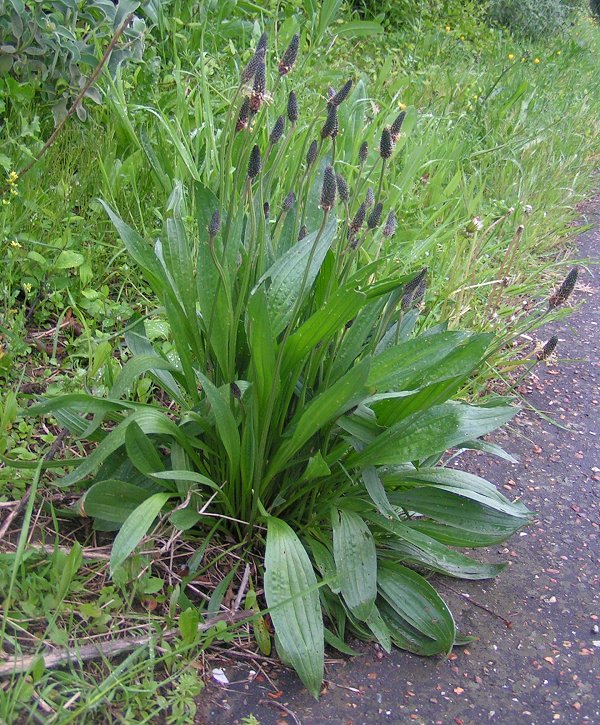
Photograph on Wikimedia Commons (CC BY-SA 3.0).
Plant habit
Quick overview
A practical summary; details are in the sections below.
- Safety grade
- Generally recognised as safe details
- Scientific sources on the card
- Yes — sources are listed with claims Science section
- When and what to harvest
- Leaf — April–October
- Processing methods
Herbal infusion (tea), Salve / ointment, Poultice / compress
All methods and recipes on the card- Topics and symptoms
Breathing comfort, Bruises & scars (topical care), Complexion and local blemishes…
Topics section, Symptoms overview
Identification and mix-ups
Perennial herb with a basal rosette of lanceolate to linear-lanceolate leaves with 3-5 prominent parallel veins. Leaves tapering at the base into a petiole, usually hairy on the upper surface. Scapes strongly ribbed (5-7 ribs), terminating in a dense cylindrical spike with small brownish flowers and conspicuous white stamens. Best identified by the combination of lanceolate leaves, ribbed scape, and cylindrical spike.
Possible mix-ups and risks
Most commonly confused with greater plantain (Plantago major), which has broadly ovate to elliptic leaves with an abruptly contracted or cordate base and a distinct petiole, and bears a narrower, more elongated spike relative to the scape. Both species may co-occur and are frequently confused during foraging; reliable separation relies on leaf blade shape.
Similar herbs
- Stinging nettle
Spring greens and "weed" salads; nettle stings, plantain does not — mind the identification.
- Dandelion
Spring meadow herbs in greens and teas; different aromatics and a different flower-head identification.
Topics and symptoms
More topics are in the symptoms and topics overview.
- Breathing comfortTraditional· Traditional / cultural framing
- Bruises & scars (topical care)Traditional· Traditional / cultural framing
- Complexion and local blemishesTraditional· Traditional / cultural framing
- ConstipationTraditional· Traditional / cultural framing
- Cough and mucusTraditional· Traditional / cultural framing
- Diarrhea and indigestionTraditional· Traditional / cultural framing
- DigestionTraditional· Traditional / cultural framing
- Ear comfortTraditional· Traditional / cultural framing
- Healing after procedures (general context)Traditional· Traditional / cultural framing
- HeartburnTraditional· Traditional / cultural framing
- Insect bites (topical)Traditional· Traditional / cultural framing
- Kidneys & urinary comfortTraditional· Traditional / cultural framing
- Men's urinary comfortTraditional· Traditional / cultural framing
- Nausea & queasy stomachTraditional· Traditional / cultural framing
- Seasonal allergiesTraditional· Traditional / cultural framing
- SkinScientific· Preliminary or weaker scientific findingsTraditional· Traditional / cultural framing
- Skin after sunTraditional· Traditional / cultural framing
- Stuffy nose & coldsTraditional· Traditional / cultural framing
- Tired eyesTraditional· Traditional / cultural framing
Sources
Geographic occurrence
Czechia
Common (expected wild occurrence in the region)
Widespread occurrence in the Czech Republic in suitable habitats.
Austria
Common (expected wild occurrence in the region)
Germany
Common (expected wild occurrence in the region)
Hungary
Common (expected wild occurrence in the region)
Poland
Common (expected wild occurrence in the region)
Slovakia
Common (expected wild occurrence in the region)
France
Common (expected wild occurrence in the region)
Myanmar
Common (expected wild occurrence in the region)
Japan
Common (expected wild occurrence in the region)
Morocco
Common (expected wild occurrence in the region)
Canada
Common (expected wild occurrence in the region)
Australia
Common (expected wild occurrence in the region)
South Africa
Common (expected wild occurrence in the region)
Harvest
- LeafApril–October
vegetace
Region: CzechiaNotes: Basal leaf rosette.
Storage
- Drying(Leaf)
Keep dried plant material in a sealed container.
- Light:
- Out of direct UV.
- Moisture:
- Low relative humidity.
Processing methods on this herb card
Infusion or brief extraction in hot water; usually without long boiling.
Full method description (from the catalogue)
In the narrow sense, "tea" often means an infusion: you pour water just off the boil over the dried plant matter and let it steep for a few minutes. Temperature, steep time, and the herb-to-water ratio change both flavour and what dissolves into the liquid.
Compared with a decoction, heat exposure is shorter and gentler; tender leaves and flowers are often better as an infusion than with prolonged simmering. For each herb, always follow the plant card for suitable plant part, preparation, and safety notes — general rules never replace species-level judgement.
Traditional context for this method: yes·Scientific context for this method: no
Solid base (wax, fat) with herbal extract or macerate; usually topical.
Full method description (from the catalogue)
Salves combine extracted or finely ground herb with fat and often beeswax. Consistency depends on ratios; protective or emollient salves aim for a skin film with slow release.
Clean work reduces microbial contamination; refrigerated storage may extend life per recipe.
Traditional context for this method: yes·Scientific context for this method: no
Liquid or paste on the skin, often through a thin cloth.
Full method description (from the catalogue)
A compress applies moist warm or cool material to the skin directly or through fabric. Duration and temperature are key — too hot can burn; too long can macerate the skin.
Use clean textiles and watch skin reaction during the first minutes.
Traditional context for this method: yes·Scientific context for this method: no
Traditional / spiritual use
Kept separate from science — entries are cultural or symbolic, not medical advice.
Related guides in the library
Paths, boots, and the plantain leaf on the road
General
Traditional useFolk useHerbal loreRibwort plantain tracks paths, verges, and boots after a walk; folk tales linked it with feet and simple leaf tea. The symbolism is practical and outdoor, not a treatment claim.
- Form:
- čaj, zevní spojení v lidové praxi
- Claim strength:
- Tradition
- Source note:
- European folk road nicknames (e.g. waybread) — cultural layer only.
Scientific notes
Each claim lists a study type and a source (URL or DOI) where available. Dose notes from the literature are informational only.
How to read evidence strength and study type labels
Labels summarise how the catalogue entry is tagged — they are not a medical verdict on efficacy. For every row, read the summary, limitations and source link.
Evidence strength
- Evidence level not specified
- The author did not grade the record; judge from the summary, limitations and source link.
- Narrative / orientational literature
- Descriptive or expert literature without controlled group comparison — context rather than proof of effect.
- Weak evidence
- Study or conclusion with major methodological limits; treat only as a pointer for further reading.
- Preliminary findings
- First or smaller studies — interesting direction, not the final word on efficacy or safety.
- Moderate strength of evidence
- Moderate strength by study design; sample and context limits still apply.
- Stronger evidence
- Stronger design or consistency of results within the study's stated limits.
- Review article
- A review summarises multiple sources; quality depends on review method and field.
Study type
- Narrative / expert text
- Expert text or overview without a classical study design.
- In vitro study
- Cell culture or test-tube experiment — does not show an effect in the body.
- Animal study
- Animal model — transfer to humans is not automatic.
- Observational study
- Observing groups without random treatment assignment; confounding is possible.
- Clinical trial
- Human clinical trial; sample size and control group matter.
- Randomised controlled trial
- Randomised controlled trials are among the stronger designs when well conducted.
- Review study
- A review aggregates multiple papers — quality depends on selection rules.
- Systematic review
- Systematic review with explicit search and selection methodology.
- Meta-analysis
- Statistical pooling of studies; outcome depends on input data and heterogeneity.
- Regulatory assessment / monograph (EMA, WHO…)
- Regulatory body summary for a herbal product — different context from a single RCT; often about products, not home tea.
- Expert monograph (herbal preparations)
- Structured literature summary for a plant or drug — quality depends on author and edition year.
Ribwort plantain leaf is discussed in reviews of mucilage-containing herbs for soothing topical or oral applications; human data for cough endpoints are modest and heterogeneous.
Evidence level not specifiedNarrative / expert textLimitations: Preparation strength varies; roadside contamination is a real-world issue; not a substitute for infection care when red flags appear.
Images
The main photo is in the card header. More images will appear here when available.
Safety
What the warning types mean
The type on each warning helps group themes — it does not replace the separate severity badge.
- Internal use
- Risks from swallowing, extracts, duration of use or concentration for internal use.
- Interactions / medicines
- Possible effect on medicines or concurrent treatment — check sources and a professional.
- Raw plant parts
- Raw, unripe or poorly prepared plant parts can be dangerous.
- Toxins and regulation
- Toxic constituents or regulated compounds (e.g. in distillates).
- Contact with the plant
- Skin or mucosa irritation from contact with fresh plant or sap.
- Allergy
- Allergic reactions, often linked to family sensitisation.
- Harvesting and contamination
- Contamination, species mix-ups or harvesting from unsuitable places.
No structured safety records yet.