Thuja occidentalis
Northern white cedar
CautionOther names: Arborvitae, Eastern white cedar
Northern white cedar—boreal wetlands and gravel; First Nations and colonial use.
Evergreen conifer with scale leaves on branchlets.
- Family
- Cupressaceae
- Plant type
- Tree / shrub
What the safety levels mean (expand legend)
- Generally recognised as safe. Often a common herb with reasonable harvest and use; still read the specific warnings on the card.
- Information. Primarily informational — details in the text and warnings below matter most.
- Caution. Needs extra care (dose, duration, sensitive groups, interactions).
- Risky. Significant risks — verify sources, contraindications and professional guidance.
- Not for home experimentation. Not suitable to experiment with at home without knowledge and certainty.
- High risk for internal use. Particular risk with internal use (e.g. alkaloids); avoid prolonged or irresponsible dosing.
- Not specified. Level not filled in yet — rely on individual warnings and links below.
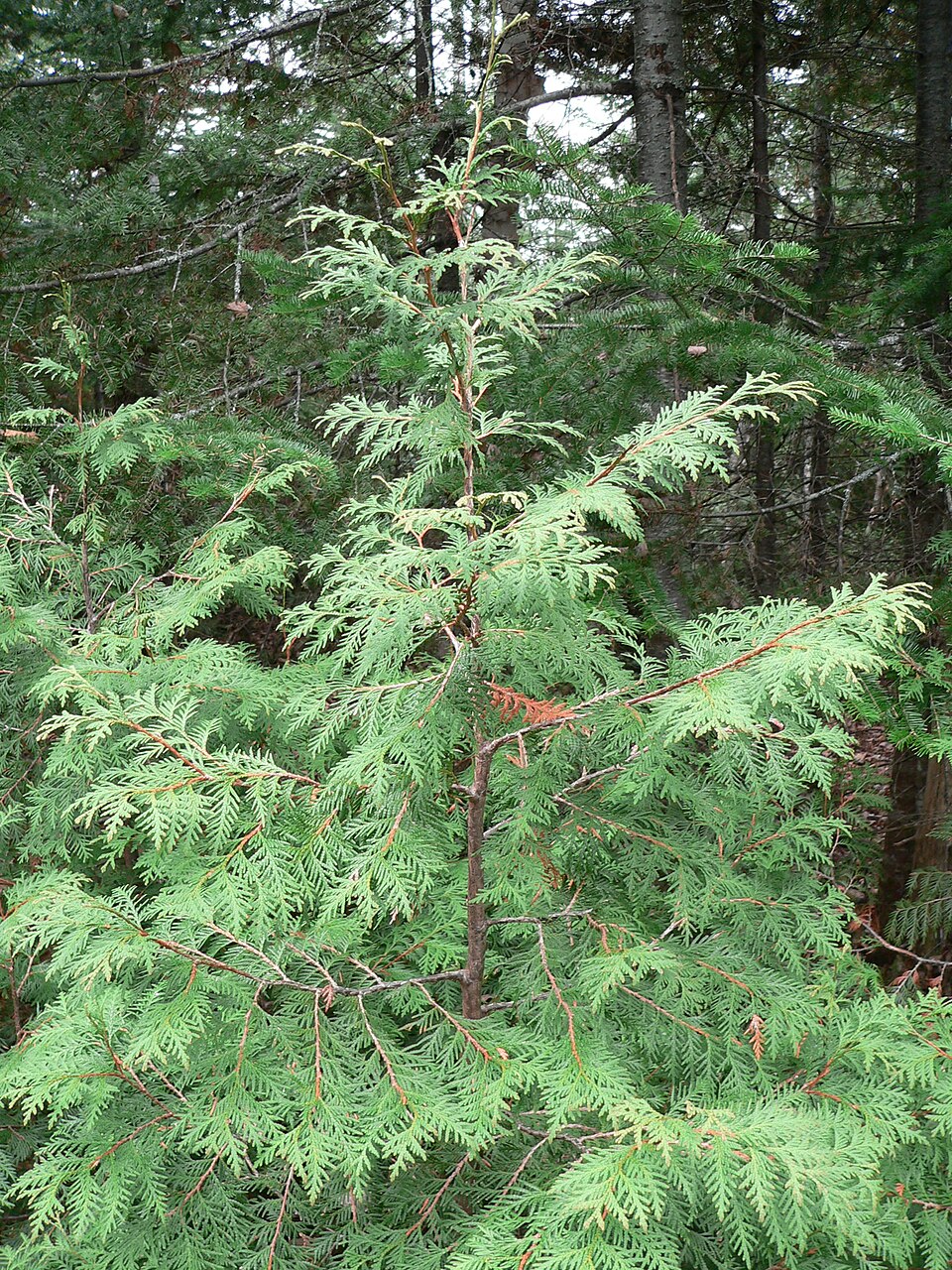
Photograph on Wikimedia Commons (CC BY-SA 4.0).
Plant habit
Safety — read before use
For this herb it is important to check warnings, mix-ups and cautions. Start with the Safety section.
Quick overview
A practical summary; details are in the sections below.
- Safety grade
- Caution details
- Scientific sources on the card
- Yes — sources are listed with claims Science section
- When and what to harvest
- Leaf — January–December
- Processing methods
Incense / smoke offering, Salve / ointment
All methods and recipes on the card- Topics and symptoms
Skin
Topics section, Symptoms overview
Identification and mix-ups
Opposite scale rows; small woody cones.
Possible mix-ups and risks
In plantings confirm species label.
Similar herbs
- Common juniper
Both cypress-family conifers used for smudging; juniper has needles and blue berries, thuja flat scaly sprays and small woody cones. Juniper berries are a spice, thuja is not.
Topics and symptoms
More topics are in the symptoms and topics overview.
- SkinTraditional· Traditional / cultural framing
Geographic occurrence
Canada
Common (expected wild occurrence in the region)
Harvest
- LeafJanuary–December
celoročně
Region: CanadaNotes: The flat scaly sprays are cut all year, traditionally from lower branches and sparingly so the tree is not harmed; they dry hanging in bundles. In Czechia the tree grows only planted (hedges, cemeteries) — make sure it is Thuja occidentalis, not western red cedar or a false cypress.
Storage
- Drying(Leaf)
Dried sprays keep 12 months in a paper bag or bundle; the camphor-apple scent fades.
- Light:
- Out of light.
- Moisture:
- Protect from moisture.
- Safety:
- Store separately and label 'external / smudge only' — not among tea herbs.
Processing methods on this herb card
Burning or heating aromatic plant material (smoke, steam).
Full method description (from the catalogue)
Incense may be dried herb, resin blends, or preparations on charcoal. The effect is sensory and cultural; smoke can irritate airways in sensitive people.
Ventilate the space; use non-flammable bases and heat-safe vessels.
Traditional context for this method: yes·Scientific context for this method: no
Solid base (wax, fat) with herbal extract or macerate; usually topical.
Full method description (from the catalogue)
Salves combine extracted or finely ground herb with fat and often beeswax. Consistency depends on ratios; protective or emollient salves aim for a skin film with slow release.
Clean work reduces microbial contamination; refrigerated storage may extend life per recipe.
Traditional context for this method: yes·Scientific context for this method: no
External folk use on warts; only on a small area of intact skin.
Traditional / spiritual use
Kept separate from science — entries are cultural or symbolic, not medical advice.
Giizhik — tree of life and sacred medicine
Symbolism
Spiritual useFolk useRitualSymbolismAmong the Anishinaabe and other peoples of the Great Lakes region, cedar (giizhik) is one of the four sacred medicines with tobacco, sage and sweetgrass: its sprays are burnt for purification, laid on the floor of sweat lodges and placed at the threshold for protection. The European name arbor vitae, 'tree of life', dates from Cartier's expedition (1535–36), whose crew was saved from scurvy by a decoction of the conifer 'annedda' — now thought to be thuja or fir. A record of religious and historical tradition.
- Form:
- jedna ze čtyř posvátných medicín, vykuřování, ochrana obydlí
- Claim strength:
- Tradition
- Source note:
- Anishinaabe tradition of the four sacred medicines; Jacques Cartier, Relations (1535–36); Naser et al. 2005 (history of the name).
Scientific notes
Each claim lists a study type and a source (URL or DOI) where available. Dose notes from the literature are informational only.
How to read evidence strength and study type labels
Labels summarise how the catalogue entry is tagged — they are not a medical verdict on efficacy. For every row, read the summary, limitations and source link.
Evidence strength
- Evidence level not specified
- The author did not grade the record; judge from the summary, limitations and source link.
- Narrative / orientational literature
- Descriptive or expert literature without controlled group comparison — context rather than proof of effect.
- Weak evidence
- Study or conclusion with major methodological limits; treat only as a pointer for further reading.
- Preliminary findings
- First or smaller studies — interesting direction, not the final word on efficacy or safety.
- Moderate strength of evidence
- Moderate strength by study design; sample and context limits still apply.
- Stronger evidence
- Stronger design or consistency of results within the study's stated limits.
- Review article
- A review summarises multiple sources; quality depends on review method and field.
Study type
- Narrative / expert text
- Expert text or overview without a classical study design.
- In vitro study
- Cell culture or test-tube experiment — does not show an effect in the body.
- Animal study
- Animal model — transfer to humans is not automatic.
- Observational study
- Observing groups without random treatment assignment; confounding is possible.
- Clinical trial
- Human clinical trial; sample size and control group matter.
- Randomised controlled trial
- Randomised controlled trials are among the stronger designs when well conducted.
- Review study
- A review aggregates multiple papers — quality depends on selection rules.
- Systematic review
- Systematic review with explicit search and selection methodology.
- Meta-analysis
- Statistical pooling of studies; outcome depends on input data and heterogeneity.
- Regulatory assessment / monograph (EMA, WHO…)
- Regulatory body summary for a herbal product — different context from a single RCT; often about products, not home tea.
- Expert monograph (herbal preparations)
- Structured literature summary for a plant or drug — quality depends on author and edition year.
The review summarises the composition of thuja (thujone-containing volatile oil, polysaccharides, flavonoids), immunostimulant effects of extracts in the laboratory and clinical trials of combination products with a standardised, thujone-poor extract in the common cold; it stresses that thujone in unprocessed preparations is toxic.
Narrative / orientational literatureReview studyYear: 2005Limitations: Clinical data exist only for commercial combination extracts (thuja + echinacea + baptisia), not the plant itself; the authors are affiliated with the manufacturer. Not applicable to home tea or tincture.
Naser B, Bodinet C, Tegtmeier M, Lindequist U — Evidence-Based Complementary and Alternative Medicine
DOI: 10.1093/ecam/neh065
Images
The main photo is in the card header. More images will appear here when available.
Safety
What the warning types mean
The type on each warning helps group themes — it does not replace the separate severity badge.
- Internal use
- Risks from swallowing, extracts, duration of use or concentration for internal use.
- Interactions / medicines
- Possible effect on medicines or concurrent treatment — check sources and a professional.
- Raw plant parts
- Raw, unripe or poorly prepared plant parts can be dangerous.
- Toxins and regulation
- Toxic constituents or regulated compounds (e.g. in distillates).
- Contact with the plant
- Skin or mucosa irritation from contact with fresh plant or sap.
- Allergy
- Allergic reactions, often linked to family sensitisation.
- Harvesting and contamination
- Contamination, species mix-ups or harvesting from unsuitable places.
- Thujone — no tea, no tinctureHigh severityInternal use
Thuja oil contains up to 65 % thujone, a neurotoxic ketone that at higher doses causes seizures and damages kidneys and liver; Naser's review records poisonings after internal use of unprocessed preparations. A home tea, tincture or 'cure' from thuja has no justification. External use on small areas and smudging are another category.