Argania spinosa
Argan
Generally recognised as safeOther names: Argan tree
Argan—endemic to western Maghreb; argan oil and coastal Atlas ecology.
Thorny shrub to tree with narrow leaves and olive-brown fruits.
- Family
- Vitaceae
- Plant type
- Tree / shrub
What the safety levels mean (expand legend)
- Generally recognised as safe. Often a common herb with reasonable harvest and use; still read the specific warnings on the card.
- Information. Primarily informational — details in the text and warnings below matter most.
- Caution. Needs extra care (dose, duration, sensitive groups, interactions).
- Risky. Significant risks — verify sources, contraindications and professional guidance.
- Not for home experimentation. Not suitable to experiment with at home without knowledge and certainty.
- High risk for internal use. Particular risk with internal use (e.g. alkaloids); avoid prolonged or irresponsible dosing.
- Not specified. Level not filled in yet — rely on individual warnings and links below.
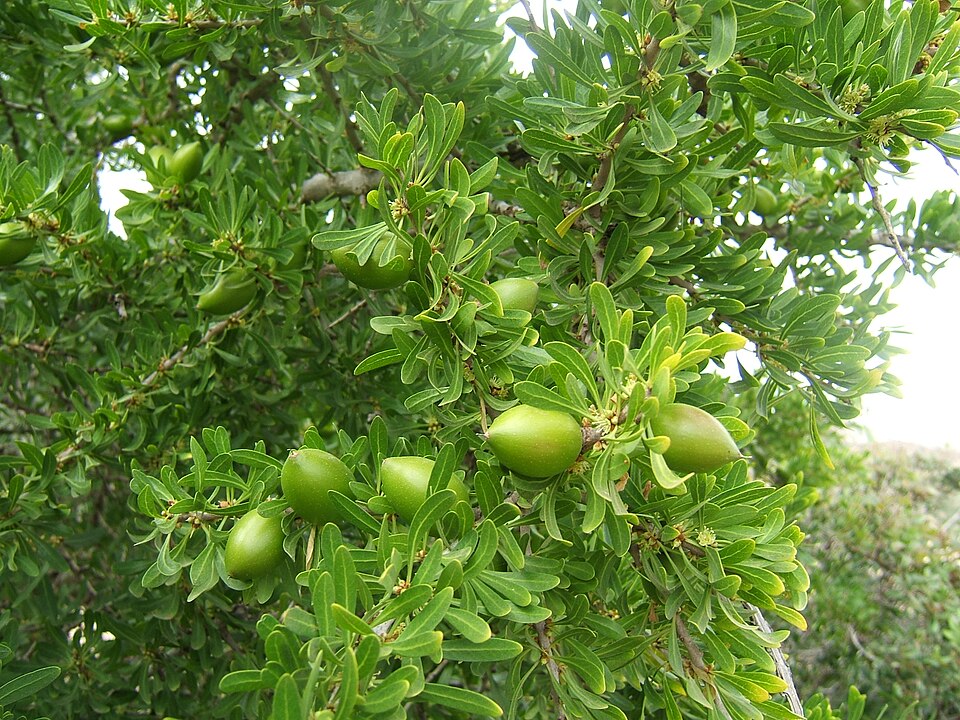
Photograph on Wikimedia Commons (CC BY 2.5).
Plant habit
Quick overview
A practical summary; details are in the sections below.
- Safety grade
- Generally recognised as safe details
- Scientific sources on the card
- Yes — sources are listed with claims Science section
- When and what to harvest
- Fruit — June–August
- Processing methods
Culinary use, Herbal oil
All methods and recipes on the card- Topics and symptoms
Skin
Topics section, Symptoms overview
Identification and mix-ups
Thorns on twigs; fleshy fruits like small olives.
Possible mix-ups and risks
Olive by habit and habitat.
Similar herbs
- Olive
Both Mediterranean trees with small oily fruits; the argan has thorny branches, its fruits are gathered from the ground and the oil is pressed from the kernel, not from the flesh as with the olive.
Topics and symptoms
More topics are in the symptoms and topics overview.
- SkinCosmetic· Traditional / cultural framing
Geographic occurrence
Morocco
Common (expected wild occurrence in the region)
Harvest
- FruitJune–August
léto
Region: MoroccoNotes: Fruits are not picked from the tree but gathered from the ground after ripening and dropping in summer; they are sun-dried, the pulp removed, the hard stone cracked by hand with a rock and the kernels pressed for oil. The argan tree grows only in south-western Morocco and is protected as a UNESCO biosphere reserve.
Storage
- Airtight storage(Fruit)
Argan oil keeps 12–18 months in a dark, full, well-closed bottle; both cosmetic (unroasted) and culinary (from roasted kernels) turn rancid in light and heat.
- Light:
- Dark glass, out of the sun.
- Safety:
- Rancid oil (sharp unpleasant smell) should not be used even on skin.
- Drying(Fruit)
Dried whole fruits with the stone keep for months in the dry; process the kernels soon after cracking, they are high in unsaturated fats.
- Moisture:
- Damp stones mould.
Processing methods on this herb card
Cooking, baking, seasoning as food — general category without therapeutic claims.
Full method description (from the catalogue)
Culinary use covers herbs as ingredients in dishes, drinks, or spice mixes. This overview does not evaluate medicinal effects — only reminds you about species intent, allergies, and heat treatment where needed (e.g. some fruits or plant parts).
Combining with alcohol, sugar, or long cooking changes outcomes; verify culinary sources.
Traditional context for this method: yes·Scientific context for this method: no
Macerating herbs in a vegetable oil (cold or with gentle heat).
Full method description (from the catalogue)
Herbal oil is made by steeping dried or fresh material in oil (e.g. olive, sunflower) over time, sometimes with gentle warming. The result is not steam-distilled essential oil — it is a different extract type and usage (often topical or culinary per recipe).
Temperature, light, and material moisture affect shelf life; rancid oil must be discarded.
Traditional context for this method: yes·Scientific context for this method: no
Cosmetic oil from unroasted kernels is for the skin only; the culinary grade comes from roasted kernels. Do not mix them up.
Traditional / spiritual use
Kept separate from science — entries are cultural or symbolic, not medical advice.
The tree of Berber women
General
Traditional useFolk useHerbal lorePressing argan oil was for centuries the work of Berber (Amazigh) women of south-western Morocco: cracking the stones with a rock, roasting the kernels and kneading the paste passed from mother to daughter, and since the 1990s women's cooperatives carry it on. UNESCO inscribed 'argan — practices and know-how' on the Representative List of Intangible Cultural Heritage in 2014. A record of cultural tradition, not an effect.
- Form:
- ženská řemeslná tradice, olej na kůži i do jídla
- Claim strength:
- Tradition
- Source note:
- UNESCO, Representative List of the Intangible Cultural Heritage of Humanity (2014): Argan, practices and know-how concerning the argan tree.
Scientific notes
Each claim lists a study type and a source (URL or DOI) where available. Dose notes from the literature are informational only.
How to read evidence strength and study type labels
Labels summarise how the catalogue entry is tagged — they are not a medical verdict on efficacy. For every row, read the summary, limitations and source link.
Evidence strength
- Evidence level not specified
- The author did not grade the record; judge from the summary, limitations and source link.
- Narrative / orientational literature
- Descriptive or expert literature without controlled group comparison — context rather than proof of effect.
- Weak evidence
- Study or conclusion with major methodological limits; treat only as a pointer for further reading.
- Preliminary findings
- First or smaller studies — interesting direction, not the final word on efficacy or safety.
- Moderate strength of evidence
- Moderate strength by study design; sample and context limits still apply.
- Stronger evidence
- Stronger design or consistency of results within the study's stated limits.
- Review article
- A review summarises multiple sources; quality depends on review method and field.
Study type
- Narrative / expert text
- Expert text or overview without a classical study design.
- In vitro study
- Cell culture or test-tube experiment — does not show an effect in the body.
- Animal study
- Animal model — transfer to humans is not automatic.
- Observational study
- Observing groups without random treatment assignment; confounding is possible.
- Clinical trial
- Human clinical trial; sample size and control group matter.
- Randomised controlled trial
- Randomised controlled trials are among the stronger designs when well conducted.
- Review study
- A review aggregates multiple papers — quality depends on selection rules.
- Systematic review
- Systematic review with explicit search and selection methodology.
- Meta-analysis
- Statistical pooling of studies; outcome depends on input data and heterogeneity.
- Regulatory assessment / monograph (EMA, WHO…)
- Regulatory body summary for a herbal product — different context from a single RCT; often about products, not home tea.
- Expert monograph (herbal preparations)
- Structured literature summary for a plant or drug — quality depends on author and edition year.
The review summarises the composition of argan oil (about 80 % unsaturated fatty acids, tocopherols, squalene, phytosterols) and small studies in Moroccan consumers suggesting a favourable effect on blood lipids; it notes the difference between culinary and cosmetic oil.
Narrative / orientational literatureReview studyYear: 2008Limitations: Narrative review; clinical data from small, mostly observational studies in one population. It does not support a therapeutic effect.
Charrouf Z, Guillaume D — European Journal of Lipid Science and Technology
Argan oil: Occurrence, composition and impact on human health
Images
The main photo is in the card header. More images will appear here when available.
Safety
What the warning types mean
The type on each warning helps group themes — it does not replace the separate severity badge.
- Internal use
- Risks from swallowing, extracts, duration of use or concentration for internal use.
- Interactions / medicines
- Possible effect on medicines or concurrent treatment — check sources and a professional.
- Raw plant parts
- Raw, unripe or poorly prepared plant parts can be dangerous.
- Toxins and regulation
- Toxic constituents or regulated compounds (e.g. in distillates).
- Contact with the plant
- Skin or mucosa irritation from contact with fresh plant or sap.
- Allergy
- Allergic reactions, often linked to family sensitisation.
- Harvesting and contamination
- Contamination, species mix-ups or harvesting from unsuitable places.
No structured safety records yet.