Olea europaea
Olive
Generally recognised as safeOther names: Olive, Olive tree
Mediterranean tree—not a meadow sage; oil and leaves in tradition.
Often a low, thorny tree or shrub with opposite narrow leaves.
- Family
- Oleaceae
- Plant type
- Tree / shrub
What the safety levels mean (expand legend)
- Generally recognised as safe. Often a common herb with reasonable harvest and use; still read the specific warnings on the card.
- Information. Primarily informational — details in the text and warnings below matter most.
- Caution. Needs extra care (dose, duration, sensitive groups, interactions).
- Risky. Significant risks — verify sources, contraindications and professional guidance.
- Not for home experimentation. Not suitable to experiment with at home without knowledge and certainty.
- High risk for internal use. Particular risk with internal use (e.g. alkaloids); avoid prolonged or irresponsible dosing.
- Not specified. Level not filled in yet — rely on individual warnings and links below.
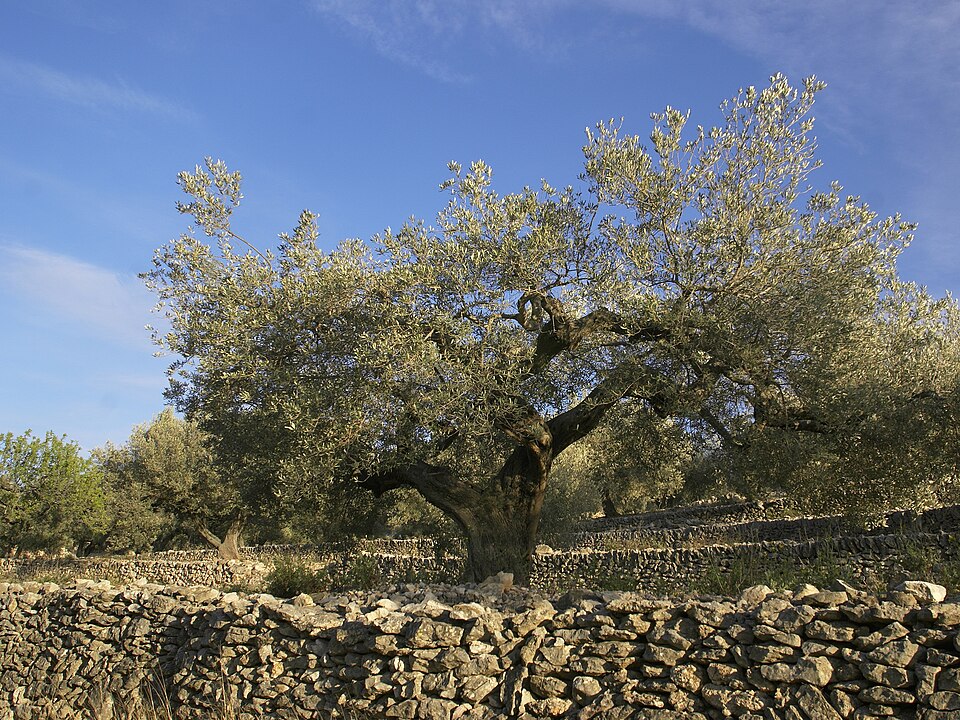
Photograph on Wikimedia Commons (CC BY-SA 3.0).
Plant habit
Safety — read before use
For this herb it is important to check warnings, mix-ups and cautions. Start with the Safety section.
Quick overview
A practical summary; details are in the sections below.
- Safety grade
- Generally recognised as safe details
- Scientific sources on the card
- Yes — sources are listed with claims Science section
- When and what to harvest
- Leaf — April–June
- Fruit — October–December
- Processing methods
Herbal infusion (tea), Culinary use
All methods and recipes on the card- Topics and symptoms
Circulation comfort (folk), Kidneys & urinary comfort
Topics section, Symptoms overview
Identification and mix-ups
Olives when ripe; small flowers in panicles.
Possible mix-ups and risks
Similar families only by habit and habitat.
Similar herbs
- Bay laurel
Two Mediterranean evergreens with leathery lance-shaped leaves. Bay is strongly aromatic when crushed and has a wavy leaf margin; olive leaf is silvery underneath and scentless.
Topics and symptoms
More topics are in the symptoms and topics overview.
- Circulation comfort (folk)Scientific· Preliminary or weaker scientific findings
- Kidneys & urinary comfortTraditional· Traditional / cultural framing
Geographic occurrence
France
Occasional (garden, cultivation, or fringe of the range)
Morocco
Occasional (garden, cultivation, or fringe of the range)
South Africa
Occasional (garden, cultivation, or fringe of the range)
Harvest
- LeafApril–June
jaro
Region: GreeceNotes: Leaves can be picked year-round, ideally young leaves from the spring growth; dry in the shade so they do not brown.
- FruitOctober–December
podzim
Region: GreeceNotes: Fruits are harvested from October to December according to ripeness (green → purple → black); raw they are bitter and must be cured or pressed for oil before eating.
Storage
- Drying(Leaf)
Dried leaves keep 12 months in a closed container.
- Light:
- Out of direct sun, otherwise the leaves turn grey.
- Moisture:
- Leathery leaves dry slowly — dry fully before sealing.
- Airtight storage(Fruit)
Olive oil keeps 12–18 months from pressing in a dark, full, closed bottle; use within a few months once opened.
- Light:
- Light and heat turn oil rancid — dark glass, cool place.
- Safety:
- Keep cured olives below the brine surface.
Processing methods on this herb card
Infusion or brief extraction in hot water; usually without long boiling.
Full method description (from the catalogue)
In the narrow sense, "tea" often means an infusion: you pour water just off the boil over the dried plant matter and let it steep for a few minutes. Temperature, steep time, and the herb-to-water ratio change both flavour and what dissolves into the liquid.
Compared with a decoction, heat exposure is shorter and gentler; tender leaves and flowers are often better as an infusion than with prolonged simmering. For each herb, always follow the plant card for suitable plant part, preparation, and safety notes — general rules never replace species-level judgement.
Traditional context for this method: yes·Scientific context for this method: no
Cooking, baking, seasoning as food — general category without therapeutic claims.
Full method description (from the catalogue)
Culinary use covers herbs as ingredients in dishes, drinks, or spice mixes. This overview does not evaluate medicinal effects — only reminds you about species intent, allergies, and heat treatment where needed (e.g. some fruits or plant parts).
Combining with alcohol, sugar, or long cooking changes outcomes; verify culinary sources.
Traditional context for this method: yes·Scientific context for this method: no
Raw fruits are not eaten — curing in water, salt or lye removes the bitterness.
Traditional / spiritual use
Kept separate from science — entries are cultural or symbolic, not medical advice.
Branch of peace and the victor's wreath
Symbolism
Historical mentionMythologySymbolismThe olive branch has stood for peace and reconciliation from the Old Testament (the dove with a branch after the flood, Gen 8:11) through ancient Greece, where the olive was Athena's gift to Athens and Olympic victors received an olive wreath, to today's UN emblem. Olive oil was used to anoint kings and priests. This is cultural symbolism, not an effect of the plant.
- Form:
- symbolické — ratolest, věnec, olej k pomazání
- Claim strength:
- Historical mention
- Source note:
- Genesis 8:11; Herodotus, Histories VIII; ancient Olympic tradition (kotinos). Cultural-historical record.
Scientific notes
Each claim lists a study type and a source (URL or DOI) where available. Dose notes from the literature are informational only.
How to read evidence strength and study type labels
Labels summarise how the catalogue entry is tagged — they are not a medical verdict on efficacy. For every row, read the summary, limitations and source link.
Evidence strength
- Evidence level not specified
- The author did not grade the record; judge from the summary, limitations and source link.
- Narrative / orientational literature
- Descriptive or expert literature without controlled group comparison — context rather than proof of effect.
- Weak evidence
- Study or conclusion with major methodological limits; treat only as a pointer for further reading.
- Preliminary findings
- First or smaller studies — interesting direction, not the final word on efficacy or safety.
- Moderate strength of evidence
- Moderate strength by study design; sample and context limits still apply.
- Stronger evidence
- Stronger design or consistency of results within the study's stated limits.
- Review article
- A review summarises multiple sources; quality depends on review method and field.
Study type
- Narrative / expert text
- Expert text or overview without a classical study design.
- In vitro study
- Cell culture or test-tube experiment — does not show an effect in the body.
- Animal study
- Animal model — transfer to humans is not automatic.
- Observational study
- Observing groups without random treatment assignment; confounding is possible.
- Clinical trial
- Human clinical trial; sample size and control group matter.
- Randomised controlled trial
- Randomised controlled trials are among the stronger designs when well conducted.
- Review study
- A review aggregates multiple papers — quality depends on selection rules.
- Systematic review
- Systematic review with explicit search and selection methodology.
- Meta-analysis
- Statistical pooling of studies; outcome depends on input data and heterogeneity.
- Regulatory assessment / monograph (EMA, WHO…)
- Regulatory body summary for a herbal product — different context from a single RCT; often about products, not home tea.
- Expert monograph (herbal preparations)
- Structured literature summary for a plant or drug — quality depends on author and edition year.
The HMPC accepted, on the basis of long-standing use, olive leaf to promote water elimination through the kidneys in mild water retention in adults, once serious causes have been excluded by a doctor.
Review articleRegulatory assessment / monograph (EMA, WHO…)Year: 2017Limitations: Traditional use; laboratory and clinical data on increased urine volume are limited. Not to be used where reduced fluid intake is recommended (severe heart or kidney disease).
EMA Committee on Herbal Medicinal Products (HMPC)
A double-blind trial (232 patients with stage-1 hypertension) compared a standardised olive leaf extract (500 mg twice daily) with captopril; after 8 weeks blood pressure fell similarly in both groups.
Preliminary findingsClinical trialYear: 2011Limitations: One standardised extract, no placebo, short follow-up; says nothing about tea or long-term treatment. Hypertension belongs with a doctor.
Susalit E, Agus N, Effendi I, et al. — Phytomedicine
Images
The main photo is in the card header. More images will appear here when available.
Safety
What the warning types mean
The type on each warning helps group themes — it does not replace the separate severity badge.
- Internal use
- Risks from swallowing, extracts, duration of use or concentration for internal use.
- Interactions / medicines
- Possible effect on medicines or concurrent treatment — check sources and a professional.
- Raw plant parts
- Raw, unripe or poorly prepared plant parts can be dangerous.
- Toxins and regulation
- Toxic constituents or regulated compounds (e.g. in distillates).
- Contact with the plant
- Skin or mucosa irritation from contact with fresh plant or sap.
- Allergy
- Allergic reactions, often linked to family sensitisation.
- Harvesting and contamination
- Contamination, species mix-ups or harvesting from unsuitable places.
- Not where fluid intake is restrictedModerate severityInternal use
According to the EMA monograph, olive leaf must not be taken in conditions where reduced fluid intake is recommended, i.e. severe heart or kidney disease. Adults only.