Arnica montana
Arnica
CautionOther names: Mountain arnica, Leopard's bane
Mountain arnica; ointments; mainly above the treeline.
Perennial with basal rosette and yellow heads.
- Family
- Asteraceae
- Plant type
- Perennial herb
What the safety levels mean (expand legend)
- Generally recognised as safe. Often a common herb with reasonable harvest and use; still read the specific warnings on the card.
- Information. Primarily informational — details in the text and warnings below matter most.
- Caution. Needs extra care (dose, duration, sensitive groups, interactions).
- Risky. Significant risks — verify sources, contraindications and professional guidance.
- Not for home experimentation. Not suitable to experiment with at home without knowledge and certainty.
- High risk for internal use. Particular risk with internal use (e.g. alkaloids); avoid prolonged or irresponsible dosing.
- Not specified. Level not filled in yet — rely on individual warnings and links below.
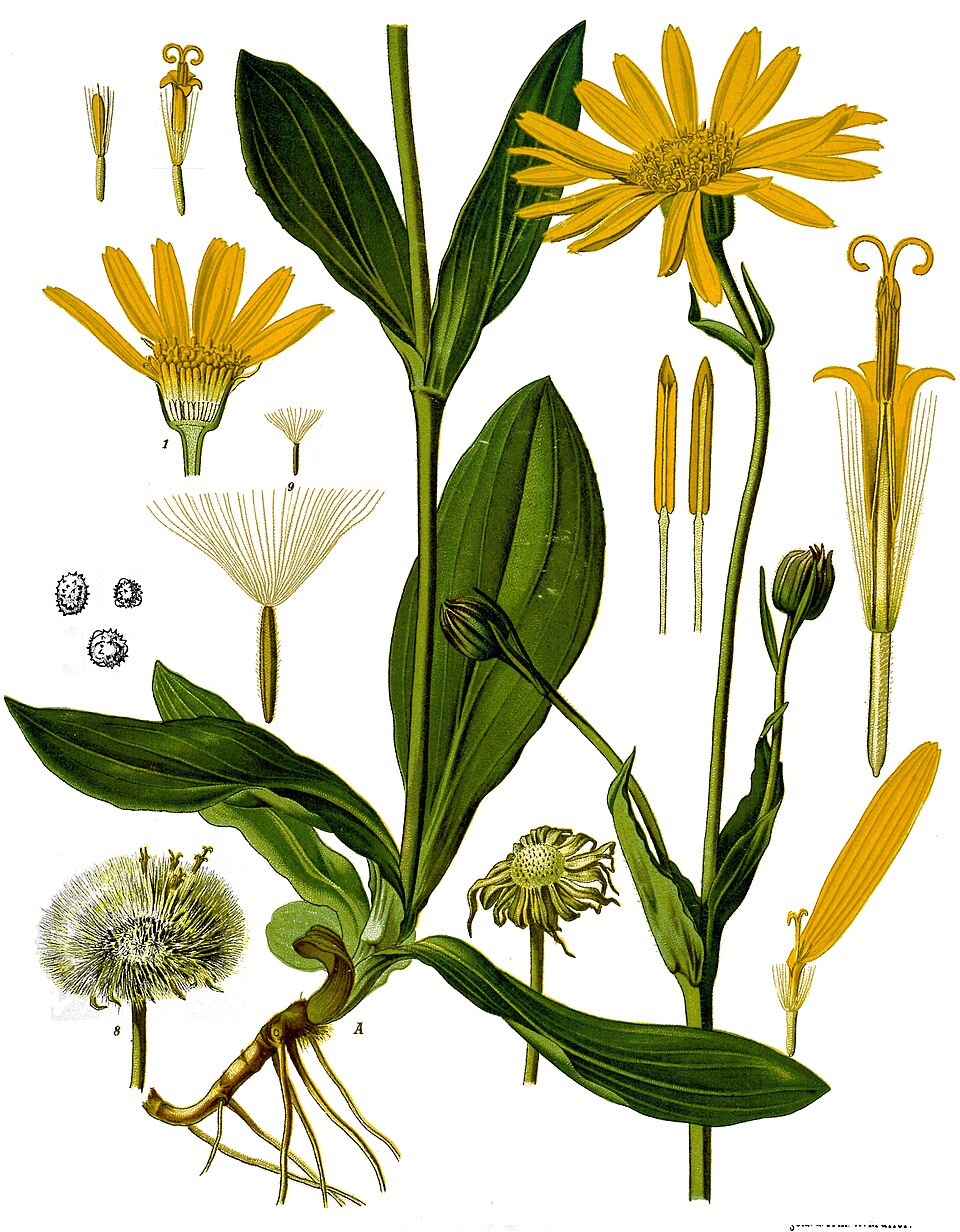
Photograph on Wikimedia Commons (Public domain).
Plant habit
Safety — read before use
For this herb it is important to check warnings, mix-ups and cautions. Start with the Safety section.
Quick overview
A practical summary; details are in the sections below.
- Safety grade
- Caution details
- Scientific sources on the card
- Yes — sources are listed with claims Science section
- When and what to harvest
- Flower — June–July
- Processing methods
Herbal oil, Tincture, Salve / ointment
All methods and recipes on the card- Topics and symptoms
Bruises & scars (topical care), Muscles after exertion
Topics section, Symptoms overview
Identification and mix-ups
Basal rosette leaves; yellow head.
Possible mix-ups and risks
Other yellow composites can look similar when gathering is uncertain. SAFETY NOTE: arnica itself is toxic by internal/oral use; ingestion can cause poisoning. Use only externally in appropriate preparations unless guided by a qualified clinician.
Similar herbs
- Pot marigold
Both are orange daisy-family flowers for external skin care — calendula is also safe internally, arnica is not. Never swap them in tea blends.
Topics and symptoms
More topics are in the symptoms and topics overview.
- Bruises & scars (topical care)Traditional· Traditional / cultural framing
- Muscles after exertionTraditional· Traditional / cultural framing
Geographic occurrence
France
Common (expected wild occurrence in the region)
Harvest
- FlowerJune–July
léto
Region: FranceNotes: Flower heads just after opening, in dry weather. Arnica is a legally protected species in Czechia and most of Europe has moved from wild picking to cultivation — buy cultivated dried flowers for home use.
Storage
- Drying(Flower)
Dried flower heads keep up to 12 months in a dark, tightly closed jar; older flowers lose aroma and colour.
- Light:
- Light-sensitive — pigments and volatile oils fade.
- Moisture:
- Flower heads absorb moisture and mould easily; store completely dry.
- Safety:
- Label as an external-use herb so it is never mixed with tea herbs.
- In alcohol / tincture(Flower)
External-use tincture keeps 2–3 years at room temperature.
- Light:
- Dark bottle.
- Safety:
- Label clearly 'external use only'; arnica is not swallowed.
Processing methods on this herb card
Macerating herbs in a vegetable oil (cold or with gentle heat).
Full method description (from the catalogue)
Herbal oil is made by steeping dried or fresh material in oil (e.g. olive, sunflower) over time, sometimes with gentle warming. The result is not steam-distilled essential oil — it is a different extract type and usage (often topical or culinary per recipe).
Temperature, light, and material moisture affect shelf life; rancid oil must be discarded.
Traditional context for this method: yes·Scientific context for this method: no
Intact skin only; keep away from eyes and open wounds.
Alcoholic or alcohol–water maceration extract.
Full method description (from the catalogue)
A tincture is usually a long maceration of plant material in ethanol (sometimes with water). Alcohol and time release different compound groups than hot water alone; concentration and stability depend on the herb-to-solvent ratio and procedure.
Home production involves legal and safety limits that vary by country; this site gives a general overview, not a recipe. For each herb, read the card for interactions and warnings before preparing anything yourself.
Traditional context for this method: yes·Scientific context for this method: no
Dilute the tincture with water before external use; never take internally.
Solid base (wax, fat) with herbal extract or macerate; usually topical.
Full method description (from the catalogue)
Salves combine extracted or finely ground herb with fat and often beeswax. Consistency depends on ratios; protective or emollient salves aim for a skin film with slow release.
Clean work reduces microbial contamination; refrigerated storage may extend life per recipe.
Traditional context for this method: yes·Scientific context for this method: yes
Traditional / spiritual use
Kept separate from science — entries are cultural or symbolic, not medical advice.
Midsummer field protection in Alpine folklore
General
Traditional useFolk useHerbal loreSuperstitionIn Bavarian and Tyrolean folk custom arnica was picked around St John's Day and pushed into the corners of grain fields to guard the crop against hail and the 'Bilmesschnitter', a night demon said to cut the corn. Hence the folk name Johannisblume. This is a record of a superstition, not an instruction.
- Form:
- svazky květů, ochranná rostlina
- Claim strength:
- Tradition
- Source note:
- Alpine (Bavarian–Tyrolean) folk custom recorded in 19th-century German collections of superstitions; regional, today mostly a historical memory.
Scientific notes
Each claim lists a study type and a source (URL or DOI) where available. Dose notes from the literature are informational only.
How to read evidence strength and study type labels
Labels summarise how the catalogue entry is tagged — they are not a medical verdict on efficacy. For every row, read the summary, limitations and source link.
Evidence strength
- Evidence level not specified
- The author did not grade the record; judge from the summary, limitations and source link.
- Narrative / orientational literature
- Descriptive or expert literature without controlled group comparison — context rather than proof of effect.
- Weak evidence
- Study or conclusion with major methodological limits; treat only as a pointer for further reading.
- Preliminary findings
- First or smaller studies — interesting direction, not the final word on efficacy or safety.
- Moderate strength of evidence
- Moderate strength by study design; sample and context limits still apply.
- Stronger evidence
- Stronger design or consistency of results within the study's stated limits.
- Review article
- A review summarises multiple sources; quality depends on review method and field.
Study type
- Narrative / expert text
- Expert text or overview without a classical study design.
- In vitro study
- Cell culture or test-tube experiment — does not show an effect in the body.
- Animal study
- Animal model — transfer to humans is not automatic.
- Observational study
- Observing groups without random treatment assignment; confounding is possible.
- Clinical trial
- Human clinical trial; sample size and control group matter.
- Randomised controlled trial
- Randomised controlled trials are among the stronger designs when well conducted.
- Review study
- A review aggregates multiple papers — quality depends on selection rules.
- Systematic review
- Systematic review with explicit search and selection methodology.
- Meta-analysis
- Statistical pooling of studies; outcome depends on input data and heterogeneity.
- Regulatory assessment / monograph (EMA, WHO…)
- Regulatory body summary for a herbal product — different context from a single RCT; often about products, not home tea.
- Expert monograph (herbal preparations)
- Structured literature summary for a plant or drug — quality depends on author and edition year.
The HMPC accepted, on the basis of long-standing use, external use of arnica flower preparations for bruises, sprains and localised muscle pain (adults and adolescents from 12 years). Clinical studies were judged insufficient for a conclusion on efficacy.
Review articleRegulatory assessment / monograph (EMA, WHO…)Year: 2014Limitations: 'Traditional use' status, not proven efficacy. External only; allergic skin reactions have been reported.
EMA Committee on Herbal Medicinal Products (HMPC)
A randomised double-blind trial (204 patients with hand osteoarthritis) found no difference between an arnica gel and 5 % ibuprofen gel in pain or function after 21 days.
Preliminary findingsClinical trialYear: 2007Limitations: No placebo arm, short follow-up, one commercial product — not transferable to a home-made macerate.
Widrig R, Suter A, Saller R, Melzer J — Rheumatology International
Images
The main photo is in the card header. More images will appear here when available.
Safety
What the warning types mean
The type on each warning helps group themes — it does not replace the separate severity badge.
- Internal use
- Risks from swallowing, extracts, duration of use or concentration for internal use.
- Interactions / medicines
- Possible effect on medicines or concurrent treatment — check sources and a professional.
- Raw plant parts
- Raw, unripe or poorly prepared plant parts can be dangerous.
- Toxins and regulation
- Toxic constituents or regulated compounds (e.g. in distillates).
- Contact with the plant
- Skin or mucosa irritation from contact with fresh plant or sap.
- Allergy
- Allergic reactions, often linked to family sensitisation.
- Harvesting and contamination
- Contamination, species mix-ups or harvesting from unsuitable places.
- Never internallyHigh severityInternal use
Arnica contains helenalin and other sesquiterpene lactones; swallowed, it irritates the gut and in larger amounts affects the heart. The EMA monograph allows external use only. Tea or a tincture for drinking is out of the question.
- Contact allergy (daisy family)Moderate severityAllergy
Itching, redness and eczema have been reported after external application. Anyone reacting to chamomile, yarrow or chrysanthemums should avoid arnica; do not apply to broken skin.