Agave tequilana
Blue agave
CautionOther names: Blue agave
A blue-grey succulent from the Mexican highlands, the source plant for tequila.
A large rosette-forming succulent with thick fleshy leaves and spiny margins; the sweet stem juice is the basis of tequila and agave syrup in Mexico.
- Family
- Asparagaceae
- Plant type
- Succulent
What the safety levels mean (expand legend)
- Generally recognised as safe. Often a common herb with reasonable harvest and use; still read the specific warnings on the card.
- Information. Primarily informational — details in the text and warnings below matter most.
- Caution. Needs extra care (dose, duration, sensitive groups, interactions).
- Risky. Significant risks — verify sources, contraindications and professional guidance.
- Not for home experimentation. Not suitable to experiment with at home without knowledge and certainty.
- High risk for internal use. Particular risk with internal use (e.g. alkaloids); avoid prolonged or irresponsible dosing.
- Not specified. Level not filled in yet — rely on individual warnings and links below.
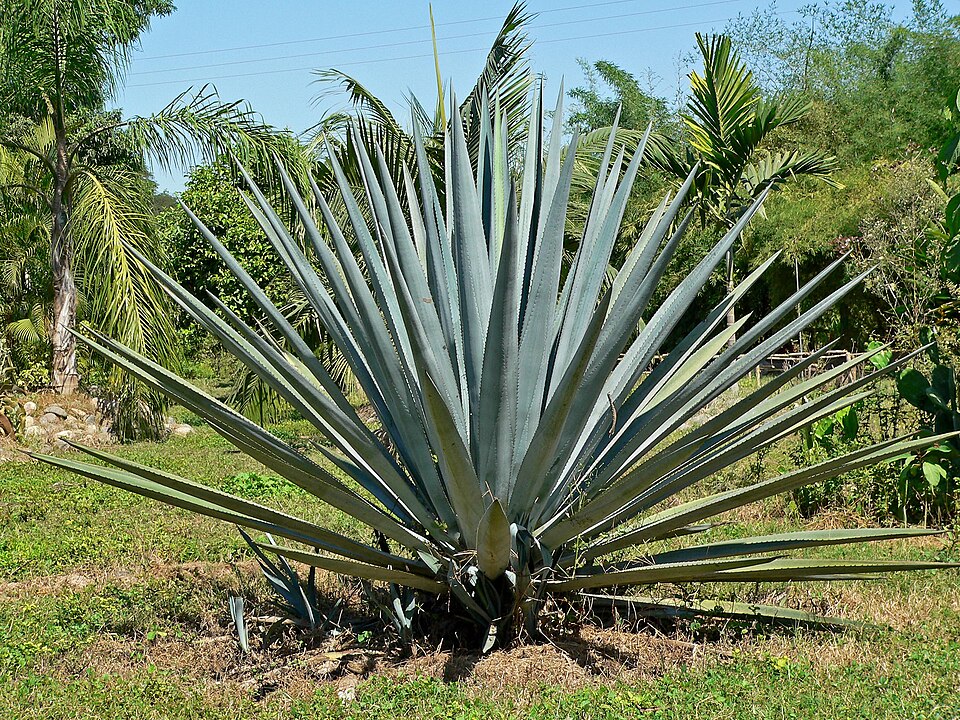
Photograph on Wikimedia Commons (CC BY-SA 3.0).
Plant habit
Safety — read before use
For this herb it is important to check warnings, mix-ups and cautions. Start with the Safety section.
Quick overview
A practical summary; details are in the sections below.
- Safety grade
- Caution details
- Scientific sources on the card
- No specific citations attached to claims yet
- When and what to harvest
- Leaf — October–April
- Processing methods
Syrup, Fermentation
All methods and recipes on the card- Topics and symptoms
Earth element (symbolism), Fire element (symbolism), Sacred plants
Topics section, Symptoms overview
Identification and mix-ups
Succulent perennial in Asparagaceae forming a basal rosette of fleshy lance-shaped leaves, distinctly blue-green (glaucous), about 100–150 cm long and 10–12 cm wide, with small brown marginal teeth and a sharp brown-black terminal spine. The rosette is 1.2–2 m tall and wide. After 5–10 years it sends up a panicle 5–8 m tall, then dies (monocarpic).
Possible mix-ups and risks
Most often confused with century plant (Agave americana), which is much larger (to 2–4 m) and has broader grey-green (not narrow blue) leaves. It is not strongly toxic, but the sap contains irritant crystals (raphides) and can cause skin and mucous-membrane irritation. No acutely poisonous lookalike is documented.
Similar herbs
No related herbs are linked yet.
Topics and symptoms
More topics are in the symptoms and topics overview.
- Earth element (symbolism)Traditional· Traditional / cultural framing
- Fire element (symbolism)Traditional· Traditional / cultural framing
- Sacred plantsTraditional· Traditional / cultural framing
Sources
Geographic occurrence
Mexico
Common (expected wild occurrence in the region)
Harvest
- LeafOctober–April
winter
Region: MexicoNotes: The heart ('piña') at maturity, 6–10 years after planting.
Storage
- Airtight storage(Leaf)
Agave syrup keeps 2 years in a closed bottle at room temperature; it does not crystallise. The roasted heart (piña) is processed at once.
- Safety:
- Fresh leaf sap contains irritant crystals (raphides) — wear gloves when handling the plant.
Processing methods on this herb card
Decoction or infusion with sweetener and reduction; shelf life depends on sugar and storage.
Full method description (from the catalogue)
Syrups combine a herbal base with sugar or honey and often a short boil to concentrate and improve hygiene. Preservation depends strongly on water content, sugar level, and bottling practice.
Home syrups may fall under food rules; store in the fridge after opening per recipe.
Traditional context for this method: no·Scientific context for this method: no
Agave syrup comes from industrial hydrolysis of the fructans in the roasted heart; the result is 70–90 % fructose — a sweetener, not a 'healthier sugar'. It is not made at home.
Microbial processing (fermentation) of plant material for drinks or foods.
Full method description (from the catalogue)
Fermentation changes sugars, flavour, and microbial composition (e.g. herbal ferments, oxymels combining honey and vinegar per tradition). Hygiene, temperature, and time are critical for a safe outcome.
Home ferments should not smell "rotten"; when in doubt, discard.
Traditional context for this method: yes·Scientific context for this method: no
Fermenting and distilling the hearts into tequila is a craft with a protected designation of origin (Jalisco); home distillation is illegal in Czechia.
Traditional / spiritual use
Kept separate from science — entries are cultural or symbolic, not medical advice.
Mayahuel and the four hundred rabbits
Symbolism
Spiritual useMythologyRitualSymbolismIn Aztec mythology the agave (metl) is the body of the goddess Mayahuel, whose four hundred breasts nursed the four hundred rabbits, gods of drunkenness (Centzon Totochtin). Pulque, the fermented agave sap, was a ceremonial drink allowed to elders and priests, and drinking it to excess was punished. Today's tequila from blue agave is a colonial distillate of the same plant. A record of myth, not effect.
- Form:
- goddess Mayahuel, ceremonial pulque, 400 rabbits
- Claim strength:
- Tradition
- Source note:
- Aztec mythology (Codex Magliabechiano, Codex Borgia — Mayahuel); history of pulque and tequila (Jalisco).
Scientific notes
Each claim lists a study type and a source (URL or DOI) where available. Dose notes from the literature are informational only.
No published study records yet.
Images
The main photo is in the card header. More images will appear here when available.
Safety
What the warning types mean
The type on each warning helps group themes — it does not replace the separate severity badge.
- Internal use
- Risks from swallowing, extracts, duration of use or concentration for internal use.
- Interactions / medicines
- Possible effect on medicines or concurrent treatment — check sources and a professional.
- Raw plant parts
- Raw, unripe or poorly prepared plant parts can be dangerous.
- Toxins and regulation
- Toxic constituents or regulated compounds (e.g. in distillates).
- Contact with the plant
- Skin or mucosa irritation from contact with fresh plant or sap.
- Allergy
- Allergic reactions, often linked to family sensitisation.
- Harvesting and contamination
- Contamination, species mix-ups or harvesting from unsuitable places.
No structured safety records yet.