Vanilla planifolia
Flat-leaved vanilla
CautionOther names: Vanilla
A climbing orchid whose fermented pods give the vanilla aroma.
An evergreen climbing orchid with creamy-white flowers; the green pods are fermented and dried after harvest, which develops their characteristic vanilla aroma.
- Family
- Orchidaceae
- Plant type
- Climbing orchid
What the safety levels mean (expand legend)
- Generally recognised as safe. Often a common herb with reasonable harvest and use; still read the specific warnings on the card.
- Information. Primarily informational — details in the text and warnings below matter most.
- Caution. Needs extra care (dose, duration, sensitive groups, interactions).
- Risky. Significant risks — verify sources, contraindications and professional guidance.
- Not for home experimentation. Not suitable to experiment with at home without knowledge and certainty.
- High risk for internal use. Particular risk with internal use (e.g. alkaloids); avoid prolonged or irresponsible dosing.
- Not specified. Level not filled in yet — rely on individual warnings and links below.
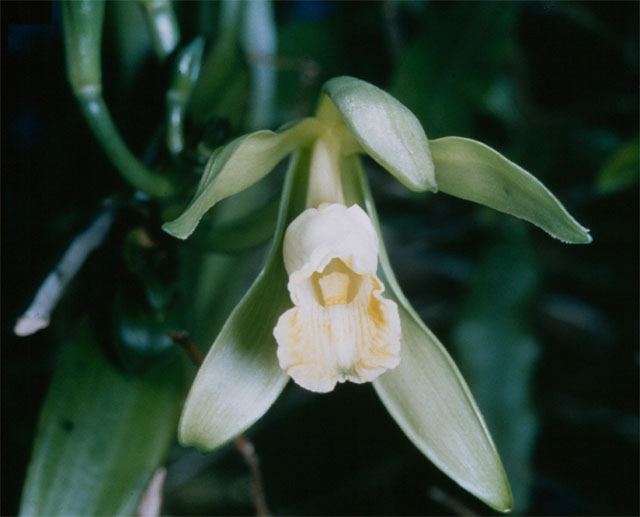
Photograph on Wikimedia Commons (Public domain).
Plant habit
Safety — read before use
For this herb it is important to check warnings, mix-ups and cautions. Start with the Safety section.
Quick overview
A practical summary; details are in the sections below.
- Safety grade
- Caution details
- Scientific sources on the card
- No specific citations attached to claims yet
- When and what to harvest
- Fruit — January–March
- Processing methods
Tincture, Culinary use
All methods and recipes on the card- Topics and symptoms
Sacred plants, Sadness and melancholy, Self-love and relationships
Topics section, Symptoms overview
Identification and mix-ups
Climbing succulent vine in Orchidaceae reaching 10–15 m, with fleshy stems and aerial adventitious roots clinging to host trees. Leaves alternate, single, succulent, flat, glossy bright green, lanceolate-oval (8–25 cm), pointed. Flowers in axillary racemes of 12–20, greenish-yellow, about 5 cm wide, faintly scented, each lasting a single day. Fruit an elongate fleshy capsule (the pod, 10–25 cm) ripening black with a strong aroma and thousands of minute seeds.
Possible mix-ups and risks
May be confused with the related vanillas Vanilla ×tahitensis and Vanilla pompona, which differ in leaf and pod shape and in aroma chemistry. No toxic lookalike is documented for this species; the issue is one of quality, not safety.
Similar herbs
No related herbs are linked yet.
Topics and symptoms
More topics are in the symptoms and topics overview.
- Sacred plantsTraditional· Traditional / cultural framing
- Sadness and melancholyTraditional· Traditional / cultural framing
- Self-love and relationshipsTraditional· Traditional / cultural framing
Sources
Geographic occurrence
Mexico
Common (expected wild occurrence in the region)
Harvest
- FruitJanuary–March
winter
Region: MexicoNotes: Green pods 8–9 months after pollination; fermentation and drying are required after harvest.
Storage
- Airtight storage(Fruit)
Cured pods keep 2–3 years in an airtight jar or waxed paper; they must neither dry out nor mould, air them occasionally. White vanillin crystals on the surface (givre) are a sign of quality, not mould.
- Light:
- Out of light.
- Moisture:
- In the fridge water condenses and the pods mould — store at room temperature.
Processing methods on this herb card
Alcoholic or alcohol–water maceration extract.
Full method description (from the catalogue)
A tincture is usually a long maceration of plant material in ethanol (sometimes with water). Alcohol and time release different compound groups than hot water alone; concentration and stability depend on the herb-to-solvent ratio and procedure.
Home production involves legal and safety limits that vary by country; this site gives a general overview, not a recipe. For each herb, read the card for interactions and warnings before preparing anything yourself.
Traditional context for this method: yes·Scientific context for this method: no
Cooking, baking, seasoning as food — general category without therapeutic claims.
Full method description (from the catalogue)
Culinary use covers herbs as ingredients in dishes, drinks, or spice mixes. This overview does not evaluate medicinal effects — only reminds you about species intent, allergies, and heat treatment where needed (e.g. some fruits or plant parts).
Combining with alcohol, sugar, or long cooking changes outcomes; verify culinary sources.
Traditional context for this method: yes·Scientific context for this method: no
Traditional / spiritual use
Kept separate from science — entries are cultural or symbolic, not medical advice.
Xanath — the princess who became an orchid
Symbolism
Historical mentionMythologySymbolismThe Totonac of Papantla (Veracruz), who domesticated vanilla, tell of princess Xanath and her lover, killed by priests for a forbidden love; from their blood grew the vanilla vine twining round a tree. The Aztecs demanded vanilla (tlilxochitl, 'black flower') from the Totonac as tribute and added it to the rulers' cacao drink. A record of legend and history, not effect.
- Form:
- origin legend, Aztec tribute, fragrance of offerings
- Claim strength:
- Historical mention
- Source note:
- Totonac oral tradition (Papantla, Veracruz); Codex Mendoza (tribute lists); history of vanilla in Mesoamerica.
Scientific notes
Each claim lists a study type and a source (URL or DOI) where available. Dose notes from the literature are informational only.
No published study records yet.
Images
The main photo is in the card header. More images will appear here when available.
Safety
What the warning types mean
The type on each warning helps group themes — it does not replace the separate severity badge.
- Internal use
- Risks from swallowing, extracts, duration of use or concentration for internal use.
- Interactions / medicines
- Possible effect on medicines or concurrent treatment — check sources and a professional.
- Raw plant parts
- Raw, unripe or poorly prepared plant parts can be dangerous.
- Toxins and regulation
- Toxic constituents or regulated compounds (e.g. in distillates).
- Contact with the plant
- Skin or mucosa irritation from contact with fresh plant or sap.
- Allergy
- Allergic reactions, often linked to family sensitisation.
- Harvesting and contamination
- Contamination, species mix-ups or harvesting from unsuitable places.
No structured safety records yet.