Melaleuca alternifolia
Tea tree
CautionOther names: Tea tree, Narrow-leaved paperbark
Tea tree oil source—eastern coast commercial and cultural use.
Evergreen shrub with tiny scale-like leaves and white flowers in spikes.
- Family
- Myrtaceae
- Plant type
- Shrub / small tree
What the safety levels mean (expand legend)
- Generally recognised as safe. Often a common herb with reasonable harvest and use; still read the specific warnings on the card.
- Information. Primarily informational — details in the text and warnings below matter most.
- Caution. Needs extra care (dose, duration, sensitive groups, interactions).
- Risky. Significant risks — verify sources, contraindications and professional guidance.
- Not for home experimentation. Not suitable to experiment with at home without knowledge and certainty.
- High risk for internal use. Particular risk with internal use (e.g. alkaloids); avoid prolonged or irresponsible dosing.
- Not specified. Level not filled in yet — rely on individual warnings and links below.
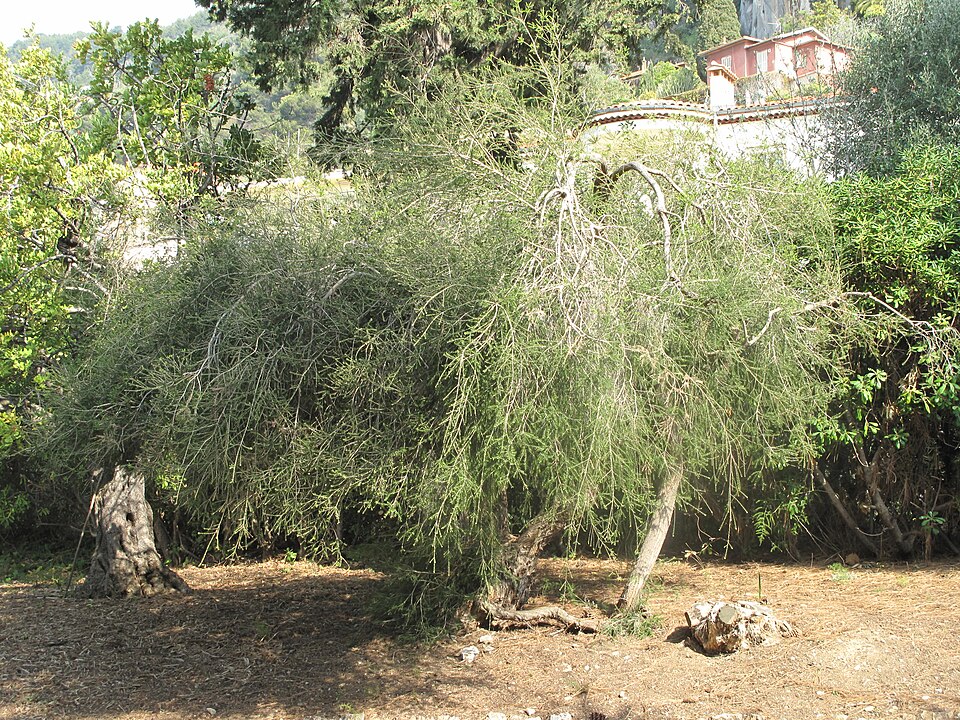
Photograph on Wikimedia Commons (Public domain).
Plant habit
Safety — read before use
For this herb it is important to check warnings, mix-ups and cautions. Start with the Safety section.
Quick overview
A practical summary; details are in the sections below.
- Safety grade
- Caution details
- Scientific sources on the card
- Yes — sources are listed with claims Science section
- When and what to harvest
- Leaf — January–December
- Processing methods
Herbal oil, Essential oil
All methods and recipes on the card- Topics and symptoms
Complexion and local blemishes, Mouth and gums, Skin
Topics section, Symptoms overview
Identification and mix-ups
Paper bark in relatives; aromatic leaves.
Possible mix-ups and risks
Other myrtles by habit and locality.
Similar herbs
- Blue gum
Both myrtle-family trees with an industrial essential oil; eucalyptus oil is camphorous (1,8-cineole), tea tree resinous (terpinen-4-ol). Swapping the bottles is easy, the uses differ.
Topics and symptoms
More topics are in the symptoms and topics overview.
- Complexion and local blemishesTraditional· Traditional / cultural framing
- Mouth and gumsTraditional· Traditional / cultural framing
- SkinTraditional· Traditional / cultural framing
Geographic occurrence
Australia
Common (expected wild occurrence in the region)
Harvest
- LeafJanuary–December
celoročně
Region: AustraliaNotes: On plantations in New South Wales the shrubs are coppiced to the ground every year and the whole above-ground mass is steam-distilled; the oil makes up 1–2 % of leaf weight. The oil cannot be made from leaves at home — tea tree is an industrial essential oil, not a household herb.
Storage
- Airtight storage(Leaf)
The oil keeps 12–24 months in a dark, full, tightly closed bottle in the cold; in air and light it oxidises and oxidised oil more often causes skin allergy.
- Light:
- Dark glass, out of light.
- Safety:
- Out of children's reach — swallowing is toxic.
Processing methods on this herb card
Macerating herbs in a vegetable oil (cold or with gentle heat).
Full method description (from the catalogue)
Herbal oil is made by steeping dried or fresh material in oil (e.g. olive, sunflower) over time, sometimes with gentle warming. The result is not steam-distilled essential oil — it is a different extract type and usage (often topical or culinary per recipe).
Temperature, light, and material moisture affect shelf life; rancid oil must be discarded.
Traditional context for this method: yes·Scientific context for this method: yes
Steam-distilled highly aromatic oil; requires dilution and respect for potency.
Full method description (from the catalogue)
Essential oil is a highly concentrated product of steam distillation (or other approved methods). A single drop can be plenty; topical use normally requires dilution in a carrier oil using established ratios.
Never apply strong neat oil to large areas without knowing irritancy.
Traditional context for this method: yes·Scientific context for this method: yes
Distillation is industrial; a household 'oil' cannot be made from the leaves.
Traditional / spiritual use
Kept separate from science — entries are cultural or symbolic, not medical advice.
The healing lakes of the Bundjalung
General
Traditional useFolk remediesFolk useHerbal loreThe Bundjalung people of the New South Wales coast crushed tea tree leaves onto cuts and skin inflammation and bathed in 'healing lakes' into which leaves fell from the surrounding stands (Bungawalbin). Cook gave the tree its name 'tea tree' in 1770 when the leaves were brewed as tea; chemist Arthur Penfold began studying the oil in the 1920s. A record of tradition and history; clinical data under Science.
- Form:
- rozmačkané listy a „léčivá jezera“ Bundjalungů
- Claim strength:
- Tradition
- Source note:
- Bundjalung tradition (north coast of NSW); Carson et al. 2006 (historical introduction to the review).
Scientific notes
Each claim lists a study type and a source (URL or DOI) where available. Dose notes from the literature are informational only.
How to read evidence strength and study type labels
Labels summarise how the catalogue entry is tagged — they are not a medical verdict on efficacy. For every row, read the summary, limitations and source link.
Evidence strength
- Evidence level not specified
- The author did not grade the record; judge from the summary, limitations and source link.
- Narrative / orientational literature
- Descriptive or expert literature without controlled group comparison — context rather than proof of effect.
- Weak evidence
- Study or conclusion with major methodological limits; treat only as a pointer for further reading.
- Preliminary findings
- First or smaller studies — interesting direction, not the final word on efficacy or safety.
- Moderate strength of evidence
- Moderate strength by study design; sample and context limits still apply.
- Stronger evidence
- Stronger design or consistency of results within the study's stated limits.
- Review article
- A review summarises multiple sources; quality depends on review method and field.
Study type
- Narrative / expert text
- Expert text or overview without a classical study design.
- In vitro study
- Cell culture or test-tube experiment — does not show an effect in the body.
- Animal study
- Animal model — transfer to humans is not automatic.
- Observational study
- Observing groups without random treatment assignment; confounding is possible.
- Clinical trial
- Human clinical trial; sample size and control group matter.
- Randomised controlled trial
- Randomised controlled trials are among the stronger designs when well conducted.
- Review study
- A review aggregates multiple papers — quality depends on selection rules.
- Systematic review
- Systematic review with explicit search and selection methodology.
- Meta-analysis
- Statistical pooling of studies; outcome depends on input data and heterogeneity.
- Regulatory assessment / monograph (EMA, WHO…)
- Regulatory body summary for a herbal product — different context from a single RCT; often about products, not home tea.
- Expert monograph (herbal preparations)
- Structured literature summary for a plant or drug — quality depends on author and edition year.
The HMPC accepted, on the basis of long-standing use, tea tree oil for external treatment of small superficial wounds, insect bites, small boils and mild acne, for relief of itching in mild athlete's foot and for minor inflammation of the lining of the mouth, in adults and adolescents from 12 years.
Review articleRegulatory assessment / monograph (EMA, WHO…)Year: 2014Limitations: Traditional use; clinical studies judged insufficient. External only, for at most a month; allergic skin reactions reported.
EMA Committee on Herbal Medicinal Products (HMPC)
The review summarises the broad antibacterial, antifungal and antiviral activity of tea tree oil in vitro (carried by terpinen-4-ol), smaller clinical trials in acne, athlete's foot and MRSA colonisation, and safety data: toxicity after ingestion and contact allergy, especially with oxidised oil.
Narrative / orientational literatureReview studyYear: 2006Limitations: Clinical trials are small and of mixed quality; in vitro activity does not transfer automatically to skin. The authors point to the lack of product standardisation.
Carson CF, Hammer KA, Riley TV — Clinical Microbiology Reviews
Melaleuca alternifolia (Tea Tree) Oil: a Review of Antimicrobial and Other Medicinal Properties
Images
The main photo is in the card header. More images will appear here when available.
Safety
What the warning types mean
The type on each warning helps group themes — it does not replace the separate severity badge.
- Internal use
- Risks from swallowing, extracts, duration of use or concentration for internal use.
- Interactions / medicines
- Possible effect on medicines or concurrent treatment — check sources and a professional.
- Raw plant parts
- Raw, unripe or poorly prepared plant parts can be dangerous.
- Toxins and regulation
- Toxic constituents or regulated compounds (e.g. in distillates).
- Contact with the plant
- Skin or mucosa irritation from contact with fresh plant or sap.
- Allergy
- Allergic reactions, often linked to family sensitisation.
- Harvesting and contamination
- Contamination, species mix-ups or harvesting from unsuitable places.
- Swallowing is toxicHigh severityInternal use
Drowsiness, confusion, loss of coordination and, in children, unconsciousness have been described after ingesting tea tree oil (Carson et al. 2006). The oil belongs only on the skin and in a diluted mouth rinse that is not swallowed; keep the bottle away from children.
- Contact allergy and undiluted oilModerate severityContact with the plant
Undiluted and especially oxidised (old, opened) tea tree oil causes contact dermatitis; the EMA monograph reports allergic skin reactions and allows use from age 12 for at most a month. Dilute, patch-test, keep the bottle well closed.