Azadirachta indica
Neem
CautionOther names: Indian lilac, Margosa
An Indian tree with bitter leaves and oil-rich seeds.
An evergreen tree with pinnate leaves and small white flowers; the leaves are strongly bitter and the seed kernel yields an oil traditionally used in Indian skin and hair care.
- Family
- Meliaceae
- Plant type
- Evergreen tree
What the safety levels mean (expand legend)
- Generally recognised as safe. Often a common herb with reasonable harvest and use; still read the specific warnings on the card.
- Information. Primarily informational — details in the text and warnings below matter most.
- Caution. Needs extra care (dose, duration, sensitive groups, interactions).
- Risky. Significant risks — verify sources, contraindications and professional guidance.
- Not for home experimentation. Not suitable to experiment with at home without knowledge and certainty.
- High risk for internal use. Particular risk with internal use (e.g. alkaloids); avoid prolonged or irresponsible dosing.
- Not specified. Level not filled in yet — rely on individual warnings and links below.
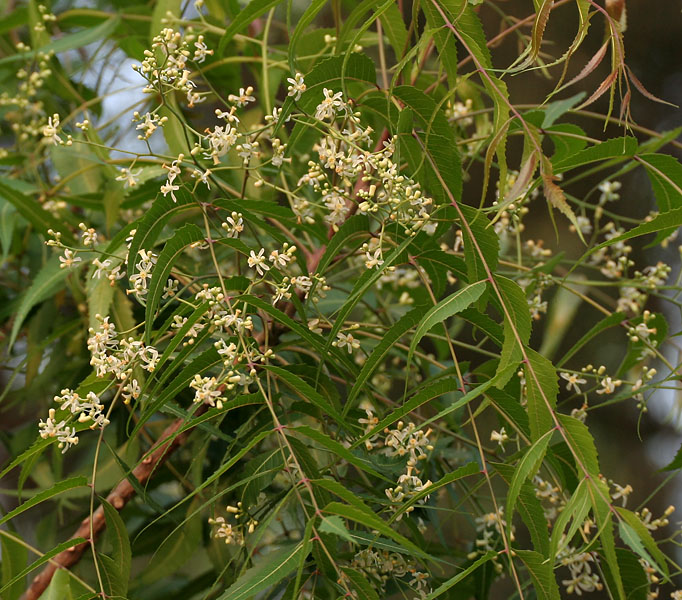
Photograph on Wikimedia Commons (CC BY 3.0).
Plant habit
Safety — read before use
For this herb it is important to check warnings, mix-ups and cautions. Start with the Safety section.
Quick overview
A practical summary; details are in the sections below.
- Safety grade
- Caution details
- Scientific sources on the card
- Yes — sources are listed with claims Science section
- When and what to harvest
- Leaf — January–December
- Fruit — June–August
- Processing methods
Bath additive, Herbal oil, Culinary use
All methods and recipes on the card- Topics and symptoms
Complexion and local blemishes, Insect bites (topical), Mouth and gums…
Topics section, Symptoms overview
Identification and mix-ups
Evergreen to semi-deciduous tree in Meliaceae, usually reaching 15–20 m. Leaves odd-pinnate (simply pinnate), alternate, with 8–19 falcate, sharply serrate leaflets with an asymmetric base; young foliage is often reddish. Flowers small, white, fragrant, arranged in loose panicles. Fruit a smooth ovoid drupe (about 1–2 cm) ripening yellow and containing a single seed. Both leaves and seeds carry a characteristic bitter, garlic-sulphurous odour.
Possible mix-ups and risks
The most serious risk is confusion with the closely related chinaberry (Melia azedarach), whose fruits are POISONOUS. Key distinctions: neem (Azadirachta indica) has simply pinnate (once-divided) leaves and a one-seeded ovoid drupe, whereas Melia azedarach has 2- to 3-pinnate leaves and globose fruits with 3–6 seeds. Neem leaves are also notably glossier. Historical nomenclatural confusion (former names Melia indica, M. azadirachta) further deepens this risk.
Similar herbs
No related herbs are linked yet.
Topics and symptoms
More topics are in the symptoms and topics overview.
- Complexion and local blemishesTraditional· Traditional / cultural framing
- Insect bites (topical)Traditional· Traditional / cultural framing
- Mouth and gumsTraditional· Traditional / cultural framing
- Sacred plantsTraditional· Traditional / cultural framing
- SkinTraditional· Traditional / cultural framing
Sources
Geographic occurrence
India
Occasional (garden, cultivation, or fringe of the range)
Indonesia
Occasional (garden, cultivation, or fringe of the range)
Harvest
- LeafJanuary–December
year-round
Region: IndiaNotes: Leaves and young branches year-round; seeds after the fruit drops.
- FruitJune–August
summer
Region: IndiaNotes: The yellowish drupes ripen with the monsoon from June to August; they are gathered fallen, depulped and the seeds shade-dried for oil. Seeds lose azadirachtin quickly — process within a few weeks.
Storage
- Drying(Leaf)
Dried leaves keep a year in an airtight jar; in India a handful of dry leaves goes into stored rice and pulses against insects.
- Light:
- Out of light.
- Moisture:
- Protect from moisture.
- Refrigeration(Fruit)
Pressed neem oil keeps a year in a dark bottle in the cool; it solidifies below 20 °C, warm in the hands before use. The sulphur-garlic smell is normal.
- Light:
- Dark glass.
- Safety:
- Label 'external use only' and keep out of children's reach — swallowing the oil is poisonous.
Processing methods on this herb card
Addition to bath water or a bath decoction; topical use.
Full method description (from the catalogue)
Bath preparations transfer soluble compounds into water for short-term skin contact. Concentration and water temperature change sensation and possible irritation.
Rinse the tub afterwards so residues from strongly coloured plants do not linger.
Traditional context for this method: yes·Scientific context for this method: no
Macerating herbs in a vegetable oil (cold or with gentle heat).
Full method description (from the catalogue)
Herbal oil is made by steeping dried or fresh material in oil (e.g. olive, sunflower) over time, sometimes with gentle warming. The result is not steam-distilled essential oil — it is a different extract type and usage (often topical or culinary per recipe).
Temperature, light, and material moisture affect shelf life; rancid oil must be discarded.
Traditional context for this method: yes·Scientific context for this method: no
Cold-pressed seed oil is an external and garden product (insect spray). Never give internally — poisonings of children with neem oil, with vomiting, seizures and impaired consciousness, are described in the paediatric literature (Sundaravalli et al. 1982).
Cooking, baking, seasoning as food — general category without therapeutic claims.
Full method description (from the catalogue)
Culinary use covers herbs as ingredients in dishes, drinks, or spice mixes. This overview does not evaluate medicinal effects — only reminds you about species intent, allergies, and heat treatment where needed (e.g. some fruits or plant parts).
Combining with alcohol, sugar, or long cooking changes outcomes; verify culinary sources.
Traditional context for this method: yes·Scientific context for this method: no
Traditional / spiritual use
Kept separate from science — entries are cultural or symbolic, not medical advice.
The tree where Shitala dwells — and a bitter new year
Symbolism
Spiritual useFolk useMythologyRitualIn folk Hinduism neem is the seat of the goddess Shitala, protector against smallpox and fevers; during illness its twigs are hung over the door and the sick lie on its leaves. At the spring new year Ugadi (Andhra Pradesh, Karnataka) neem flowers are eaten with jaggery — a bitter pachadi reminding that the year brings sweet and bitter alike. A record of ritual and symbolism.
- Form:
- tree of the goddess Shitala; bitter-sweet pachadi for Ugadi
- Claim strength:
- Tradition
- Source note:
- Alzohairy 2016 (introduction on cultural significance); Ugadi and Gudi Padwa tradition; the folk cult of Shitala in northern India.
Scientific notes
Each claim lists a study type and a source (URL or DOI) where available. Dose notes from the literature are informational only.
How to read evidence strength and study type labels
Labels summarise how the catalogue entry is tagged — they are not a medical verdict on efficacy. For every row, read the summary, limitations and source link.
Evidence strength
- Evidence level not specified
- The author did not grade the record; judge from the summary, limitations and source link.
- Narrative / orientational literature
- Descriptive or expert literature without controlled group comparison — context rather than proof of effect.
- Weak evidence
- Study or conclusion with major methodological limits; treat only as a pointer for further reading.
- Preliminary findings
- First or smaller studies — interesting direction, not the final word on efficacy or safety.
- Moderate strength of evidence
- Moderate strength by study design; sample and context limits still apply.
- Stronger evidence
- Stronger design or consistency of results within the study's stated limits.
- Review article
- A review summarises multiple sources; quality depends on review method and field.
Study type
- Narrative / expert text
- Expert text or overview without a classical study design.
- In vitro study
- Cell culture or test-tube experiment — does not show an effect in the body.
- Animal study
- Animal model — transfer to humans is not automatic.
- Observational study
- Observing groups without random treatment assignment; confounding is possible.
- Clinical trial
- Human clinical trial; sample size and control group matter.
- Randomised controlled trial
- Randomised controlled trials are among the stronger designs when well conducted.
- Review study
- A review aggregates multiple papers — quality depends on selection rules.
- Systematic review
- Systematic review with explicit search and selection methodology.
- Meta-analysis
- Statistical pooling of studies; outcome depends on input data and heterogeneity.
- Regulatory assessment / monograph (EMA, WHO…)
- Regulatory body summary for a herbal product — different context from a single RCT; often about products, not home tea.
- Expert monograph (herbal preparations)
- Structured literature summary for a plant or drug — quality depends on author and edition year.
The review summarises neem constituents (azadirachtin, nimbin, nimbidin, nimbolide, quercetin) and laboratory and animal studies of antimicrobial, anti-inflammatory, antioxidant and hepatoprotective activity; controlled studies in humans are rare.
Narrative / orientational literatureReview studyYear: 2016Limitations: Mostly preclinical data; heterogeneous extracts and plant parts; a journal with weaker quality control.
Alzohairy MA — Evidence-Based Complementary and Alternative Medicine
DOI: 10.1155/2016/7382506
Images
The main photo is in the card header. More images will appear here when available.
Safety
What the warning types mean
The type on each warning helps group themes — it does not replace the separate severity badge.
- Internal use
- Risks from swallowing, extracts, duration of use or concentration for internal use.
- Interactions / medicines
- Possible effect on medicines or concurrent treatment — check sources and a professional.
- Raw plant parts
- Raw, unripe or poorly prepared plant parts can be dangerous.
- Toxins and regulation
- Toxic constituents or regulated compounds (e.g. in distillates).
- Contact with the plant
- Skin or mucosa irritation from contact with fresh plant or sap.
- Allergy
- Allergic reactions, often linked to family sensitisation.
- Harvesting and contamination
- Contamination, species mix-ups or harvesting from unsuitable places.
- Pregnancy and breastfeedingHigh severitypregnancy
Neem (especially the oil and bark) is not recommended during pregnancy or breastfeeding; in Ayurveda it is traditionally used outside these periods.
- Neem oil poisoning in childrenHigh severityToxins and regulation
Paediatric literature from India (Sundaravalli et al. 1982, Indian Journal of Pediatrics) described poisonings of infants and small children after a spoonful of neem (margosa) oil given 'for a cold': vomiting, drowsiness, seizures, metabolic acidosis and a Reye-like encephalopathy, including deaths. Never give the oil internally, especially to children; keep leaf decoctions and oil apart and labelled.