Panax quinquefolius
American ginseng
CautionOther names: American ginseng
American ginseng—eastern forest herb; culturally valued root (protected in places).
Perennial with umbel inflorescence and five leaflets per whorl.
- Family
- Sapindaceae
- Plant type
- Perennial herb
What the safety levels mean (expand legend)
- Generally recognised as safe. Often a common herb with reasonable harvest and use; still read the specific warnings on the card.
- Information. Primarily informational — details in the text and warnings below matter most.
- Caution. Needs extra care (dose, duration, sensitive groups, interactions).
- Risky. Significant risks — verify sources, contraindications and professional guidance.
- Not for home experimentation. Not suitable to experiment with at home without knowledge and certainty.
- High risk for internal use. Particular risk with internal use (e.g. alkaloids); avoid prolonged or irresponsible dosing.
- Not specified. Level not filled in yet — rely on individual warnings and links below.
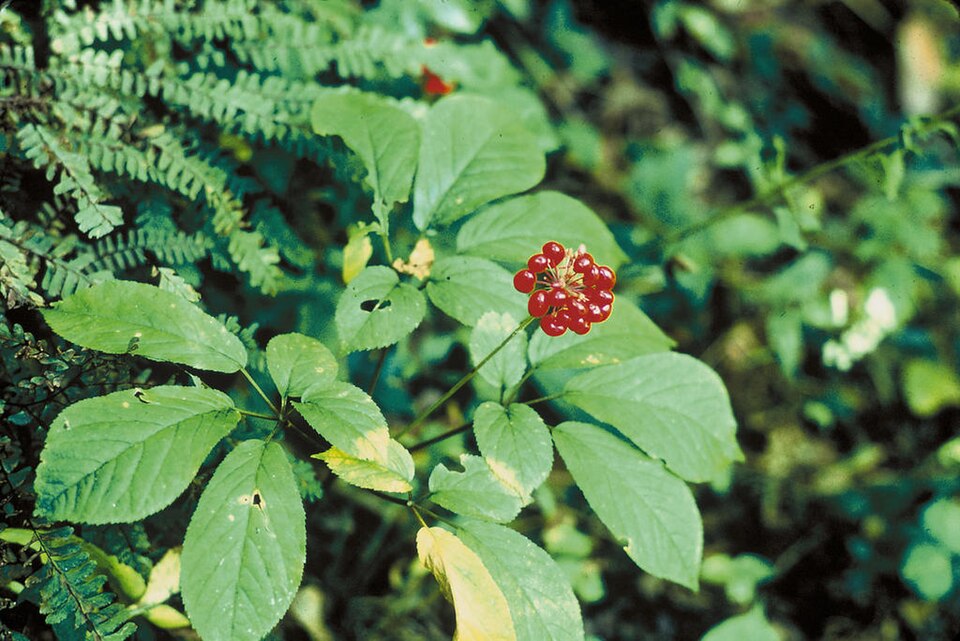
Photograph on Wikimedia Commons (Public domain).
Plant habit
Safety — read before use
For this herb it is important to check warnings, mix-ups and cautions. Start with the Safety section.
Quick overview
A practical summary; details are in the sections below.
- Safety grade
- Caution details
- Scientific sources on the card
- Yes — sources are listed with claims Science section
- When and what to harvest
- Root — September–October
- Processing methods
Decoction, Powder, Tincture
All methods and recipes on the card- Topics and symptoms
Common cold — overall comfort, Fatigue and low energy
Topics section, Symptoms overview
Identification and mix-ups
Three large leaflets + two smaller; fleshy root.
Possible mix-ups and risks
Other Panax spp. are difficult vegetatively.
Similar herbs
No related herbs are linked yet.
Topics and symptoms
More topics are in the symptoms and topics overview.
- Common cold — overall comfortScientific· Preliminary or weaker scientific findings
- Fatigue and low energyTraditional· Traditional / cultural framing
Geographic occurrence
Canada
Occasional (garden, cultivation, or fringe of the range)
Harvest
- RootSeptember–October
podzim
Region: CanadaNotes: The root is dug in autumn when the berries redden and the leaves yellow, from plants at least five to seven years old; the red berries are traditionally sown back in place. Wild harvest is banned in Canada and licensed and seasonal in the USA; the species is in CITES Appendix II — only cultivated root belongs in the kitchen.
Storage
- Drying(Root)
Whole dried root keeps 3–5 years in a closed container; slices and powder 12 months.
- Light:
- Out of light.
- Moisture:
- Protect from moisture and insects.
Processing methods on this herb card
Longer simmering of plant material in water.
Full method description (from the catalogue)
A decoction is made by simmering plant material in water — often around 10–20 minutes depending on tradition and plant part. Denser parts (roots, bark, some seeds) are often prepared more reliably this way than with a short infusion.
Compared with an infusion it can extract more compounds, but also more tannins or bitterness; the flavour profile differs from a delicate tea. Combine this overview with the herb card for suitable plant part and contraindications.
Traditional context for this method: yes·Scientific context for this method: yes
Finely ground dried herb; dosing and solubility depend on species.
Full method description (from the catalogue)
Powder increases surface area for liquids or food. Home milling needs a clean grinder and control of fineness; very fine powder may clog tea filters.
Store airtight against moisture and pests.
Traditional context for this method: yes·Scientific context for this method: yes
Alcoholic or alcohol–water maceration extract.
Full method description (from the catalogue)
A tincture is usually a long maceration of plant material in ethanol (sometimes with water). Alcohol and time release different compound groups than hot water alone; concentration and stability depend on the herb-to-solvent ratio and procedure.
Home production involves legal and safety limits that vary by country; this site gives a general overview, not a recipe. For each herb, read the card for interactions and warnings before preparing anything yourself.
Traditional context for this method: yes·Scientific context for this method: no
Traditional / spiritual use
Kept separate from science — entries are cultural or symbolic, not medical advice.
Garent-oguen — the root the Jesuits sent to China
General
Historical mentionFolk useHerbal loreThe Mohawk called it garent-oguen, 'likeness of a man', after the root's shape, and used it as a tonic and in childbirth. In 1716 the Jesuit Joseph-François Lafitau recognised it near Montreal from a description of Chinese ginseng sent by a fellow Jesuit in Beijing — and within a few years ginseng from the Canadian woods became an export to China, where it counts as the 'cooling' counterpart of the Korean root. A historical record, not evidence of effect.
- Form:
- kořen jako tonikum a obchodní artikl, ceremoniální dar
- Claim strength:
- Historical mention
- Source note:
- Lafitau, Mémoire… concernant la précieuse plante du gin-seng de Tartarie (1718); Iroquoian ethnobotany; history of the ginseng trade.
Scientific notes
Each claim lists a study type and a source (URL or DOI) where available. Dose notes from the literature are informational only.
How to read evidence strength and study type labels
Labels summarise how the catalogue entry is tagged — they are not a medical verdict on efficacy. For every row, read the summary, limitations and source link.
Evidence strength
- Evidence level not specified
- The author did not grade the record; judge from the summary, limitations and source link.
- Narrative / orientational literature
- Descriptive or expert literature without controlled group comparison — context rather than proof of effect.
- Weak evidence
- Study or conclusion with major methodological limits; treat only as a pointer for further reading.
- Preliminary findings
- First or smaller studies — interesting direction, not the final word on efficacy or safety.
- Moderate strength of evidence
- Moderate strength by study design; sample and context limits still apply.
- Stronger evidence
- Stronger design or consistency of results within the study's stated limits.
- Review article
- A review summarises multiple sources; quality depends on review method and field.
Study type
- Narrative / expert text
- Expert text or overview without a classical study design.
- In vitro study
- Cell culture or test-tube experiment — does not show an effect in the body.
- Animal study
- Animal model — transfer to humans is not automatic.
- Observational study
- Observing groups without random treatment assignment; confounding is possible.
- Clinical trial
- Human clinical trial; sample size and control group matter.
- Randomised controlled trial
- Randomised controlled trials are among the stronger designs when well conducted.
- Review study
- A review aggregates multiple papers — quality depends on selection rules.
- Systematic review
- Systematic review with explicit search and selection methodology.
- Meta-analysis
- Statistical pooling of studies; outcome depends on input data and heterogeneity.
- Regulatory assessment / monograph (EMA, WHO…)
- Regulatory body summary for a herbal product — different context from a single RCT; often about products, not home tea.
- Expert monograph (herbal preparations)
- Structured literature summary for a plant or drug — quality depends on author and edition year.
A randomised placebo-controlled trial (323 adults, 4 months) reports that a standardised polysaccharide extract of American ginseng (200 mg twice daily) reduced the mean number of colds per person and their duration and severity.
Preliminary findingsClinical trialYear: 2005Limitations: One commercial extract funded by the manufacturer, one season, self-reported symptoms; it says nothing about root decoction or other preparations.
Predy GN, Goel V, Lovlin R, Donner A, Stitt L, Basu TK — Canadian Medical Association Journal
DOI: 10.1503/cmaj.1041470
Images
The main photo is in the card header. More images will appear here when available.
Safety
What the warning types mean
The type on each warning helps group themes — it does not replace the separate severity badge.
- Internal use
- Risks from swallowing, extracts, duration of use or concentration for internal use.
- Interactions / medicines
- Possible effect on medicines or concurrent treatment — check sources and a professional.
- Raw plant parts
- Raw, unripe or poorly prepared plant parts can be dangerous.
- Toxins and regulation
- Toxic constituents or regulated compounds (e.g. in distillates).
- Contact with the plant
- Skin or mucosa irritation from contact with fresh plant or sap.
- Allergy
- Allergic reactions, often linked to family sensitisation.
- Harvesting and contamination
- Contamination, species mix-ups or harvesting from unsuitable places.
- Reduces warfarin's effectHigh severityInteractions / medicines
In a randomised study in healthy volunteers (Yuan et al. 2004) American ginseng (1 g twice daily) reduced warfarin's effect measured by INR, and its blood level, within two weeks. Anyone on warfarin or other anticoagulants should not take ginseng at all.
- Protected species (CITES II)Moderate severityHarvesting and contamination
American ginseng is listed in CITES Appendix II; wild harvest is banned in Canada and licensed in the USA. Buy only certifiably cultivated root — demand for wild root keeps decimating the species in the wild.