Piper nigrum
Black pepper
Generally recognised as safeOther names: Black pepper
Black pepper—a major tropical Asian crop.
Liana with petiolate leaves and dense inflorescences.
- Family
- Piperaceae
- Plant type
- Climbing herb
What the safety levels mean (expand legend)
- Generally recognised as safe. Often a common herb with reasonable harvest and use; still read the specific warnings on the card.
- Information. Primarily informational — details in the text and warnings below matter most.
- Caution. Needs extra care (dose, duration, sensitive groups, interactions).
- Risky. Significant risks — verify sources, contraindications and professional guidance.
- Not for home experimentation. Not suitable to experiment with at home without knowledge and certainty.
- High risk for internal use. Particular risk with internal use (e.g. alkaloids); avoid prolonged or irresponsible dosing.
- Not specified. Level not filled in yet — rely on individual warnings and links below.
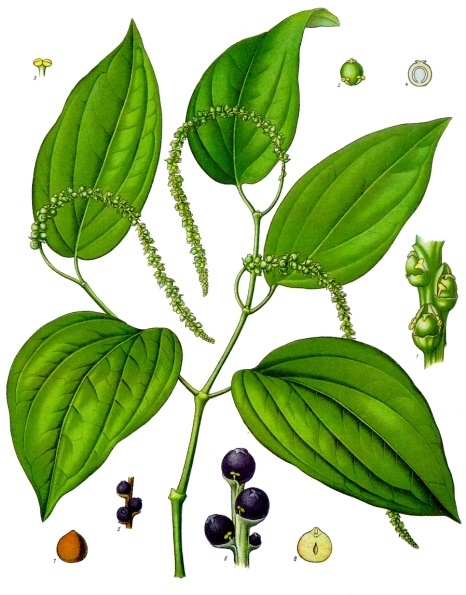
Photograph on Wikimedia Commons (Public domain).
Plant habit
Quick overview
A practical summary; details are in the sections below.
- Safety grade
- Generally recognised as safe details
- Scientific sources on the card
- Yes — sources are listed with claims Science section
- When and what to harvest
- Fruit — November–February
- Processing methods
Decoction, Culinary use, Powder
All methods and recipes on the card- Topics and symptoms
Common cold — overall comfort, Digestion
Topics section, Symptoms overview
Identification and mix-ups
Berries in dense cylinders by ripeness.
Possible mix-ups and risks
Other Piper species.
Similar herbs
No related herbs are linked yet.
Topics and symptoms
More topics are in the symptoms and topics overview.
- Common cold — overall comfortTraditional· Traditional / cultural framing
- DigestionTraditional· Traditional / cultural framing
Geographic occurrence
Myanmar
Common (expected wild occurrence in the region)
Brazil
Common (expected wild occurrence in the region)
Mexico
Common (expected wild occurrence in the region)
India
Common (expected wild occurrence in the region)
Indonesia
Common (expected wild occurrence in the region)
Thailand
Common (expected wild occurrence in the region)
Viet Nam
Common (expected wild occurrence in the region)
Harvest
- FruitNovember–February
zima
Region: IndiaNotes: Fruit spikes are picked when the first berries start to redden (November–February in Kerala). Black pepper is made by briefly blanching and drying whole unripe fruits, white pepper by removing the pericarp of ripe fruits, green pepper by fast drying or brining.
Storage
- Airtight storage(Fruit)
Whole corns keep 2–3 years in an airtight jar; ground pepper loses aroma within months — grind just before use.
- Light:
- Away from light and stove heat.
- Moisture:
- Moisture means mould and clumping; do not dip a steamy spoon straight into the jar.
Processing methods on this herb card
Longer simmering of plant material in water.
Full method description (from the catalogue)
A decoction is made by simmering plant material in water — often around 10–20 minutes depending on tradition and plant part. Denser parts (roots, bark, some seeds) are often prepared more reliably this way than with a short infusion.
Compared with an infusion it can extract more compounds, but also more tannins or bitterness; the flavour profile differs from a delicate tea. Combine this overview with the herb card for suitable plant part and contraindications.
Traditional context for this method: yes·Scientific context for this method: no
Cooking, baking, seasoning as food — general category without therapeutic claims.
Full method description (from the catalogue)
Culinary use covers herbs as ingredients in dishes, drinks, or spice mixes. This overview does not evaluate medicinal effects — only reminds you about species intent, allergies, and heat treatment where needed (e.g. some fruits or plant parts).
Combining with alcohol, sugar, or long cooking changes outcomes; verify culinary sources.
Traditional context for this method: yes·Scientific context for this method: no
Finely ground dried herb; dosing and solubility depend on species.
Full method description (from the catalogue)
Powder increases surface area for liquids or food. Home milling needs a clean grinder and control of fineness; very fine powder may clog tea filters.
Store airtight against moisture and pests.
Traditional context for this method: yes·Scientific context for this method: no
Traditional / spiritual use
Kept separate from science — entries are cultural or symbolic, not medical advice.
Black gold — pepper as currency
Symbolism
Historical mentionHerbal loreSymbolismPepper from the Malabar Coast was for centuries Europe's most valuable spice: Alaric, besieging Rome in 408, demanded among other things 3,000 pounds of pepper as ransom; in the Middle Ages rents were paid in pepper ('peppercorn rent'), and the phrase survives for something expensive. Pepper also opened the Portuguese sea route to India (1498). A historical record, not a claim about effect.
- Form:
- symbolické — platidlo, tribut, obětina
- Claim strength:
- Historical mention
- Source note:
- Zosimus, Historia Nova V, 41 (ransom of 408); history of the spice trade with India (Vasco da Gama, 1498).
Scientific notes
Each claim lists a study type and a source (URL or DOI) where available. Dose notes from the literature are informational only.
How to read evidence strength and study type labels
Labels summarise how the catalogue entry is tagged — they are not a medical verdict on efficacy. For every row, read the summary, limitations and source link.
Evidence strength
- Evidence level not specified
- The author did not grade the record; judge from the summary, limitations and source link.
- Narrative / orientational literature
- Descriptive or expert literature without controlled group comparison — context rather than proof of effect.
- Weak evidence
- Study or conclusion with major methodological limits; treat only as a pointer for further reading.
- Preliminary findings
- First or smaller studies — interesting direction, not the final word on efficacy or safety.
- Moderate strength of evidence
- Moderate strength by study design; sample and context limits still apply.
- Stronger evidence
- Stronger design or consistency of results within the study's stated limits.
- Review article
- A review summarises multiple sources; quality depends on review method and field.
Study type
- Narrative / expert text
- Expert text or overview without a classical study design.
- In vitro study
- Cell culture or test-tube experiment — does not show an effect in the body.
- Animal study
- Animal model — transfer to humans is not automatic.
- Observational study
- Observing groups without random treatment assignment; confounding is possible.
- Clinical trial
- Human clinical trial; sample size and control group matter.
- Randomised controlled trial
- Randomised controlled trials are among the stronger designs when well conducted.
- Review study
- A review aggregates multiple papers — quality depends on selection rules.
- Systematic review
- Systematic review with explicit search and selection methodology.
- Meta-analysis
- Statistical pooling of studies; outcome depends on input data and heterogeneity.
- Regulatory assessment / monograph (EMA, WHO…)
- Regulatory body summary for a herbal product — different context from a single RCT; often about products, not home tea.
- Expert monograph (herbal preparations)
- Structured literature summary for a plant or drug — quality depends on author and edition year.
The review summarises the pharmacology of piperine, the main pungent alkaloid of black pepper: in laboratory and small clinical studies it increases the bioavailability of other substances (curcumin among them) by inhibiting CYP3A4 and P-glycoprotein and shows anti-inflammatory and antioxidant actions.
Narrative / orientational literatureReview studyYear: 2020Limitations: Narrative review; most data come from isolated piperine in vitro and in animals, not from pepper in food. The effect on drug absorption is also a safety issue.
Phytotherapy Research
Piperine: A review of its biological effects
DOI: 10.1002/ptr.6855
Images
The main photo is in the card header. More images will appear here when available.
Safety
What the warning types mean
The type on each warning helps group themes — it does not replace the separate severity badge.
- Internal use
- Risks from swallowing, extracts, duration of use or concentration for internal use.
- Interactions / medicines
- Possible effect on medicines or concurrent treatment — check sources and a professional.
- Raw plant parts
- Raw, unripe or poorly prepared plant parts can be dangerous.
- Toxins and regulation
- Toxic constituents or regulated compounds (e.g. in distillates).
- Contact with the plant
- Skin or mucosa irritation from contact with fresh plant or sap.
- Allergy
- Allergic reactions, often linked to family sensitisation.
- Harvesting and contamination
- Contamination, species mix-ups or harvesting from unsuitable places.
- Piperine and drug absorptionLow severityInteractions / medicines
Piperine inhibits the CYP3A4 enzyme and the P-glycoprotein transporter, so in studies it raised levels of some drugs (for example phenytoin, propranolol, theophylline). Kitchen amounts are fine; concentrated piperine supplements are not for people on narrow-therapeutic-range medication.