Aspalathus linearis
Rooibos
Generally recognised as safeOther names: Rooibos tea, Red bush tea
A South African legume shrub with needle-like leaves; the source of the red tea.
A fine-leaved shrub with flexible branches growing in the Cederberg region; harvest and fermentation of leaves and fine twigs produce a tannin-mild, caffeine-free red infusion.
- Family
- Fabaceae
- Plant type
- Shrub
What the safety levels mean (expand legend)
- Generally recognised as safe. Often a common herb with reasonable harvest and use; still read the specific warnings on the card.
- Information. Primarily informational — details in the text and warnings below matter most.
- Caution. Needs extra care (dose, duration, sensitive groups, interactions).
- Risky. Significant risks — verify sources, contraindications and professional guidance.
- Not for home experimentation. Not suitable to experiment with at home without knowledge and certainty.
- High risk for internal use. Particular risk with internal use (e.g. alkaloids); avoid prolonged or irresponsible dosing.
- Not specified. Level not filled in yet — rely on individual warnings and links below.
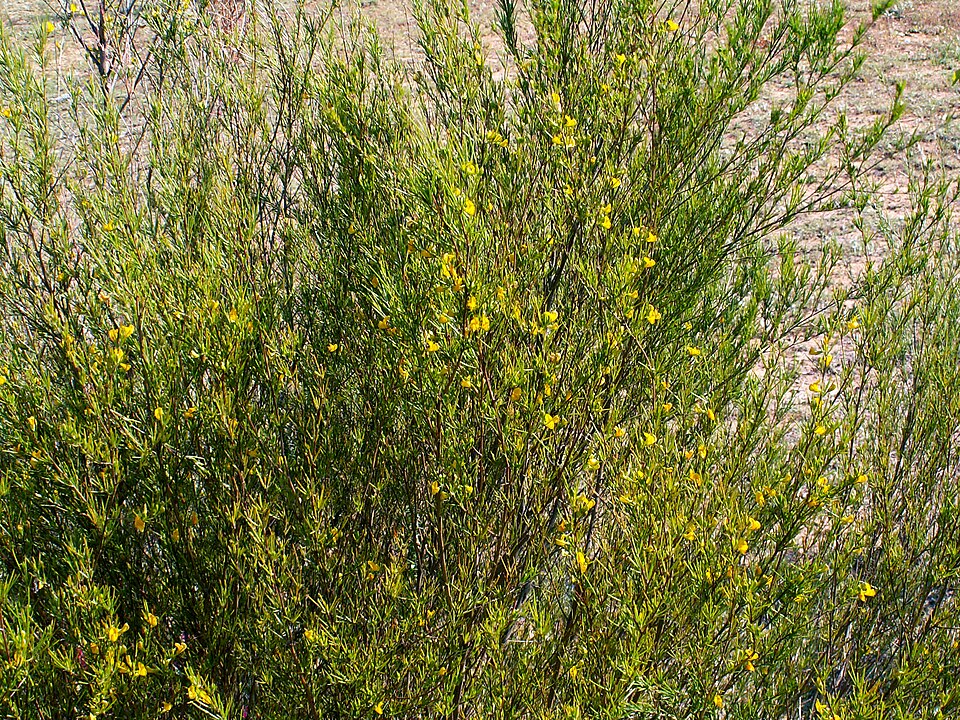
Photograph on Wikimedia Commons (CC BY-SA 2.5).
Plant habit
Quick overview
A practical summary; details are in the sections below.
- Safety grade
- Generally recognised as safe details
- Scientific sources on the card
- Yes — sources are listed with claims Science section
- When and what to harvest
- Leaf — January–April
- Processing methods
Herbal infusion (tea), Fermentation, Culinary use
All methods and recipes on the card- Topics and symptoms
Anxiety & inner restlessness, Circulation comfort (folk), Digestion…
Topics section, Symptoms overview
Identification and mix-ups
Erect to spreading shrub in Fabaceae reaching about 2 m; young branchlets are often reddish. Leaves green, needle-like to linear, 15–60 mm long and around 1 mm wide, sessile, without stipules, often densely clustered. Flowers yellow, solitary or in dense terminal clusters, blooming in spring and early summer. Fruit a small lance-shaped pod with 1–2 hard seeds.
Possible mix-ups and risks
Aspalathus is a large, taxonomically difficult genus, and rooibos itself has many wild ecotypes, yet no clear toxic lookalike is documented. Confusion concerns within-genus forms rather than poisonous plants.
Similar herbs
- Honeybush
Rooibos and honeybush are drunk the same way and often blended. Rooibos has needle-like leaves and a sharper, slightly 'woodland' taste, honeybush broader leaves and a honey scent. Both are caffeine-free.
Topics and symptoms
More topics are in the symptoms and topics overview.
- Anxiety & inner restlessnessTraditional· Traditional / cultural framing
- Circulation comfort (folk)Scientific· Preliminary or weaker scientific findings
- DigestionTraditional· Traditional / cultural framing
- Fear at bedtimeTraditional· Traditional / cultural framing
- IrritabilityTraditional· Traditional / cultural framing
- TopicTraditional· Traditional / cultural framing
- TopicTraditional· Traditional / cultural framing
Sources
Identification
Confusion risk
Geographic occurrence
South Africa
Common (expected wild occurrence in the region)
Harvest
- LeafJanuary–April
summer
Region: South AfricaNotes: Young shoots and fine twigs; fermented and dried after cutting.
Storage
- Airtight storage(Leaf)
Fermented (red) rooibos keeps 2 years in an airtight jar; green unfermented rooibos up to a year before it loses its grassy freshness.
- Light:
- Out of light.
- Moisture:
- Protect from moisture and smells — the fine cut needles absorb aromas.
Processing methods on this herb card
Infusion or brief extraction in hot water; usually without long boiling.
Full method description (from the catalogue)
Here, herbal tea is prepared as an infusion: pour freshly boiling water over dried herbs or a herbal blend and steep for at least 5 minutes. BfR gives this as a hygiene rule, not a medicinal dose. Follow the specific product instructions, including a longer steeping time when stated. This rule for herbal infusions is not a general preparation guide for true tea (Camellia sinensis). Temperature, steep time, and the herb-to-water ratio change both flavour and what dissolves into the liquid.
Compared with a decoction, heat exposure is shorter and gentler; tender leaves and flowers are often better as an infusion than with prolonged simmering. For each herb, always follow the plant card for suitable plant part, preparation, and safety notes — general rules never replace species-level judgement.
Traditional context for this method: yes·Scientific context for this method: yes
Microbial processing (fermentation) of plant material for drinks or foods.
Full method description (from the catalogue)
Fermentation changes sugars, flavour, and microbial composition (e.g. herbal ferments, oxymels combining honey and vinegar per tradition). Hygiene, temperature, and time are critical for a safe outcome.
Home ferments should not smell "rotten"; when in doubt, discard.
Traditional context for this method: yes·Scientific context for this method: no
Rooibos 'fermentation' is enzymatic oxidation, not a microbial ferment: the cut and bruised shoots are wetted, heaped for 12–14 hours in the sun, turn red and take on a sweet scent, then are spread out to dry. It is done on the Cederberg farms; there is no point doing it at home.
Cooking, baking, seasoning as food — general category without therapeutic claims.
Full method description (from the catalogue)
Culinary use covers herbs as ingredients in dishes, drinks, or spice mixes. This overview does not evaluate medicinal effects — only reminds you about species intent, allergies, and heat treatment where needed (e.g. some fruits or plant parts).
Combining with alcohol, sugar, or long cooking changes outcomes; verify culinary sources.
Traditional context for this method: no·Scientific context for this method: no
Traditional / spiritual use
Kept separate from science — entries are cultural or symbolic, not medical advice.
Tea from the Cederberg mountains — from the Khoisan to a tin in every kitchen
General
Traditional useFolk useHerbal loreThe first people of the Cederberg, the Khoi and San, cut rooibos shoots with stone axes, pounded them, let them heat in heaps and dried them in the sun — the same process is used today. Dutch settlers adopted the tea as a substitute for costly black tea; Benjamin Ginsberg made it a commercial product from 1904, and in the 20th century rooibos became South Africa's 'national drink', given even to infants against colic. A record of tradition; the last claim has no clinical backing.
- Form:
- Khoisan mountain tea, farmers' drink of the Cederberg
- Claim strength:
- Tradition
- Source note:
- Joubert E, de Beer D (2011), S Afr J Bot 77:869–886 (historical introduction); SANBI PlantZAfrica — Aspalathus linearis.
Scientific notes
Each claim lists a study type and a source (URL or DOI) where available. Dose notes from the literature are informational only.
How to read evidence strength and study type labels
Labels summarise how the catalogue entry is tagged — they are not a medical verdict on efficacy. For every row, read the summary, limitations and source link.
Evidence strength
- Evidence level not specified
- The author did not grade the record; judge from the summary, limitations and source link.
- Narrative / orientational literature
- Descriptive or expert literature without controlled group comparison — context rather than proof of effect.
- Weak evidence
- Study or conclusion with major methodological limits; treat only as a pointer for further reading.
- Preliminary findings
- First or smaller studies — interesting direction, not the final word on efficacy or safety.
- Moderate strength of evidence
- Moderate strength by study design; sample and context limits still apply.
- Stronger evidence
- Stronger design or consistency of results within the study's stated limits.
- Review article
- A review summarises multiple sources; quality depends on review method and field.
Study type
- Narrative / expert text
- Expert text or overview without a classical study design.
- In vitro study
- Cell culture or test-tube experiment — does not show an effect in the body.
- Animal study
- Animal model — transfer to humans is not automatic.
- Observational study
- Observing groups without random treatment assignment; confounding is possible.
- Clinical trial
- Human clinical trial; sample size and control group matter.
- Randomised controlled trial
- Randomised controlled trials are among the stronger designs when well conducted.
- Review study
- A review aggregates multiple papers — quality depends on selection rules.
- Systematic review
- Systematic review with explicit search and selection methodology.
- Meta-analysis
- Statistical pooling of studies; outcome depends on input data and heterogeneity.
- Regulatory assessment / monograph (EMA, WHO…)
- Regulatory body summary for a herbal product — different context from a single RCT; often about products, not home tea.
- Expert monograph (herbal preparations)
- Structured literature summary for a plant or drug — quality depends on author and edition year.
The review summarises the history, processing and composition of rooibos (aspalathin, nothofagin, orientin, no caffeine, low tannins) and laboratory and animal studies of antioxidant, antidiabetic and cardioprotective activity; human studies are few.
Narrative / orientational literatureReview studyYear: 2011Limitations: Mostly preclinical data; authors from a South African research institute tied to the industry.
Joubert E, de Beer D — South African Journal of Botany
Rooibos (Aspalathus linearis) beyond the farm gate: From herbal tea to potential phytopharmaceutical
In 40 adults with cardiovascular risk factors, 6 cups of fermented rooibos daily for 6 weeks lowered LDL cholesterol and triglycerides, raised HDL and improved markers of lipid oxidation compared with the control period.
Preliminary findingsClinical trialYear: 2011Limitations: Small unblinded crossover study, 6 weeks; hard outcomes not followed.
Marnewick JL, Rautenbach F, Venter I, Neethling H, Blackhurst DM, Wolmarans P, Macharia M — Journal of Ethnopharmacology
Images
The main photo is in the card header. More images will appear here when available.
Safety
What the warning types mean
The type on each warning helps group themes — it does not replace the separate severity badge.
- Internal use
- Risks from swallowing, extracts, duration of use or concentration for internal use.
- Interactions / medicines
- Possible effect on medicines or concurrent treatment — check sources and a professional.
- Raw plant parts
- Raw, unripe or poorly prepared plant parts can be dangerous.
- Toxins and regulation
- Toxic constituents or regulated compounds (e.g. in distillates).
- Contact with the plant
- Skin or mucosa irritation from contact with fresh plant or sap.
- Allergy
- Allergic reactions, often linked to family sensitisation.
- Harvesting and contamination
- Contamination, species mix-ups or harvesting from unsuitable places.
- An isolated case report of liver injuryLow severityliver
Sinisalo et al. 2010 described a single case of hepatotoxicity in a person drinking large amounts of rooibos daily; liver tests normalised after stopping. It is the only known case and causality is uncertain. With liver disease and new symptoms (jaundice, dark urine) stop the tea and talk to a doctor.