Alpinia zerumbet
Shell ginger
Generally recognised as safeOther names: Pink porcelain lily, Alpinia speciosa
A tall tropical ginger-family herb with striking shell-like flowers.
A tall perennial with a robust rhizome and drooping clusters of white flowers with a yellow-and-pink lip (hence 'shell ginger'); the leaves carry a citrus aroma and are used in Japan and Taiwan to wrap sweets.
- Family
- Zingiberaceae
- Plant type
- Rhizomatous perennial
What the safety levels mean (expand legend)
- Generally recognised as safe. Often a common herb with reasonable harvest and use; still read the specific warnings on the card.
- Information. Primarily informational — details in the text and warnings below matter most.
- Caution. Needs extra care (dose, duration, sensitive groups, interactions).
- Risky. Significant risks — verify sources, contraindications and professional guidance.
- Not for home experimentation. Not suitable to experiment with at home without knowledge and certainty.
- High risk for internal use. Particular risk with internal use (e.g. alkaloids); avoid prolonged or irresponsible dosing.
- Not specified. Level not filled in yet — rely on individual warnings and links below.
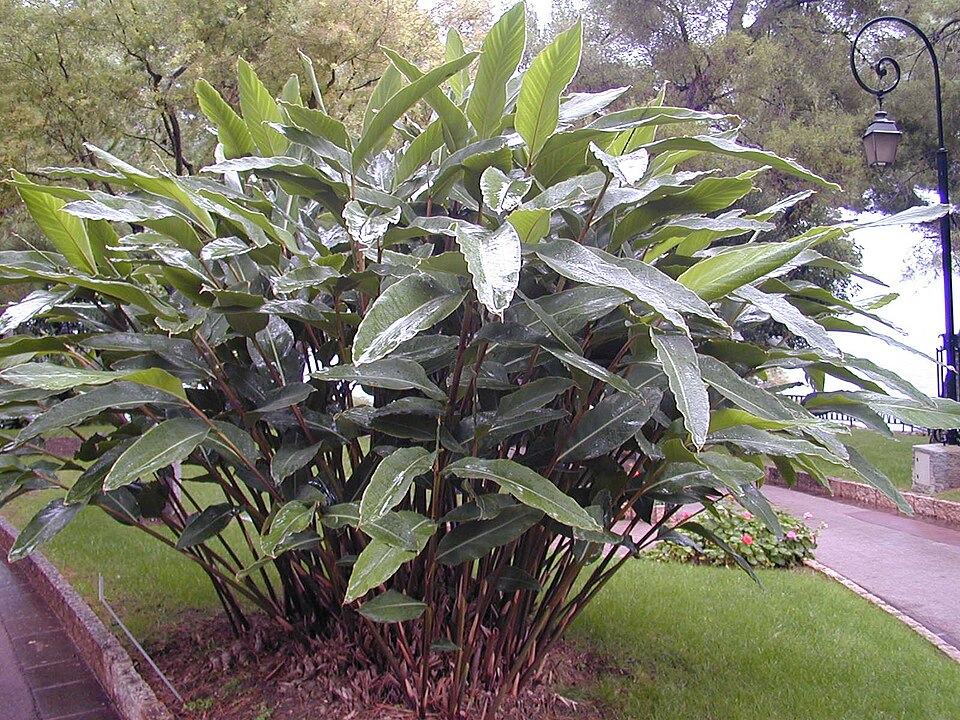
Photograph on Wikimedia Commons (CC BY-SA 3.0).
Plant habit
Quick overview
A practical summary; details are in the sections below.
- Safety grade
- Generally recognised as safe details
- Scientific sources on the card
- Yes — sources are listed with claims Science section
- When and what to harvest
- Leaf — January–December
- Processing methods
Culinary use, Herbal infusion (tea), Essential oil
All methods and recipes on the card- Topics and symptoms
Bloating & gas, Circulation comfort (folk), Digestion…
Topics section, Symptoms overview
Identification and mix-ups
Large clumping evergreen perennial in Zingiberaceae with leafy canes to 2.5–3 m (variegated cultivar shorter). Leaves lance-shaped, glossy dark green, to 60 cm, parallel-veined, ginger-scented when crushed. The flowers are diagnostic: waxy white/pink shell-like buds (resembling seashells) with a red-and-yellow-marked throat, in drooping terminal clusters at the ends of LEAFY stems (not arising directly from the rhizome).
Possible mix-ups and risks
It was historically called Alpinia speciosa, but that name was also applied to torch ginger; the name A. speciosa is no longer accepted (torch ginger moved to the genus Etlingera elatior). It differs from torch ginger and Hedychium lilies in its pendent inflorescences on leafy stems (versus erect spikes directly from the rhizome). It is not toxic.
Similar herbs
- Fingerroot
Shell ginger and fingerroot are both in the ginger family, but shell ginger is grown for its large aromatic leaves and shell-like flowers, fingerroot for its bundles of rhizomes. Shell ginger rhizome is no substitute for galangal (Alpinia galanga) — the taste differs.
Topics and symptoms
More topics are in the symptoms and topics overview.
- Bloating & gasTraditional· Traditional / cultural framing
- Circulation comfort (folk)Traditional· Traditional / cultural framing
- DigestionTraditional· Traditional / cultural framing
- Joy & celebration ritualsSpiritual· Traditional / cultural framing
- Nausea & queasy stomachTraditional· Traditional / cultural framing
Sources
Geographic occurrence
Viet Nam
Common (expected wild occurrence in the region)
Harvest
- LeafJanuary–December
year-round
Region: Viet NamNotes: Fresh fragrant leaves; traditionally used to wrap sweets.
Storage
- Drying(Leaf)
Dried leaves (getto tea) keep a year in an airtight jar; fresh leaves for wrapping food a week in the fridge. Fresh rhizome 2 weeks.
- Light:
- Out of light.
- Moisture:
- The large leaves dry slowly — cut up and dry through.
Processing methods on this herb card
Cooking, baking, seasoning as food — general category without therapeutic claims.
Full method description (from the catalogue)
Culinary use covers herbs as ingredients in dishes, drinks, or spice mixes. This overview does not evaluate medicinal effects — only reminds you about species intent, allergies, and heat treatment where needed (e.g. some fruits or plant parts).
Combining with alcohol, sugar, or long cooking changes outcomes; verify culinary sources.
Traditional context for this method: yes·Scientific context for this method: no
Infusion or brief extraction in hot water; usually without long boiling.
Full method description (from the catalogue)
Here, herbal tea is prepared as an infusion: pour freshly boiling water over dried herbs or a herbal blend and steep for at least 5 minutes. BfR gives this as a hygiene rule, not a medicinal dose. Follow the specific product instructions, including a longer steeping time when stated. This rule for herbal infusions is not a general preparation guide for true tea (Camellia sinensis). Temperature, steep time, and the herb-to-water ratio change both flavour and what dissolves into the liquid.
Compared with a decoction, heat exposure is shorter and gentler; tender leaves and flowers are often better as an infusion than with prolonged simmering. For each herb, always follow the plant card for suitable plant part, preparation, and safety notes — general rules never replace species-level judgement.
Traditional context for this method: yes·Scientific context for this method: no
A concentrated aromatic plant product; use depends on the specific product.
Full method description (from the catalogue)
Essential oil is a concentrated plant product obtained, for example, by steam distillation or pressing. A general drop count or dilution ratio does not establish safe use.
Choose a finished product intended for your purpose and follow its directions. Do not apply it to skin or swallow it unless the manufacturer explicitly allows that use. This overview is not a recipe for home dilution.
Traditional context for this method: no·Scientific context for this method: no
The leaf oil is distilled industrially on Okinawa for cosmetics (getto). Dilute on the skin; do not take internally.
Traditional / spiritual use
Kept separate from science — entries are cultural or symbolic, not medical advice.
Leaves that wrap a wish for health
General
Traditional useFolk useHerbal loreRitualOn Okinawa, on the coldest day of the year, the 12th day of the 12th lunar month, muchi are made — mochi wrapped in shell ginger (sannin) leaves. They are given to children, one for each year of age, hung from the beams and meant to drive off evil spirits and illness; legend has it a sister bound her demon brother this way. In Brazil the same plant is called colonia and folk medicine gives a leaf decoction 'for the blood pressure'. A record of ritual and tradition.
- Form:
- muchi: festive mochi wrapped in leaves for children's health; colônia in Brazilian folk medicine
- Claim strength:
- Tradition
- Source note:
- Teschke R, Xuan TD (2018), Nutrients 10:166 (Okinawan tradition); the Okinawan muchi festival; Brazilian folk medicine (colonia).
Scientific notes
Each claim lists a study type and a source (URL or DOI) where available. Dose notes from the literature are informational only.
How to read evidence strength and study type labels
Labels summarise how the catalogue entry is tagged — they are not a medical verdict on efficacy. For every row, read the summary, limitations and source link.
Evidence strength
- Evidence level not specified
- The author did not grade the record; judge from the summary, limitations and source link.
- Narrative / orientational literature
- Descriptive or expert literature without controlled group comparison — context rather than proof of effect.
- Weak evidence
- Study or conclusion with major methodological limits; treat only as a pointer for further reading.
- Preliminary findings
- First or smaller studies — interesting direction, not the final word on efficacy or safety.
- Moderate strength of evidence
- Moderate strength by study design; sample and context limits still apply.
- Stronger evidence
- Stronger design or consistency of results within the study's stated limits.
- Review article
- A review summarises multiple sources; quality depends on review method and field.
Study type
- Narrative / expert text
- Expert text or overview without a classical study design.
- In vitro study
- Cell culture or test-tube experiment — does not show an effect in the body.
- Animal study
- Animal model — transfer to humans is not automatic.
- Observational study
- Observing groups without random treatment assignment; confounding is possible.
- Clinical trial
- Human clinical trial; sample size and control group matter.
- Randomised controlled trial
- Randomised controlled trials are among the stronger designs when well conducted.
- Review study
- A review aggregates multiple papers — quality depends on selection rules.
- Systematic review
- Systematic review with explicit search and selection methodology.
- Meta-analysis
- Statistical pooling of studies; outcome depends on input data and heterogeneity.
- Regulatory assessment / monograph (EMA, WHO…)
- Regulatory body summary for a herbal product — different context from a single RCT; often about products, not home tea.
- Expert monograph (herbal preparations)
- Structured literature summary for a plant or drug — quality depends on author and edition year.
The viewpoint article summarises the composition of shell ginger (dihydro-5,6-dehydrokawain, 5,6-dehydrokawain, essential oil, phenolic acids), its culinary use on Okinawa and animal data on antioxidant and anti-obesity activity and lifespan extension in model organisms; the authors themselves call the link to human longevity a hypothesis.
Narrative / orientational literatureReview studyYear: 2018Limitations: An opinion article; no human studies; one author has a personal connection to the plant, as stated.
Teschke R, Xuan TD — Nutrients
DOI: 10.3390/nu10020166
Images
The main photo is in the card header. More images will appear here when available.
Safety
What the warning types mean
The type on each warning helps group themes — it does not replace the separate severity badge.
- Internal use
- Risks from swallowing, extracts, duration of use or concentration for internal use.
- Interactions / medicines
- Possible effect on medicines or concurrent treatment — check sources and a professional.
- Raw plant parts
- Raw, unripe or poorly prepared plant parts can be dangerous.
- Toxins and regulation
- Toxic constituents or regulated compounds (e.g. in distillates).
- Contact with the plant
- Skin or mucosa irritation from contact with fresh plant or sap.
- Allergy
- Allergic reactions, often linked to family sensitisation.
- Harvesting and contamination
- Contamination, species mix-ups or harvesting from unsuitable places.
No structured safety records yet.