Annona muricata
Soursop
CautionOther names: Soursop
A tropical tree with large spiny fruits and creamy white flesh.
A small tropical tree with glossy leaves and large green, spiny-knobbed fruits; the white juicy flesh has a sweet-tart flavor used in drinks and desserts.
- Family
- Annonaceae
- Plant type
- Small tree
What the safety levels mean (expand legend)
- Generally recognised as safe. Often a common herb with reasonable harvest and use; still read the specific warnings on the card.
- Information. Primarily informational — details in the text and warnings below matter most.
- Caution. Needs extra care (dose, duration, sensitive groups, interactions).
- Risky. Significant risks — verify sources, contraindications and professional guidance.
- Not for home experimentation. Not suitable to experiment with at home without knowledge and certainty.
- High risk for internal use. Particular risk with internal use (e.g. alkaloids); avoid prolonged or irresponsible dosing.
- Not specified. Level not filled in yet — rely on individual warnings and links below.
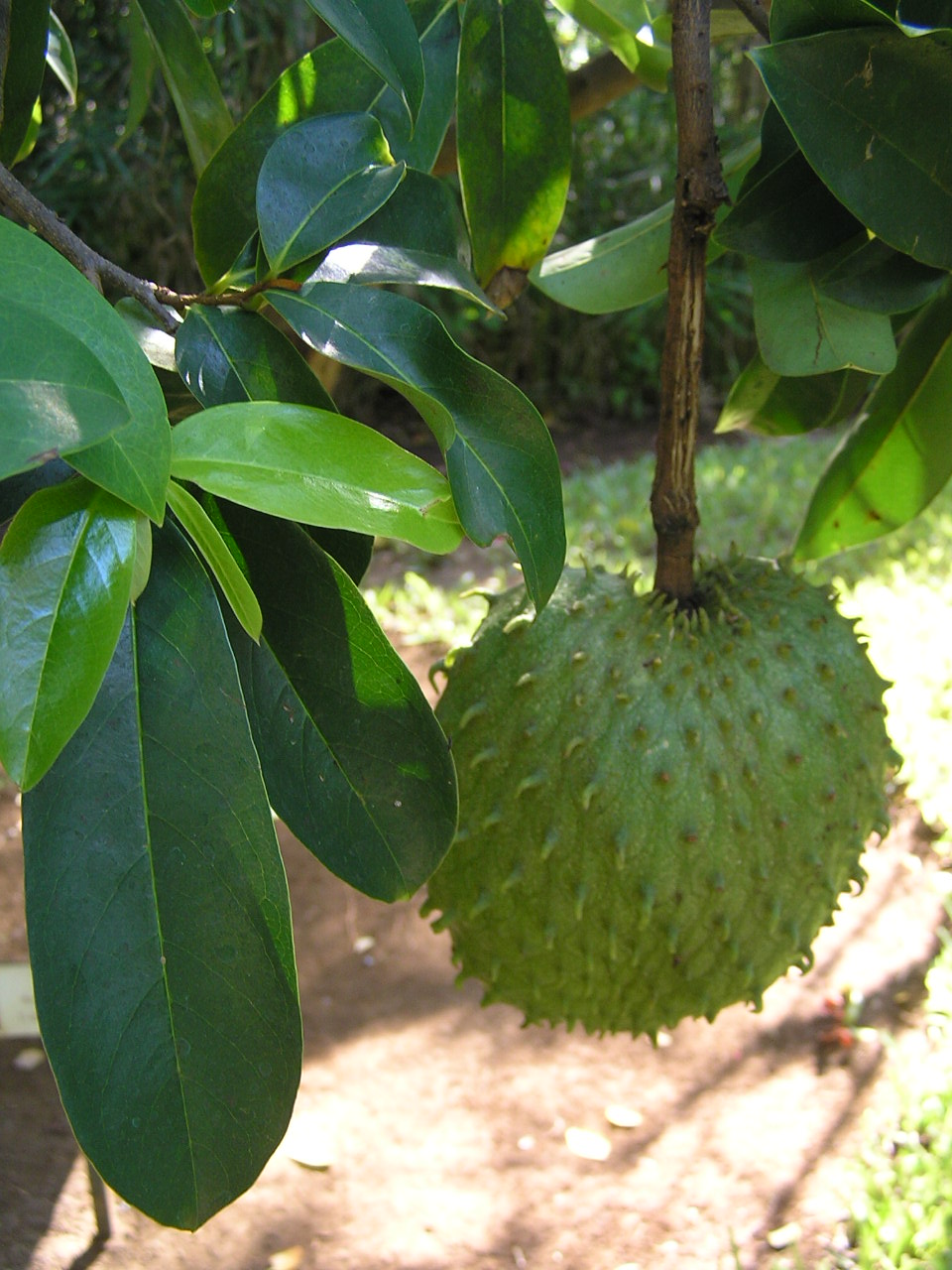
Photograph on Wikimedia Commons (CC BY 2.0).
Plant habit
Safety — read before use
For this herb it is important to check warnings, mix-ups and cautions. Start with the Safety section.
Quick overview
A practical summary; details are in the sections below.
- Safety grade
- Caution details
- Scientific sources on the card
- Yes — sources are listed with claims Science section
- When and what to harvest
- Fruit — January–December
- Processing methods
Culinary use, Herbal infusion (tea)
All methods and recipes on the card- Topics and symptoms
Fatigue and low energy, Immunity - informational context
Topics section, Symptoms overview
Identification and mix-ups
Small evergreen tree in Annonaceae about 5–8 m tall. Leaves alternate, simple, oblong-obovate, 8–16 cm, glossy dark green above, paler below. Flowers solitary, fleshy, with three thick yellowish-green outer and three dull-yellow inner petals. Fruit a large ovoid syncarp (10–35 cm), green, covered in soft fleshy spines, with white fibrous aromatic pulp.
Possible mix-ups and risks
Confused with mountain soursop (Annona montana), which has a more spreading crown, glossier leaves and smaller, rounder fruit with denser spines and sour, unpalatable pulp. Caution: both species contain neurotoxic acetogenins (annonacin), linked to atypical parkinsonism; A. montana generally has higher acetogenin content. Exact toxicity comparison for A. montana is less firmly documented.
Similar herbs
No related herbs are linked yet.
Topics and symptoms
More topics are in the symptoms and topics overview.
- Fatigue and low energyTraditional· Traditional / cultural framing
- Immunity - informational contextTraditional· Traditional / cultural framing
Sources
Geographic occurrence
Mexico
Occasional (garden, cultivation, or fringe of the range)
Harvest
- FruitJanuary–December
year-round
Region: MexicoNotes: Fruits just before full ripeness, when they start to soften.
Storage
- Refrigeration(Fruit)
A ripe fruit keeps 2–3 days in the fridge; seedless pulp frozen for 6 months.
- Safety:
- Seeds and leaves are neither eaten nor brewed — they carry the most acetogenins.
Processing methods on this herb card
Cooking, baking, seasoning as food — general category without therapeutic claims.
Full method description (from the catalogue)
Culinary use covers herbs as ingredients in dishes, drinks, or spice mixes. This overview does not evaluate medicinal effects — only reminds you about species intent, allergies, and heat treatment where needed (e.g. some fruits or plant parts).
Combining with alcohol, sugar, or long cooking changes outcomes; verify culinary sources.
Traditional context for this method: yes·Scientific context for this method: no
An occasional portion of pulp is ordinary tropical fruit; daily consumption, leaf teas and 'graviola' supplements carry the acetogenin risk (see Safety).
Infusion or brief extraction in hot water; usually without long boiling.
Full method description (from the catalogue)
Here, herbal tea is prepared as an infusion: pour freshly boiling water over dried herbs or a herbal blend and steep for at least 5 minutes. BfR gives this as a hygiene rule, not a medicinal dose. Follow the specific product instructions, including a longer steeping time when stated. This rule for herbal infusions is not a general preparation guide for true tea (Camellia sinensis). Temperature, steep time, and the herb-to-water ratio change both flavour and what dissolves into the liquid.
Compared with a decoction, heat exposure is shorter and gentler; tender leaves and flowers are often better as an infusion than with prolonged simmering. For each herb, always follow the plant card for suitable plant part, preparation, and safety notes — general rules never replace species-level judgement.
Traditional context for this method: yes·Scientific context for this method: no
The catalogue does not recommend soursop leaf tea — the leaves have the highest annonacin content.
Traditional / spiritual use
Kept separate from science — entries are cultural or symbolic, not medical advice.
Corossol — the sleep tea that became a neurological puzzle
General
Traditional useFolk remediesFolk useIn the Caribbean an evening tea 'for sleep and nerves' was brewed from soursop (corossol) leaves for generations, and the fruit is among the best-loved market fruits from Mexico to Brazil. That very tradition led neurologists in Guadeloupe in the 1990s to discover that regular consumers unusually often develop atypical parkinsonism — a tradition that became a warning. A record of folk use; risks under Safety.
- Form:
- Caribbean leaf tea "for sleep", fruit of the marketplace
- Claim strength:
- Tradition
- Source note:
- Caribbean (Guadeloupean, Jamaican) folk tradition; Caparros-Lefebvre & Elbaz 1999, The Lancet.
Scientific notes
Each claim lists a study type and a source (URL or DOI) where available. Dose notes from the literature are informational only.
How to read evidence strength and study type labels
Labels summarise how the catalogue entry is tagged — they are not a medical verdict on efficacy. For every row, read the summary, limitations and source link.
Evidence strength
- Evidence level not specified
- The author did not grade the record; judge from the summary, limitations and source link.
- Narrative / orientational literature
- Descriptive or expert literature without controlled group comparison — context rather than proof of effect.
- Weak evidence
- Study or conclusion with major methodological limits; treat only as a pointer for further reading.
- Preliminary findings
- First or smaller studies — interesting direction, not the final word on efficacy or safety.
- Moderate strength of evidence
- Moderate strength by study design; sample and context limits still apply.
- Stronger evidence
- Stronger design or consistency of results within the study's stated limits.
- Review article
- A review summarises multiple sources; quality depends on review method and field.
Study type
- Narrative / expert text
- Expert text or overview without a classical study design.
- In vitro study
- Cell culture or test-tube experiment — does not show an effect in the body.
- Animal study
- Animal model — transfer to humans is not automatic.
- Observational study
- Observing groups without random treatment assignment; confounding is possible.
- Clinical trial
- Human clinical trial; sample size and control group matter.
- Randomised controlled trial
- Randomised controlled trials are among the stronger designs when well conducted.
- Review study
- A review aggregates multiple papers — quality depends on selection rules.
- Systematic review
- Systematic review with explicit search and selection methodology.
- Meta-analysis
- Statistical pooling of studies; outcome depends on input data and heterogeneity.
- Regulatory assessment / monograph (EMA, WHO…)
- Regulatory body summary for a herbal product — different context from a single RCT; often about products, not home tea.
- Expert monograph (herbal preparations)
- Structured literature summary for a plant or drug — quality depends on author and edition year.
The review summarises epidemiological, clinical and laboratory evidence that atypical parkinsonism in Guadeloupe relates to long-term consumption of Annona plants, soursop above all: annonacin, a mitochondrial complex I inhibitor, accumulates in the brain and in animals causes neuronal degeneration resembling that seen in patients.
Narrative / orientational literatureReview studyYear: 2008Limitations: Causation in humans is probable, not definitively proven; the dose and duration of exposure needed for disease are unknown. This is evidence of risk, not benefit.
Lannuzel A, Ruberg M, Michel PP — Movement Disorders
DOI: 10.1002/mds.22300
Images
The main photo is in the card header. More images will appear here when available.
Safety
What the warning types mean
The type on each warning helps group themes — it does not replace the separate severity badge.
- Internal use
- Risks from swallowing, extracts, duration of use or concentration for internal use.
- Interactions / medicines
- Possible effect on medicines or concurrent treatment — check sources and a professional.
- Raw plant parts
- Raw, unripe or poorly prepared plant parts can be dangerous.
- Toxins and regulation
- Toxic constituents or regulated compounds (e.g. in distillates).
- Contact with the plant
- Skin or mucosa irritation from contact with fresh plant or sap.
- Allergy
- Allergic reactions, often linked to family sensitisation.
- Harvesting and contamination
- Contamination, species mix-ups or harvesting from unsuitable places.
- Annonacin and atypical parkinsonismHigh severityToxins and regulation
In Guadeloupe regular consumption of soursop — fruit and leaf teas alike — was associated with an atypical parkinsonism that does not respond to levodopa (Caparros-Lefebvre & Elbaz 1999, The Lancet); the plant's annonacin destroys dopamine neurons in animals. Skip leaves, seeds and 'graviola' supplements entirely, and eat the fruit only occasionally.
- Not a cancer cureHigh severityInternal use
Claims about 'graviola against cancer' come from cell cultures; no human clinical trial has shown efficacy, whereas the neurotoxicity of acetogenins is documented (Champy et al. 2005 measured about 15 mg of annonacin in a single fruit). Anyone replacing oncology treatment with leaf tea takes a double risk.