Tamarindus indica
Tamarind
Generally recognised as safeA tropical tree whose pods hold a sweet-tangy brown pulp.
A large tropical tree with pinnate leaves and yellowish red-veined flowers; the long pods ripen into a sticky sweet-sour pulp that anchors sauces, marinades, and drinks from India to South-East Asia.
- Family
- Fabaceae
- Plant type
- Tropical tree
What the safety levels mean (expand legend)
- Generally recognised as safe. Often a common herb with reasonable harvest and use; still read the specific warnings on the card.
- Information. Primarily informational — details in the text and warnings below matter most.
- Caution. Needs extra care (dose, duration, sensitive groups, interactions).
- Risky. Significant risks — verify sources, contraindications and professional guidance.
- Not for home experimentation. Not suitable to experiment with at home without knowledge and certainty.
- High risk for internal use. Particular risk with internal use (e.g. alkaloids); avoid prolonged or irresponsible dosing.
- Not specified. Level not filled in yet — rely on individual warnings and links below.
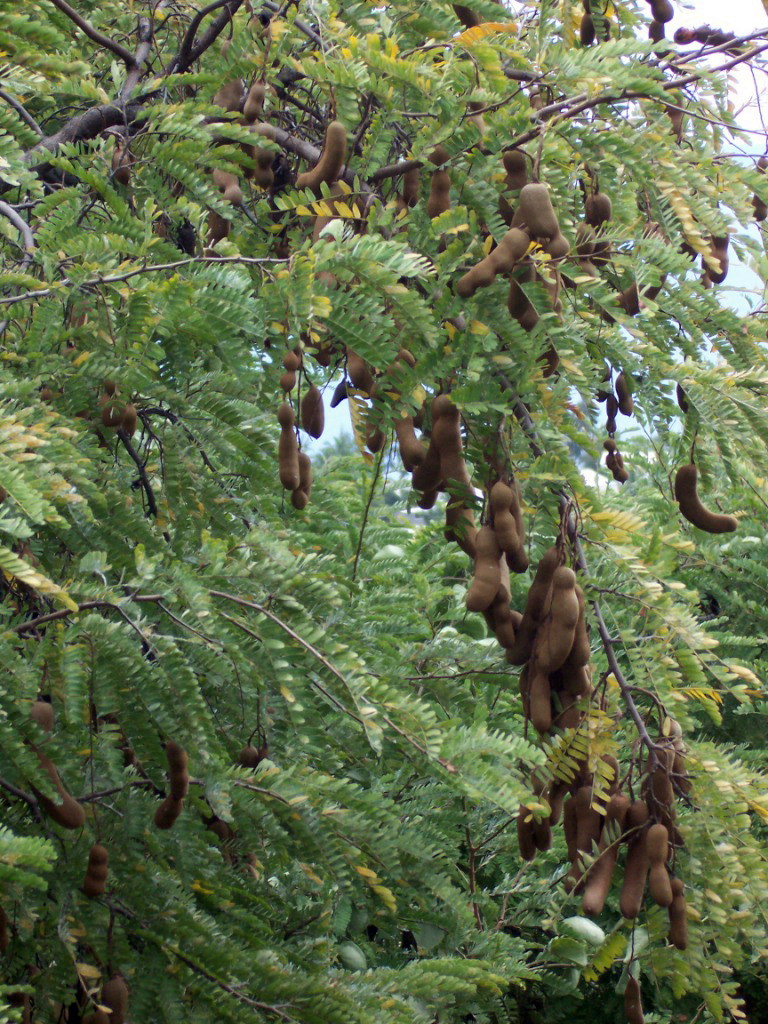
Photograph on Wikimedia Commons (CC BY 2.5).
Plant habit
Quick overview
A practical summary; details are in the sections below.
- Safety grade
- Generally recognised as safe details
- Scientific sources on the card
- Yes — sources are listed with claims Science section
- When and what to harvest
- Fruit — February–April
- Processing methods
Culinary use, Syrup and more
All methods and recipes on the card- Topics and symptoms
Constipation, Digestion, Feverish feeling and chills
Topics section, Symptoms overview
Identification and mix-ups
Long-lived evergreen tree in Fabaceae reaching 25–30 m, with a dense vase-shaped crown and rough grey checkered bark. Leaves alternate, even-pinnate, with 10–18 pairs of small (1.2–3.2 cm) light-green leaflets that fold at night. Flowers about 2.5 cm, five-petalled, yellow with red-orange streaks, in short racemes (buds pink). Fruit an indehiscent brown hard-shelled curved pod (12–18 cm) with sticky acidic brown pulp and flattened glossy brown seeds.
Possible mix-ups and risks
It is most often confused with Manila tamarind (Pithecellobium dulce), also a leguminous and edible (non-toxic) tree. That species differs clearly in its thorny branches, bipinnate leaves with a single leaflet pair, and short dehiscent pods that split open to expose a white edible aril around a flat glossy black seed (versus the long indehiscent pod with brown pulp of true tamarind).
Similar herbs
No related herbs are linked yet.
Topics and symptoms
More topics are in the symptoms and topics overview.
- ConstipationTraditional· Traditional / cultural framing
- DigestionTraditional· Traditional / cultural framing
- Feverish feeling and chillsTraditional· Traditional / cultural framing
Sources
Identification
Confusion risk
Geographic occurrence
Thailand
Common (expected wild occurrence in the region)
Harvest
- FruitFebruary–April
spring
Region: ThailandNotes: Ripe pods with a brittle brown shell; the pulp is separated from the seeds.
Storage
- Airtight storage(Fruit)
Whole dried pods a year; pressed blocks of pulp with seeds 1–2 years sealed, refrigerated once opened. Prepared paste 6 months in the fridge. The pulp darkens and hardens with time; the taste keeps.
- Light:
- Out of light.
- Moisture:
- Sticks and moulds in damp.
Processing methods on this herb card
Cooking, baking, seasoning as food — general category without therapeutic claims.
Full method description (from the catalogue)
Culinary use covers herbs as ingredients in dishes, drinks, or spice mixes. This overview does not evaluate medicinal effects — only reminds you about species intent, allergies, and heat treatment where needed (e.g. some fruits or plant parts).
Combining with alcohol, sugar, or long cooking changes outcomes; verify culinary sources.
Traditional context for this method: yes·Scientific context for this method: no
Decoction or infusion with sweetener and reduction; shelf life depends on sugar and storage.
Full method description (from the catalogue)
Syrups combine a herbal base with sugar or honey and often a short boil to concentrate and improve hygiene. Preservation depends strongly on water content, sugar level, and bottling practice.
Home syrups may fall under food rules; store in the fridge after opening per recipe.
Traditional context for this method: yes·Scientific context for this method: no
Cooking, baking, seasoning as food — general category without therapeutic claims.
Full method description (from the catalogue)
Culinary use covers herbs as ingredients in dishes, drinks, or spice mixes. This overview does not evaluate medicinal effects — only reminds you about species intent, allergies, and heat treatment where needed (e.g. some fruits or plant parts).
Combining with alcohol, sugar, or long cooking changes outcomes; verify culinary sources.
Traditional context for this method: yes·Scientific context for this method: no
Traditional / spiritual use
Kept separate from science — entries are cultural or symbolic, not medical advice.
The tree that commands respect — and under which one does not sleep
Symbolism
Spiritual useFolk useSuperstitionSymbolismIn Thailand tamarind (makham) is planted around houses and temples for luck, because its name sounds like the word for respect and awe (kreng kham); the trees also line Sanam Luang in front of the Grand Palace in Bangkok. In India, by contrast, folk superstition warns against sleeping under a tamarind — the tree is said to house spirits and its shade to be 'sour' and harmful, which is also explained by the dense foliage cooling the night air. A record of symbolism and superstition.
- Form:
- tree by the royal palace; makham and "respect"; spirit tree
- Claim strength:
- Tradition
- Source note:
- Kuru P (2014), Asian Pac J Trop Biomed 4:676–681 (introduction); Thai folk tradition (makham/kreng kham); Indian folk superstition about tamarind shade.
Scientific notes
Each claim lists a study type and a source (URL or DOI) where available. Dose notes from the literature are informational only.
How to read evidence strength and study type labels
Labels summarise how the catalogue entry is tagged — they are not a medical verdict on efficacy. For every row, read the summary, limitations and source link.
Evidence strength
- Evidence level not specified
- The author did not grade the record; judge from the summary, limitations and source link.
- Narrative / orientational literature
- Descriptive or expert literature without controlled group comparison — context rather than proof of effect.
- Weak evidence
- Study or conclusion with major methodological limits; treat only as a pointer for further reading.
- Preliminary findings
- First or smaller studies — interesting direction, not the final word on efficacy or safety.
- Moderate strength of evidence
- Moderate strength by study design; sample and context limits still apply.
- Stronger evidence
- Stronger design or consistency of results within the study's stated limits.
- Review article
- A review summarises multiple sources; quality depends on review method and field.
Study type
- Narrative / expert text
- Expert text or overview without a classical study design.
- In vitro study
- Cell culture or test-tube experiment — does not show an effect in the body.
- Animal study
- Animal model — transfer to humans is not automatic.
- Observational study
- Observing groups without random treatment assignment; confounding is possible.
- Clinical trial
- Human clinical trial; sample size and control group matter.
- Randomised controlled trial
- Randomised controlled trials are among the stronger designs when well conducted.
- Review study
- A review aggregates multiple papers — quality depends on selection rules.
- Systematic review
- Systematic review with explicit search and selection methodology.
- Meta-analysis
- Statistical pooling of studies; outcome depends on input data and heterogeneity.
- Regulatory assessment / monograph (EMA, WHO…)
- Regulatory body summary for a herbal product — different context from a single RCT; often about products, not home tea.
- Expert monograph (herbal preparations)
- Structured literature summary for a plant or drug — quality depends on author and edition year.
The review summarises the composition of the pulp (tartaric acid, sugars, pectin, polyphenols), seeds and leaves and traditional laxative, antipyretic and digestive uses; laboratory and animal studies show antioxidant, lipid-lowering and antimicrobial activity, clinical trials are few.
Narrative / orientational literatureReview studyYear: 2014Limitations: Mostly preclinical data; a journal with weaker quality control.
Kuru P — Asian Pacific Journal of Tropical Biomedicine
The pharmacognostic review documents traditional uses of all tamarind parts in Ayurveda and African folk medicine, composition and preclinical studies of anti-inflammatory, antidiabetic and hepatoprotective activity; it notes the lack of clinical data.
Narrative / orientational literatureReview studyYear: 2011Limitations: A review without clinical trials; heterogeneous extracts.
Bhadoriya SS, Ganeshpurkar A, Narwaria J, Rai G, Jain AP — Pharmacognosy Reviews
Images
The main photo is in the card header. More images will appear here when available.
Safety
What the warning types mean
The type on each warning helps group themes — it does not replace the separate severity badge.
- Internal use
- Risks from swallowing, extracts, duration of use or concentration for internal use.
- Interactions / medicines
- Possible effect on medicines or concurrent treatment — check sources and a professional.
- Raw plant parts
- Raw, unripe or poorly prepared plant parts can be dangerous.
- Toxins and regulation
- Toxic constituents or regulated compounds (e.g. in distillates).
- Contact with the plant
- Skin or mucosa irritation from contact with fresh plant or sap.
- Allergy
- Allergic reactions, often linked to family sensitisation.
- Harvesting and contamination
- Contamination, species mix-ups or harvesting from unsuitable places.
No structured safety records yet.