Chrysopogon zizanioides
Vetiver
Generally recognised as safeOther names: Vetiveria zizanioides, Khus khus
A bunch-forming tropical grass with a dense aromatic root system.
A tall perennial grass that forms dense tussocks; the aromatic roots are distilled into an essential oil with an earthy woody scent, used in perfumery and for soil stabilisation.
- Family
- Poaceae
- Plant type
- Bunch grass
What the safety levels mean (expand legend)
- Generally recognised as safe. Often a common herb with reasonable harvest and use; still read the specific warnings on the card.
- Information. Primarily informational — details in the text and warnings below matter most.
- Caution. Needs extra care (dose, duration, sensitive groups, interactions).
- Risky. Significant risks — verify sources, contraindications and professional guidance.
- Not for home experimentation. Not suitable to experiment with at home without knowledge and certainty.
- High risk for internal use. Particular risk with internal use (e.g. alkaloids); avoid prolonged or irresponsible dosing.
- Not specified. Level not filled in yet — rely on individual warnings and links below.
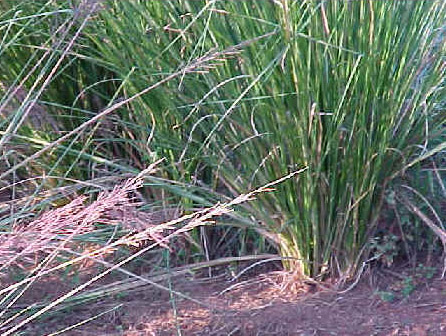
Photograph on Wikimedia Commons (Public domain).
Plant habit
Quick overview
A practical summary; details are in the sections below.
- Safety grade
- Generally recognised as safe details
- Scientific sources on the card
- Yes — sources are listed with claims Science section
- When and what to harvest
- Root — November–March
- Processing methods
Cold maceration, Essential oil, Incense / smoke offering
All methods and recipes on the card- Topics and symptoms
Anxiety & inner restlessness, Earth element (symbolism), Feverish feeling and chills…
Topics section, Symptoms overview
Identification and mix-ups
Perennial bunchgrass in Poaceae forming dense erect clumps; culms 1.5–2 m. Leaves long, narrow, stiff, linear, smooth, entire, keeled. The root system is deep, vertical and aromatic. Cultivated genotypes are sterile (propagated vegetatively, producing no fertile seed, and thus non-invasive). Roots strongly aromatic.
Possible mix-ups and risks
Hard to separate from Chrysopogon nigritanus (African wetland vetiver), which differs in its stemmy (rather than leafy) root-emergence zone, longer awned spikelets, and the fact that it seeds freely (invasive risk). It also superficially resembles lemongrass/citronella (Cymbopogon spp.). It is not toxic, but the African species is ecologically problematic.
Similar herbs
No related herbs are linked yet.
Topics and symptoms
More topics are in the symptoms and topics overview.
- Anxiety & inner restlessnessTraditional· Traditional / cultural framing
- Earth element (symbolism)Traditional· Traditional / cultural framing
- Feverish feeling and chillsTraditional· Traditional / cultural framing
- TopicAromatherapy· Traditional / cultural framing
Sources
Geographic occurrence
Indonesia
Occasional (garden, cultivation, or fringe of the range)
Harvest
- RootNovember–March
winter
Region: IndonesiaNotes: Aromatic roots after 18–24 months of cultivation; washed and dried.
Storage
- Drying(Root)
Washed and dried roots stay fragrant for years, in bundles or cut in an airtight jar. The oil matures and improves with age.
- Moisture:
- Roots take up moisture and then mould — store dry; damp they smell stronger, which is why mats are sprinkled only when used.
Processing methods on this herb card
Long steeping in cold or lukewarm water without boiling; gentler than a decoction.
Full method description (from the catalogue)
Cold maceration lets plant matter sit in liquid for hours to days at fridge or room temperature depending on the recipe. Extraction is slower and different from a hot infusion — useful for some aromatic parts when you want to limit bitterness or tannins.
Always mind jar hygiene, herb-to-water ratio, and maximum storage time for the finished macerate; the exact procedure belongs on the herb card and in trusted references.
Traditional context for this method: yes·Scientific context for this method: no
A concentrated aromatic plant product; use depends on the specific product.
Full method description (from the catalogue)
Essential oil is a concentrated plant product obtained, for example, by steam distillation or pressing. A general drop count or dilution ratio does not establish safe use.
Choose a finished product intended for your purpose and follow its directions. Do not apply it to skin or swallow it unless the manufacturer explicitly allows that use. This overview is not a recipe for home dilution.
Traditional context for this method: yes·Scientific context for this method: no
The oil is distilled industrially from the roots (Haiti, Java, Réunion) and is among the most valuable base notes in perfumery. Dilute on the skin; do not take internally.
Burning or heating aromatic plant material (smoke, steam).
Full method description (from the catalogue)
Incense may be dried herb, resin blends, or preparations on charcoal. The effect is sensory and cultural; smoke can irritate airways in sensitive people.
Ventilate the space; use non-flammable bases and heat-safe vessels.
Traditional context for this method: yes·Scientific context for this method: no
Traditional / spiritual use
Kept separate from science — entries are cultural or symbolic, not medical advice.
Root screens that cool and perfume
General
Traditional useFolk useHerbal loreIn northern India vetiver roots are woven into mats and screens for windows and doors (khus ki tatti); in summer they are sprinkled with water and the hot wind passing through them cools and takes on the earthy scent — a natural air-conditioning centuries old. Ayurveda counts ushira among the cooling herbs against fever and 'inner heat', and roots are put into drinking water. In Java and Tamil Nadu fans and baskets are woven from the roots. A record of tradition.
- Form:
- khus mats and screens against summer heat; usheera in Ayurveda
- Claim strength:
- Tradition
- Source note:
- Belhassen E et al. (2015), Flavour Fragr J 30:26–82 (ethnobotanical introduction); Ayurvedic Pharmacopoeia of India (Ushira); the Indian khus-screen tradition.
Scientific notes
Each claim lists a study type and a source (URL or DOI) where available. Dose notes from the literature are informational only.
How to read evidence strength and study type labels
Labels summarise how the catalogue entry is tagged — they are not a medical verdict on efficacy. For every row, read the summary, limitations and source link.
Evidence strength
- Evidence level not specified
- The author did not grade the record; judge from the summary, limitations and source link.
- Narrative / orientational literature
- Descriptive or expert literature without controlled group comparison — context rather than proof of effect.
- Weak evidence
- Study or conclusion with major methodological limits; treat only as a pointer for further reading.
- Preliminary findings
- First or smaller studies — interesting direction, not the final word on efficacy or safety.
- Moderate strength of evidence
- Moderate strength by study design; sample and context limits still apply.
- Stronger evidence
- Stronger design or consistency of results within the study's stated limits.
- Review article
- A review summarises multiple sources; quality depends on review method and field.
Study type
- Narrative / expert text
- Expert text or overview without a classical study design.
- In vitro study
- Cell culture or test-tube experiment — does not show an effect in the body.
- Animal study
- Animal model — transfer to humans is not automatic.
- Observational study
- Observing groups without random treatment assignment; confounding is possible.
- Clinical trial
- Human clinical trial; sample size and control group matter.
- Randomised controlled trial
- Randomised controlled trials are among the stronger designs when well conducted.
- Review study
- A review aggregates multiple papers — quality depends on selection rules.
- Systematic review
- Systematic review with explicit search and selection methodology.
- Meta-analysis
- Statistical pooling of studies; outcome depends on input data and heterogeneity.
- Regulatory assessment / monograph (EMA, WHO…)
- Regulatory body summary for a herbal product — different context from a single RCT; often about products, not home tea.
- Expert monograph (herbal preparations)
- Structured literature summary for a plant or drug — quality depends on author and edition year.
The review summarises over 300 volatile constituents of vetiver root (khusimol, vetiverol, alpha-vetivone, beta-vetivone, khusimone), differences by origin and processing and the chemistry of the fragrance oil; pharmacological data are marginal and laboratory-based.
Narrative / orientational literatureReview studyYear: 2015Limitations: A chemistry and perfumery review; no clinical data.
Belhassen E, Filippi JJ, Brévard H, Joulain D, Baldovini N — Flavour and Fragrance Journal
Volatile constituents of vetiver: a review
DOI: 10.1002/ffj.3227
Images
The main photo is in the card header. More images will appear here when available.
Safety
What the warning types mean
The type on each warning helps group themes — it does not replace the separate severity badge.
- Internal use
- Risks from swallowing, extracts, duration of use or concentration for internal use.
- Interactions / medicines
- Possible effect on medicines or concurrent treatment — check sources and a professional.
- Raw plant parts
- Raw, unripe or poorly prepared plant parts can be dangerous.
- Toxins and regulation
- Toxic constituents or regulated compounds (e.g. in distillates).
- Contact with the plant
- Skin or mucosa irritation from contact with fresh plant or sap.
- Allergy
- Allergic reactions, often linked to family sensitisation.
- Harvesting and contamination
- Contamination, species mix-ups or harvesting from unsuitable places.
No structured safety records yet.