Phyllanthus emblica
Amla
Generally recognised as safeOther names: Indian gooseberry, Emblica officinalis
An Indian tree with sour green fruits known in Ayurveda as 'amla'.
A medium-sized deciduous tree with small leaflets and pale-green gooseberry-like fruits; the fruits are intensely sour and are dried, candied, or used in Indian chutneys.
- Family
- Phyllanthaceae
- Plant type
- Deciduous tree
What the safety levels mean (expand legend)
- Generally recognised as safe. Often a common herb with reasonable harvest and use; still read the specific warnings on the card.
- Information. Primarily informational — details in the text and warnings below matter most.
- Caution. Needs extra care (dose, duration, sensitive groups, interactions).
- Risky. Significant risks — verify sources, contraindications and professional guidance.
- Not for home experimentation. Not suitable to experiment with at home without knowledge and certainty.
- High risk for internal use. Particular risk with internal use (e.g. alkaloids); avoid prolonged or irresponsible dosing.
- Not specified. Level not filled in yet — rely on individual warnings and links below.
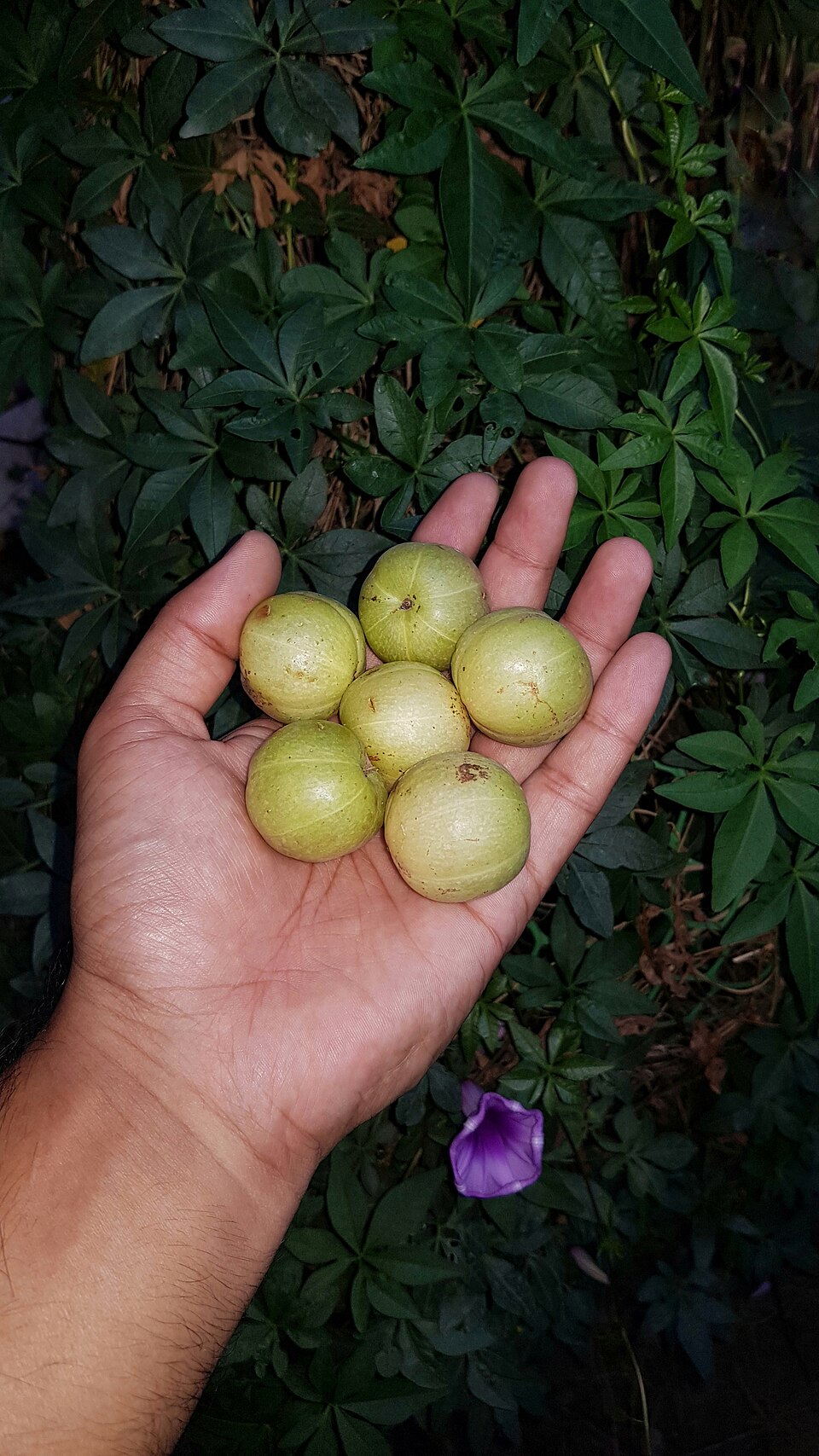
Photograph on Wikimedia Commons (CC BY-SA 4.0).
Plant habit
Quick overview
A practical summary; details are in the sections below.
- Safety grade
- Generally recognised as safe details
- Scientific sources on the card
- Yes — sources are listed with claims Science section
- When and what to harvest
- Fruit — October–March
- Processing methods
Honey macerate, Powder, Culinary use, Herbal oil
All methods and recipes on the card- Topics and symptoms
Digestion, Fatigue and low energy, Immunity - informational context…
Topics section, Symptoms overview
Identification and mix-ups
Small to medium deciduous tree in Phyllanthaceae, about 1–8 m, with smooth light-grey bark. Leaves simple, subsessile, oblong, small (around 1 cm), densely set along the branchlets so that each branchlet looks like a pinnate leaf. Flowers small, unisexual, greenish-yellow, in the leaf axils; fruit a nearly spherical fleshy berry 1–2 cm, pale green to translucent yellow, with six longitudinal furrows and about six seeds; very rich in vitamin C.
Possible mix-ups and risks
Confused with the related Phyllanthus acidus (star gooseberry), which has similarly pinnate-looking foliage but differs in its ribbed, sour, pale-yellow fruits clustered on older woody stems and its larger size. It is edible (non-toxic) and is a documented substitute for true amalaki.
Similar herbs
No related herbs are linked yet.
Topics and symptoms
More topics are in the symptoms and topics overview.
- DigestionTraditional· Traditional / cultural framing
- Fatigue and low energyTraditional· Traditional / cultural framing
- Immunity - informational contextTraditional· Traditional / cultural framing
- Liver & bile (folk framing)Traditional· Traditional / cultural framing
- Metabolism - gentle supportScientific· Preliminary or weaker scientific findings
Sources
Identification
Confusion risk
Geographic occurrence
India
Common (expected wild occurrence in the region)
Harvest
- FruitOctober–March
winter
Region: IndiaNotes: Ripe fruits during the dry season; traditionally preserved in salt.
Storage
- Drying(Fruit)
Dried fruit segments keep 1–2 years in an airtight jar; the powder up to a year. Fresh fruit lasts 2 weeks in the fridge; the sour taste does not change in storage.
- Light:
- Out of light — vitamin C and tannins degrade in light.
- Moisture:
- The powder clumps and browns in damp.
Processing methods on this herb card
Macerating plant material in honey (a honey conserve).
Full method description (from the catalogue)
Honey as a maceration medium creates a viscous mixture with its own biochemistry: water activity, acidity, and enzymes influence shelf life and flavour. Traditionally it is used with delicate flowers or herbs when you want aroma bound into honey.
Infant botulism guidance for honey and honey safety in general sit outside a single herb page; maceration time, ratios, and storage must follow a vetted recipe and source, not this general overview alone.
Traditional context for this method: yes·Scientific context for this method: no
Finely ground dried herb; dosing and solubility depend on species.
Full method description (from the catalogue)
Powder increases surface area for liquids or food. Home milling needs a clean grinder and control of fineness; very fine powder may clog tea filters.
Store airtight against moisture and pests.
Traditional context for this method: yes·Scientific context for this method: yes
Cooking, baking, seasoning as food — general category without therapeutic claims.
Full method description (from the catalogue)
Culinary use covers herbs as ingredients in dishes, drinks, or spice mixes. This overview does not evaluate medicinal effects — only reminds you about species intent, allergies, and heat treatment where needed (e.g. some fruits or plant parts).
Combining with alcohol, sugar, or long cooking changes outcomes; verify culinary sources.
Traditional context for this method: yes·Scientific context for this method: no
Macerating herbs in a vegetable oil (cold or with gentle heat).
Full method description (from the catalogue)
Herbal oil is made by steeping dried or fresh material in oil (e.g. olive, sunflower) over time, sometimes with gentle warming. The result is not steam-distilled essential oil — it is a different extract type and usage (often topical or culinary per recipe).
Temperature, light, and material moisture affect shelf life; rancid oil must be discarded.
Traditional context for this method: yes·Scientific context for this method: no
Traditional / spiritual use
Kept separate from science — entries are cultural or symbolic, not medical advice.
The tree under which Vishnu is worshipped in late winter
Symbolism
Spiritual useFolk useMythologyRitualIn the month of Phalguna (February–March) falls Amalaki Ekadashi: devotees fast, circle an amla tree, tie a thread around it and worship Vishnu and the goddess Lakshmi in it; the Padma Purana tells that the tree sprang from Brahma's tears. The fruit is also one of the three ingredients of triphala, the most widespread Ayurvedic formula. A record of ritual and myth.
- Form:
- Amalaki Ekadashi, tree worship, triphala
- Claim strength:
- Tradition
- Source note:
- Padma Purana (Amalaki Ekadashi); Charaka Samhita (amalaki rasayana); tradition in Uttar Pradesh and Bihar.
Scientific notes
Each claim lists a study type and a source (URL or DOI) where available. Dose notes from the literature are informational only.
How to read evidence strength and study type labels
Labels summarise how the catalogue entry is tagged — they are not a medical verdict on efficacy. For every row, read the summary, limitations and source link.
Evidence strength
- Evidence level not specified
- The author did not grade the record; judge from the summary, limitations and source link.
- Narrative / orientational literature
- Descriptive or expert literature without controlled group comparison — context rather than proof of effect.
- Weak evidence
- Study or conclusion with major methodological limits; treat only as a pointer for further reading.
- Preliminary findings
- First or smaller studies — interesting direction, not the final word on efficacy or safety.
- Moderate strength of evidence
- Moderate strength by study design; sample and context limits still apply.
- Stronger evidence
- Stronger design or consistency of results within the study's stated limits.
- Review article
- A review summarises multiple sources; quality depends on review method and field.
Study type
- Narrative / expert text
- Expert text or overview without a classical study design.
- In vitro study
- Cell culture or test-tube experiment — does not show an effect in the body.
- Animal study
- Animal model — transfer to humans is not automatic.
- Observational study
- Observing groups without random treatment assignment; confounding is possible.
- Clinical trial
- Human clinical trial; sample size and control group matter.
- Randomised controlled trial
- Randomised controlled trials are among the stronger designs when well conducted.
- Review study
- A review aggregates multiple papers — quality depends on selection rules.
- Systematic review
- Systematic review with explicit search and selection methodology.
- Meta-analysis
- Statistical pooling of studies; outcome depends on input data and heterogeneity.
- Regulatory assessment / monograph (EMA, WHO…)
- Regulatory body summary for a herbal product — different context from a single RCT; often about products, not home tea.
- Expert monograph (herbal preparations)
- Structured literature summary for a plant or drug — quality depends on author and edition year.
The review summarises the fruit's composition (hydrolysable tannins emblicanin A and B, gallic and ellagic acid, vitamin C) and laboratory and animal studies of antioxidant, anti-inflammatory and lipid-lowering activity; clinical trials are few and small.
Narrative / orientational literatureReview studyYear: 2016Limitations: Mostly preclinical data; heterogeneous extracts; a review without meta-analysis.
Variya BC, Bakrania AK, Patel SS — Pharmacological Research
A double-blind multicentre trial in 98 people with dyslipidaemia: 500 mg of amla extract twice daily for 12 weeks lowered total cholesterol, LDL, triglycerides and the total/HDL ratio more than placebo.
Preliminary findingsClinical trialYear: 2019Limitations: Short trial, one manufacturer's extract, which funded it; hard outcomes (heart attack, stroke) not followed.
Upadya H, Prabhu S, Prasad A, Subramanian D, Gupta S, Goel A — BMC Complementary and Alternative Medicine
Images
The main photo is in the card header. More images will appear here when available.
Safety
What the warning types mean
The type on each warning helps group themes — it does not replace the separate severity badge.
- Internal use
- Risks from swallowing, extracts, duration of use or concentration for internal use.
- Interactions / medicines
- Possible effect on medicines or concurrent treatment — check sources and a professional.
- Raw plant parts
- Raw, unripe or poorly prepared plant parts can be dangerous.
- Toxins and regulation
- Toxic constituents or regulated compounds (e.g. in distillates).
- Contact with the plant
- Skin or mucosa irritation from contact with fresh plant or sap.
- Allergy
- Allergic reactions, often linked to family sensitisation.
- Harvesting and contamination
- Contamination, species mix-ups or harvesting from unsuitable places.
No structured safety records yet.