Withania somnifera
Ashwagandha
CautionOther names: Indian ginseng, Winter cherry
An Indian perennial and one of the cornerstone herbs of Ayurveda.
A subshrub with hairy leaves, small greenish-yellow flowers, and orange berries enclosed in a papery calyx; in Indian tradition the root is dried and ground to a powder.
- Family
- Solanaceae
- Plant type
- Subshrub
What the safety levels mean (expand legend)
- Generally recognised as safe. Often a common herb with reasonable harvest and use; still read the specific warnings on the card.
- Information. Primarily informational — details in the text and warnings below matter most.
- Caution. Needs extra care (dose, duration, sensitive groups, interactions).
- Risky. Significant risks — verify sources, contraindications and professional guidance.
- Not for home experimentation. Not suitable to experiment with at home without knowledge and certainty.
- High risk for internal use. Particular risk with internal use (e.g. alkaloids); avoid prolonged or irresponsible dosing.
- Not specified. Level not filled in yet — rely on individual warnings and links below.
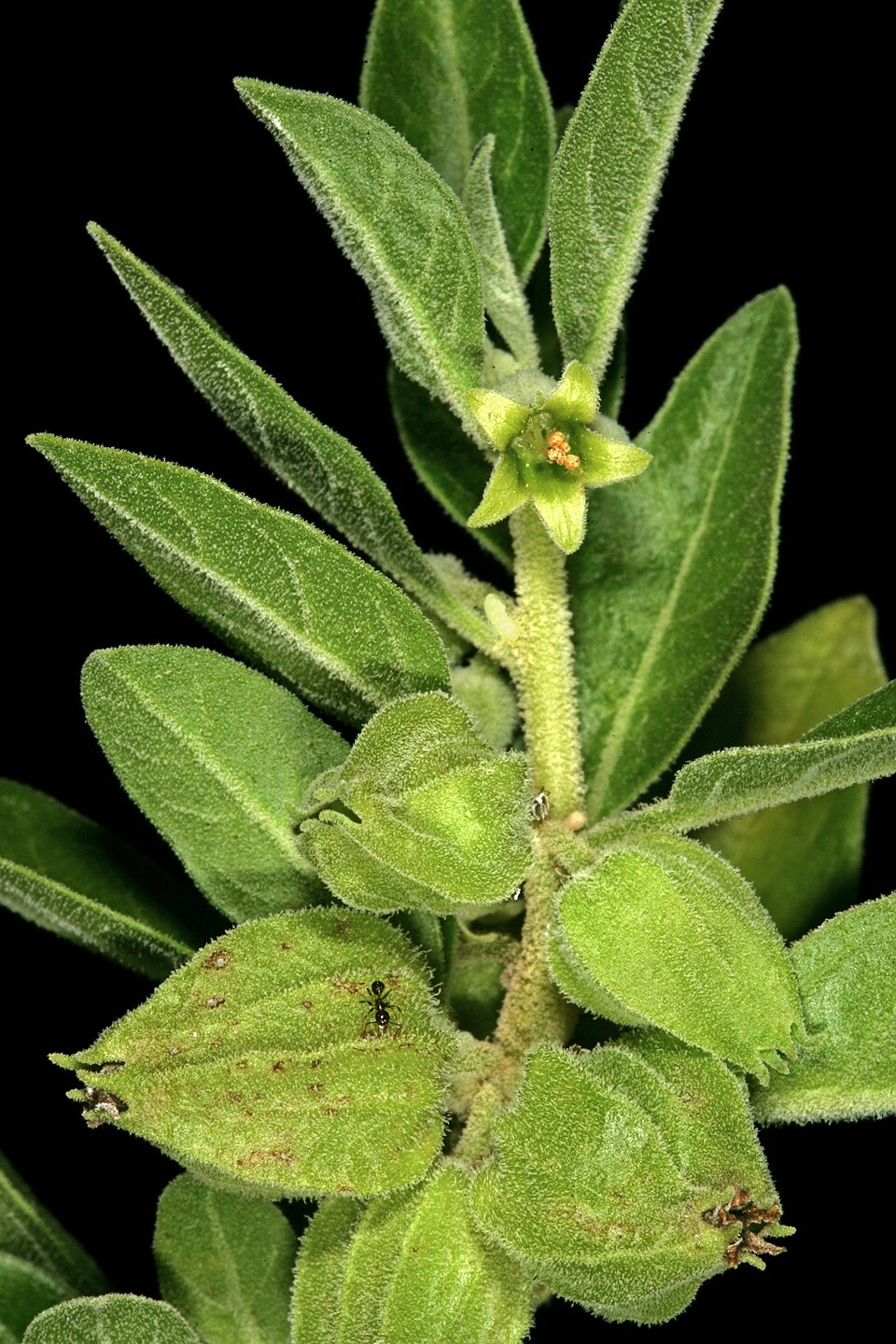
Photograph on Wikimedia Commons (CC BY-SA 4.0).
Plant habit
Safety — read before use
For this herb it is important to check warnings, mix-ups and cautions. Start with the Safety section.
Quick overview
A practical summary; details are in the sections below.
- Safety grade
- Caution details
- Scientific sources on the card
- Yes — sources are listed with claims Science section
- When and what to harvest
- Root — October–March
- Processing methods
Powder, Capsules, Decoction
All methods and recipes on the card- Topics and symptoms
Anxiety & inner restlessness, Burnout & mental fatigue, Fatigue and low energy…
Topics section, Symptoms overview
Identification and mix-ups
Erect tomentose subshrub in Solanaceae about 35–75 cm tall, with branches radiating from a central stem. Leaves simple, ovate-elliptic, dull green, hairy, to 10–12 cm, smelling of green tomatoes. Flowers small, bell-shaped, greenish-yellow, actinomorphic, with five lobes. Fruit a smooth spherical berry 5–8 mm, ripening orange-red, enclosed in an inflated papery calyx (the key trait).
Possible mix-ups and risks
Confusion is mainly with other Withania species, which are morphologically similar and require careful identification. No prominent non-Withania toxic lookalike is well-documented. Caution: the roots, foliage and berries of Withania itself are poisonous if misused.
Similar herbs
- American ginseng
The nickname 'Indian ginseng' is a marketing shorthand: ashwagandha is a nightshade with red berries in a papery calyx, ginseng an araliaceous herb. They share only the adaptogen reputation; the roots differ in shape and smell.
Topics and symptoms
More topics are in the symptoms and topics overview.
- Anxiety & inner restlessnessScientific· moderate
- Burnout & mental fatigueTraditional· Traditional / cultural framing
- Fatigue and low energyTraditional· Traditional / cultural framing
- TopicScientific· moderate
- TopicTraditional· Traditional / cultural framing
Sources
Geographic occurrence
India
Common (expected wild occurrence in the region)
Harvest
- RootOctober–March
winter
Region: IndiaNotes: Root from 1–2 year old plants after the aerial parts have died back.
Storage
- Drying(Root)
Sliced dried root keeps 2 years in an airtight jar; the powder (churna) up to a year before it loses its scent.
- Light:
- Out of light.
- Moisture:
- The powder is hygroscopic and clumps — a silica-gel sachet helps.
Processing methods on this herb card
Finely ground dried herb; dosing and solubility depend on species.
Full method description (from the catalogue)
Powder increases surface area for liquids or food. Home milling needs a clean grinder and control of fineness; very fine powder may clog tea filters.
Store airtight against moisture and pests.
Traditional context for this method: yes·Scientific context for this method: yes
Filling capsules with dried herb or powder; home and industrial variants.
Full method description (from the catalogue)
A capsule is a container; it may hold plant powder or a dry extract. Equal fill weights do not mean equal constituent levels or effects. Filling capsules with powder at home is therefore not equivalent to a standardized extract.
The word "standardized" alone does not guarantee product quality. A product sold in capsules may differ from the preparation used in a study.
This page is a guide to processing forms, not a universal dosing procedure. For each herb, distinguish the plant part, powder and extract; the list below does not by itself establish suitability for home filling.
Traditional context for this method: no·Scientific context for this method: yes
Clinical trials use standardised extracts (e.g. 300 mg twice daily); supplements differ in withanolide content. The case series by Björnsson et al. 2020 described liver injury after ashwagandha supplements — skip with liver disease, and stop and see a doctor if jaundice or itching appears.
Longer simmering of plant material in water.
Full method description (from the catalogue)
A decoction is made by simmering plant material in water — often around 10–20 minutes depending on tradition and plant part. Denser parts (roots, bark, some seeds) are often prepared more reliably this way than with a short infusion.
Compared with an infusion it can extract more compounds, but also more tannins or bitterness; the flavour profile differs from a delicate tea. Combine this overview with the herb card for suitable plant part and contraindications.
Traditional context for this method: yes·Scientific context for this method: no
Traditional / spiritual use
Kept separate from science — entries are cultural or symbolic, not medical advice.
Rasayana — the root said to give the strength of a horse
General
Traditional useFolk useHerbal loreThe Sanskrit name ashwagandha means 'smell of the horse', and tradition reads it two ways: the fresh root smells horsey, and the plant is supposed to lend a horse's strength. The Charaka Samhita lists it among the rasayanas, agents of rejuvenation and longevity, and Ayurveda gives it with milk and ghee for weakness, sleeplessness and convalescence. A record of tradition, not proof of effect.
- Form:
- rasayana in Ayurveda, "the smell and strength of a horse"
- Claim strength:
- Tradition
- Source note:
- Charaka Samhita (Chikitsa Sthana, rasayana); Ayurvedic Pharmacopoeia of India, vol. I (Ashwagandha).
Scientific notes
Each claim lists a study type and a source (URL or DOI) where available. Dose notes from the literature are informational only.
How to read evidence strength and study type labels
Labels summarise how the catalogue entry is tagged — they are not a medical verdict on efficacy. For every row, read the summary, limitations and source link.
Evidence strength
- Evidence level not specified
- The author did not grade the record; judge from the summary, limitations and source link.
- Narrative / orientational literature
- Descriptive or expert literature without controlled group comparison — context rather than proof of effect.
- Weak evidence
- Study or conclusion with major methodological limits; treat only as a pointer for further reading.
- Preliminary findings
- First or smaller studies — interesting direction, not the final word on efficacy or safety.
- Moderate strength of evidence
- Moderate strength by study design; sample and context limits still apply.
- Stronger evidence
- Stronger design or consistency of results within the study's stated limits.
- Review article
- A review summarises multiple sources; quality depends on review method and field.
Study type
- Narrative / expert text
- Expert text or overview without a classical study design.
- In vitro study
- Cell culture or test-tube experiment — does not show an effect in the body.
- Animal study
- Animal model — transfer to humans is not automatic.
- Observational study
- Observing groups without random treatment assignment; confounding is possible.
- Clinical trial
- Human clinical trial; sample size and control group matter.
- Randomised controlled trial
- Randomised controlled trials are among the stronger designs when well conducted.
- Review study
- A review aggregates multiple papers — quality depends on selection rules.
- Systematic review
- Systematic review with explicit search and selection methodology.
- Meta-analysis
- Statistical pooling of studies; outcome depends on input data and heterogeneity.
- Regulatory assessment / monograph (EMA, WHO…)
- Regulatory body summary for a herbal product — different context from a single RCT; often about products, not home tea.
- Expert monograph (herbal preparations)
- Structured literature summary for a plant or drug — quality depends on author and edition year.
A meta-analysis of 12 randomised trials found statistically significant reductions in anxiety and stress scores after root extract versus placebo in adults with anxiety or stress; the effect was clearer at 300–600 mg daily for 6–8 weeks.
Moderate strength of evidenceSystematic reviewYear: 2022Limitations: Short trials with small samples, varied extracts and scales, mostly from India; some funded by manufacturers.
Akhgarjand C, Asoudeh F, Bagheri A, Kalantar Z, Vahabi Z, Shab-Bidar S, Rezvani H, Djafarian K — Phytotherapy Research
DOI: 10.1002/ptr.7598
A double-blind trial in 64 adults with chronic stress: 300 mg of standardised root extract twice daily for 60 days lowered perceived-stress scores and morning serum cortisol more than placebo; adverse effects were mild and comparable.
Preliminary findingsClinical trialYear: 2012Limitations: Single centre, 60 days, one manufacturer's extract (KSM-66), which supported the trial.
Chandrasekhar K, Kapoor J, Anishetty S — Indian Journal of Psychological Medicine
A meta-analysis of 5 RCTs (400 participants) found a small to moderate benefit of the extract on overall sleep quality and time to fall asleep, most pronounced in people with insomnia, at 600 mg or more daily and after 8 weeks or longer; alertness on waking and anxiety also improved.
Moderate strength of evidenceMeta-analysisYear: 2021Limitations: Few trials, short duration, varied extracts and doses; long-term safety not assessed.
Cheah KL, Norhayati MN, Husniati Yaacob L, Abdul Rahman R — PLOS ONE
Effect of Ashwagandha (Withania somnifera) extract on sleep: A systematic review and meta-analysis
Images
The main photo is in the card header. More images will appear here when available.
Safety
What the warning types mean
The type on each warning helps group themes — it does not replace the separate severity badge.
- Internal use
- Risks from swallowing, extracts, duration of use or concentration for internal use.
- Interactions / medicines
- Possible effect on medicines or concurrent treatment — check sources and a professional.
- Raw plant parts
- Raw, unripe or poorly prepared plant parts can be dangerous.
- Toxins and regulation
- Toxic constituents or regulated compounds (e.g. in distillates).
- Contact with the plant
- Skin or mucosa irritation from contact with fresh plant or sap.
- Allergy
- Allergic reactions, often linked to family sensitisation.
- Harvesting and contamination
- Contamination, species mix-ups or harvesting from unsuitable places.
- Thyroid and hormonal careLow severitythyroid
Consult your doctor before use with thyroid disorders or with levothyroxine or sedative therapy.
- Liver injury after ashwagandha supplementsModerate severityliver
A case series from Iceland and the US DILIN network (Björnsson et al. 2020, Liver International) described 5 people with cholestatic or mixed liver injury 2–12 weeks after starting ashwagandha supplements; it resolved over months once stopped. Skip with liver disease, and stop at once and see a doctor if jaundice, itching or dark urine appears.