Aloe ferox
Cape aloe
CautionOther names: Bitter aloe, Red aloe, Aloe capensis
A robust South African succulent with bitter yellow leaf sap.
A succulent that can reach several metres, with a rosette of thick toothed leaves and a tall flower stalk; the leaves yield both a bitter yellow sap and an inner gel used in traditional cosmetics and beverages.
- Family
- Asphodelaceae
- Plant type
- Succulent
What the safety levels mean (expand legend)
- Generally recognised as safe. Often a common herb with reasonable harvest and use; still read the specific warnings on the card.
- Information. Primarily informational — details in the text and warnings below matter most.
- Caution. Needs extra care (dose, duration, sensitive groups, interactions).
- Risky. Significant risks — verify sources, contraindications and professional guidance.
- Not for home experimentation. Not suitable to experiment with at home without knowledge and certainty.
- High risk for internal use. Particular risk with internal use (e.g. alkaloids); avoid prolonged or irresponsible dosing.
- Not specified. Level not filled in yet — rely on individual warnings and links below.
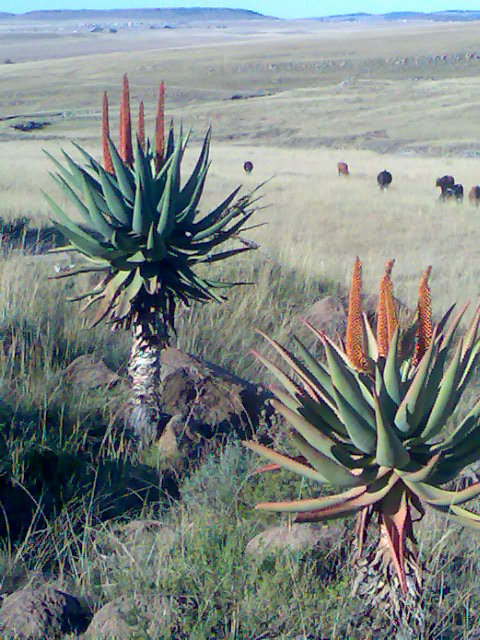
Photograph on Wikimedia Commons (CC BY 2.5).
Plant habit
Safety — read before use
For this herb it is important to check warnings, mix-ups and cautions. Start with the Safety section.
Quick overview
A practical summary; details are in the sections below.
- Safety grade
- Caution details
- Scientific sources on the card
- Yes — sources are listed with claims Science section
- When and what to harvest
- Leaf — January–December
- Processing methods
Poultice / compress, Capsules, Salve / ointment
All methods and recipes on the card- Topics and symptoms
Complexion and local blemishes, Constipation, Healing after procedures (general context)…
Topics section, Symptoms overview
Identification and mix-ups
Single-stemmed succulent in Asphodelaceae reaching 2–3 m, with a dense rosette of 50–60 erect lance-oblong leaves up to 1 m long, dull green to reddish, with reddish-brown spines on the margin (sometimes also on the leaf surface). Inflorescence candelabra-like, much-branched, standing 0.6–1.3 m above the rosette; flowers tubular, uniformly orange to red, about 2.5 cm.
Possible mix-ups and risks
The formerly recognised Aloe candelabrum has been sunk into Aloe ferox (within its range of variation), so it is not a distinct lookalike. Among co-occurring tree aloes, Aloe africana differs (curved, oblique inflorescence). No toxic confusion is documented.
Similar herbs
No related herbs are linked yet.
Topics and symptoms
More topics are in the symptoms and topics overview.
- Complexion and local blemishesTraditional· Traditional / cultural framing
- ConstipationTraditional· Traditional / cultural framing
- Healing after procedures (general context)Traditional· Traditional / cultural framing
- SkinTraditional· Traditional / cultural framing
- Skin after sunTraditional· Traditional / cultural framing
Sources
Identification
Confusion risk
Geographic occurrence
South Africa
Common (expected wild occurrence in the region)
Harvest
- LeafJanuary–December
year-round
Region: South AfricaNotes: Lower mature leaves; the bitter yellow sap drains after cutting.
Storage
- Airtight storage(Leaf)
The concentrated bitter sap (aloe lump, Aloe capensis) is stable for years, kept dry and dark. Fresh inner-leaf gel lasts 3–5 days in the fridge, a little longer with a drop of lemon.
- Light:
- Out of light — anthraquinones brown and break down in light.
- Moisture:
- The bitter mass softens and sticks in damp.
- Safety:
- Store the bitter yellow sap and the clear gel apart and labelled — the sap is a strong laxative.
Processing methods on this herb card
Liquid or paste on the skin, often through a thin cloth.
Full method description (from the catalogue)
A compress applies moist warm or cool material to the skin directly or through fabric. Duration and temperature are key — too hot can burn; too long can macerate the skin.
Use clean textiles and watch skin reaction during the first minutes.
Traditional context for this method: yes·Scientific context for this method: no
Filling capsules with dried herb or powder; home and industrial variants.
Full method description (from the catalogue)
A capsule is a container; it may hold plant powder or a dry extract. Equal fill weights do not mean equal constituent levels or effects. Filling capsules with powder at home is therefore not equivalent to a standardized extract.
The word "standardized" alone does not guarantee product quality. A product sold in capsules may differ from the preparation used in a study.
This page is a guide to processing forms, not a universal dosing procedure. For each herb, distinguish the plant part, powder and extract; the list below does not by itself establish suitability for home filling.
Traditional context for this method: no·Scientific context for this method: yes
The concentrated sap (Aloe capensis) is per EMA HMPC a short-term laxative for occasional constipation, 1–2 weeks at most, not for children under 12, in pregnancy or when breastfeeding. EFSA 2018 classed hydroxyanthracene derivatives as genotoxic and the EU banned them in food supplements in 2021 — medicinal aloe products belong in the pharmacy, not the kitchen.
Solid base (wax, fat) with herbal extract or macerate; usually topical.
Full method description (from the catalogue)
Salves combine extracted or finely ground herb with fat and often beeswax. Consistency depends on ratios; protective or emollient salves aim for a skin film with slow release.
Clean work reduces microbial contamination; refrigerated storage may extend life per recipe.
Traditional context for this method: yes·Scientific context for this method: no
Traditional / spiritual use
Kept separate from science — entries are cultural or symbolic, not medical advice.
Bitter sap from the Cape — a trade more than two centuries old
General
Traditional useFolk useHerbal loreThe Khoi and San used aloe leaves on wounds and the bitter sap as a laxative long before Europeans arrived. The Cape Colony exported 'Cape aloes' from 1761: tappers stack cut leaves in a ring around a hollow lined with hide or canvas, the yellow sap runs to the centre and is boiled down over a fire to a dark glassy mass. This craft harvest continues in South Africa today and supports rural families. A record of tradition and economic history.
- Form:
- collecting the bitter juice on a hide in a pit, a Cape export commodity
- Claim strength:
- Tradition
- Source note:
- Chen W et al. (2012), Phytochem Lett 5:1–12 (history and commercialisation); SANBI PlantZAfrica — Aloe ferox.
Scientific notes
Each claim lists a study type and a source (URL or DOI) where available. Dose notes from the literature are informational only.
How to read evidence strength and study type labels
Labels summarise how the catalogue entry is tagged — they are not a medical verdict on efficacy. For every row, read the summary, limitations and source link.
Evidence strength
- Evidence level not specified
- The author did not grade the record; judge from the summary, limitations and source link.
- Narrative / orientational literature
- Descriptive or expert literature without controlled group comparison — context rather than proof of effect.
- Weak evidence
- Study or conclusion with major methodological limits; treat only as a pointer for further reading.
- Preliminary findings
- First or smaller studies — interesting direction, not the final word on efficacy or safety.
- Moderate strength of evidence
- Moderate strength by study design; sample and context limits still apply.
- Stronger evidence
- Stronger design or consistency of results within the study's stated limits.
- Review article
- A review summarises multiple sources; quality depends on review method and field.
Study type
- Narrative / expert text
- Expert text or overview without a classical study design.
- In vitro study
- Cell culture or test-tube experiment — does not show an effect in the body.
- Animal study
- Animal model — transfer to humans is not automatic.
- Observational study
- Observing groups without random treatment assignment; confounding is possible.
- Clinical trial
- Human clinical trial; sample size and control group matter.
- Randomised controlled trial
- Randomised controlled trials are among the stronger designs when well conducted.
- Review study
- A review aggregates multiple papers — quality depends on selection rules.
- Systematic review
- Systematic review with explicit search and selection methodology.
- Meta-analysis
- Statistical pooling of studies; outcome depends on input data and heterogeneity.
- Regulatory assessment / monograph (EMA, WHO…)
- Regulatory body summary for a herbal product — different context from a single RCT; often about products, not home tea.
- Expert monograph (herbal preparations)
- Structured literature summary for a plant or drug — quality depends on author and edition year.
The EMA HMPC monograph for Aloe capensis (concentrated bitter sap) describes short-term use for occasional constipation.
Review articleRegulatory assessment / monograph (EMA, WHO…)Year: 2016Preparation form in the study: dried extract
Active compound / focus: aloin (1,8-dihydroxyanthraquinone)
Limitations: Not recommended for longer than 1–2 weeks; not for Crohn's disease, ulcerative colitis, or undiagnosed abdominal pain; not during pregnancy, breastfeeding, or in children under 12.
Dose note (from literature): Always the lowest effective dose once daily in the evening; see the PDF for preparations.
The review summarises the composition of the leaf sap (aloin A/B, aloeresin, aloe-emodin) and gel (polysaccharides), the laxative effect of the anthraquinones and mostly animal and laboratory data on anti-inflammatory and wound-healing activity of the gel; clinical studies are few.
Narrative / orientational literatureReview studyYear: 2012Limitations: Mostly preclinical data; a review without meta-analysis; some authors tied to the industry.
Chen W, Van Wyk BE, Vermaak I, Viljoen AM — Phytochemistry Letters
Cape aloes—A review of the phytochemistry, pharmacology and commercialisation of Aloe ferox
Images
The main photo is in the card header. More images will appear here when available.
Safety
What the warning types mean
The type on each warning helps group themes — it does not replace the separate severity badge.
- Internal use
- Risks from swallowing, extracts, duration of use or concentration for internal use.
- Interactions / medicines
- Possible effect on medicines or concurrent treatment — check sources and a professional.
- Raw plant parts
- Raw, unripe or poorly prepared plant parts can be dangerous.
- Toxins and regulation
- Toxic constituents or regulated compounds (e.g. in distillates).
- Contact with the plant
- Skin or mucosa irritation from contact with fresh plant or sap.
- Allergy
- Allergic reactions, often linked to family sensitisation.
- Harvesting and contamination
- Contamination, species mix-ups or harvesting from unsuitable places.
- Internal use of bitter sapHigh severityInternal use
The bitter yellow sap (aloin) has a laxative effect and is not suitable for long-term use, pregnancy, or bowel conditions.
- Hydroxyanthracene derivatives — genotoxicity and a supplement banModerate severityToxins and regulation
The EFSA panel in 2018 concluded that hydroxyanthracene derivatives (aloe-emodin, emodin, danthron and aloe leaf extracts containing them) are genotoxic in vitro and that aloe-emodin and emodin are carcinogenic in animals; no safe daily intake could be set. The EU banned them in foods and supplements by Regulation 2021/468. Do not take the bitter sap long-term; use only registered products, briefly.