Harpagophytum procumbens
Devil's claw
CautionOther names: Grapple plant, Wood spider
A southern African perennial with hooked fruits and a thick taproot.
A creeping perennial of southern African arid lands with lobed leaves, pink trumpet flowers, and distinctive hooked fruits; the dried secondary root is the part used in herbal preparations.
- Family
- Pedaliaceae
- Plant type
- Perennial herb
What the safety levels mean (expand legend)
- Generally recognised as safe. Often a common herb with reasonable harvest and use; still read the specific warnings on the card.
- Information. Primarily informational — details in the text and warnings below matter most.
- Caution. Needs extra care (dose, duration, sensitive groups, interactions).
- Risky. Significant risks — verify sources, contraindications and professional guidance.
- Not for home experimentation. Not suitable to experiment with at home without knowledge and certainty.
- High risk for internal use. Particular risk with internal use (e.g. alkaloids); avoid prolonged or irresponsible dosing.
- Not specified. Level not filled in yet — rely on individual warnings and links below.
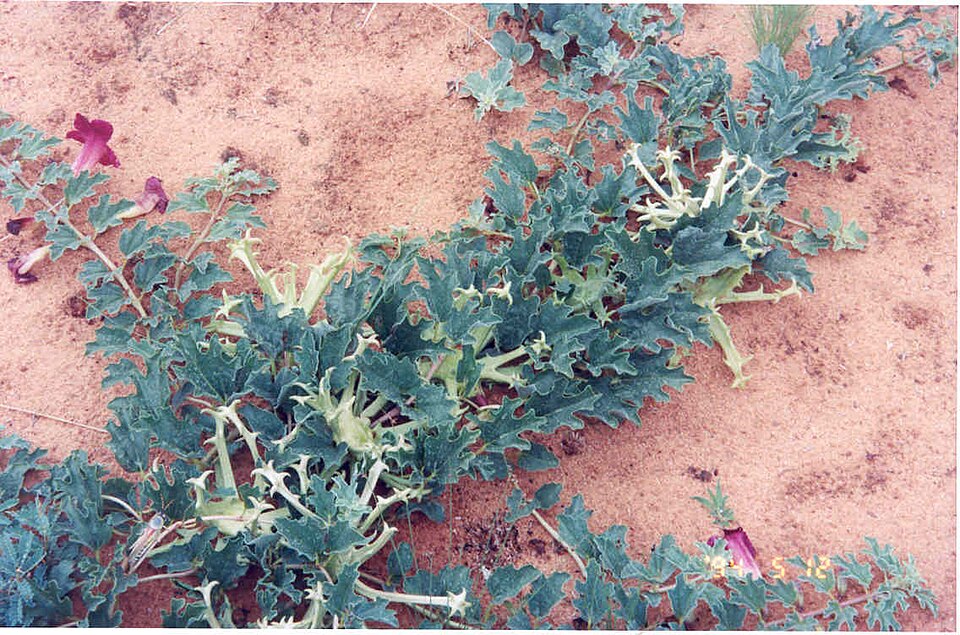
Photograph on Wikimedia Commons (Attribution).
Plant habit
Safety — read before use
For this herb it is important to check warnings, mix-ups and cautions. Start with the Safety section.
Quick overview
A practical summary; details are in the sections below.
- Safety grade
- Caution details
- Scientific sources on the card
- Yes — sources are listed with claims Science section
- When and what to harvest
- Root — April–July
- Processing methods
Cold maceration, Capsules, Powder, Salve / ointment
All methods and recipes on the card- Topics and symptoms
Joints & mobility, Muscles after exertion
Topics section, Symptoms overview
Identification and mix-ups
Prostrate perennial in Pedaliaceae with a stout primary tuberous root up to 2 m deep and secondary storage tubers. Trailing annual stems to 2 m. Leaves opposite, irregularly 3–5-lobed, grey-green (with mucilage cells). Flowers funnel-shaped, dark red to pink with a yellowish throat. Fruit a large (to 15 cm) woody structure with rows of curved arms bearing recurved hooks.
Possible mix-ups and risks
The only other species of the genus and the main lookalike is Harpagophytum zeyheri from the same Kalahari range, very similar; it differs in the much shorter spiny arms of its fruit. It is not toxic but is a frequent commercial substitute with a weaker effect.
Similar herbs
No related herbs are linked yet.
Topics and symptoms
More topics are in the symptoms and topics overview.
- Joints & mobilityScientific· moderateTraditional· Traditional / cultural framing
- Muscles after exertionTraditional· Traditional / cultural framing
Sources
Identification
Confusion risk
Geographic occurrence
South Africa
Occasional (garden, cultivation, or fringe of the range)
Harvest
- RootApril–July
autumn
Region: South AfricaNotes: Secondary ('nodule') roots after the rains end; not the primary taproot.
Storage
- Drying(Root)
Sun-dried slices of the secondary tubers keep 2–3 years in an airtight jar; the powder up to a year. The bitterness (harpagoside) does not change in storage.
- Light:
- Out of light.
- Moisture:
- The powder is hygroscopic and clumps.
Processing methods on this herb card
Long steeping in cold or lukewarm water without boiling; gentler than a decoction.
Full method description (from the catalogue)
Cold maceration lets plant matter sit in liquid for hours to days at fridge or room temperature depending on the recipe. Extraction is slower and different from a hot infusion — useful for some aromatic parts when you want to limit bitterness or tannins.
Always mind jar hygiene, herb-to-water ratio, and maximum storage time for the finished macerate; the exact procedure belongs on the herb card and in trusted references.
Traditional context for this method: yes·Scientific context for this method: yes
Filling capsules with dried herb or powder; home and industrial variants.
Full method description (from the catalogue)
A capsule is a container; it may hold plant powder or a dry extract. Equal fill weights do not mean equal constituent levels or effects. Filling capsules with powder at home is therefore not equivalent to a standardized extract.
The word "standardized" alone does not guarantee product quality. A product sold in capsules may differ from the preparation used in a study.
This page is a guide to processing forms, not a universal dosing procedure. For each herb, distinguish the plant part, powder and extract; the list below does not by itself establish suitability for home filling.
Traditional context for this method: no·Scientific context for this method: yes
Finely ground dried herb; dosing and solubility depend on species.
Full method description (from the catalogue)
Powder increases surface area for liquids or food. Home milling needs a clean grinder and control of fineness; very fine powder may clog tea filters.
Store airtight against moisture and pests.
Traditional context for this method: yes·Scientific context for this method: no
Solid base (wax, fat) with herbal extract or macerate; usually topical.
Full method description (from the catalogue)
Salves combine extracted or finely ground herb with fat and often beeswax. Consistency depends on ratios; protective or emollient salves aim for a skin film with slow release.
Clean work reduces microbial contamination; refrigerated storage may extend life per recipe.
Traditional context for this method: yes·Scientific context for this method: no
Traditional / spiritual use
Kept separate from science — entries are cultural or symbolic, not medical advice.
From the Kalahari sands to German pharmacies
General
Traditional useFolk useHerbal loreThe San and Khoi of the Kalahari dug up the secondary tubers of devil's claw for fever, pain and digestive complaints and made a wound ointment from their powder; the plant owes its name to the hooked fruits that tangle in animals' fur. The German farmer G. H. Mehnert learnt the use from a Namibian healer and began exporting the tubers to Germany in the 1950s. Today harvesting in Namibia and Botswana is regulated because demand threatens wild populations. A record of tradition and economic history.
- Form:
- remedy of the San of the Kalahari; farmer Mehnert and exports to Germany
- Claim strength:
- Tradition
- Source note:
- Stewart KM, Cole D (2005), J Ethnopharmacol 100:225–236: The commercial harvest of devil's claw (Harpagophytum spp.) in southern Africa.
Scientific notes
Each claim lists a study type and a source (URL or DOI) where available. Dose notes from the literature are informational only.
How to read evidence strength and study type labels
Labels summarise how the catalogue entry is tagged — they are not a medical verdict on efficacy. For every row, read the summary, limitations and source link.
Evidence strength
- Evidence level not specified
- The author did not grade the record; judge from the summary, limitations and source link.
- Narrative / orientational literature
- Descriptive or expert literature without controlled group comparison — context rather than proof of effect.
- Weak evidence
- Study or conclusion with major methodological limits; treat only as a pointer for further reading.
- Preliminary findings
- First or smaller studies — interesting direction, not the final word on efficacy or safety.
- Moderate strength of evidence
- Moderate strength by study design; sample and context limits still apply.
- Stronger evidence
- Stronger design or consistency of results within the study's stated limits.
- Review article
- A review summarises multiple sources; quality depends on review method and field.
Study type
- Narrative / expert text
- Expert text or overview without a classical study design.
- In vitro study
- Cell culture or test-tube experiment — does not show an effect in the body.
- Animal study
- Animal model — transfer to humans is not automatic.
- Observational study
- Observing groups without random treatment assignment; confounding is possible.
- Clinical trial
- Human clinical trial; sample size and control group matter.
- Randomised controlled trial
- Randomised controlled trials are among the stronger designs when well conducted.
- Review study
- A review aggregates multiple papers — quality depends on selection rules.
- Systematic review
- Systematic review with explicit search and selection methodology.
- Meta-analysis
- Statistical pooling of studies; outcome depends on input data and heterogeneity.
- Regulatory assessment / monograph (EMA, WHO…)
- Regulatory body summary for a herbal product — different context from a single RCT; often about products, not home tea.
- Expert monograph (herbal preparations)
- Structured literature summary for a plant or drug — quality depends on author and edition year.
The EMA HMPC monograph for devil's claw root describes traditional use for minor joint complaints and temporary back pain.
Review articleRegulatory assessment / monograph (EMA, WHO…)Year: 2016Preparation form in the study: decoction
Active compound / focus: harpagoside, harpagide (iridoid glycosides)
Limitations: Consult a doctor with peptic ulcer disease or with anticoagulant or NSAID use; bitter compounds may irritate the stomach.
Dose note (from literature): Standardised aqueous/ethanolic extract; see the PDF for dosing.
The Cochrane review found that for chronic non-specific low-back pain, devil's claw extract standardised to 50 mg harpagoside daily reduces pain short-term better than placebo (two trials, 315 people) and was comparable to 12.5 mg rofecoxib in one trial; quality of evidence low to moderate.
Moderate strength of evidenceSystematic reviewYear: 2014Limitations: Few trials, short duration (4–8 weeks), risk of bias; doses below 50 mg harpagoside without effect.
Oltean H, Robbins C, van Tulder MW, Berman BM, Bombardier C, Gagnier JJ — Cochrane Database of Systematic Reviews
Images
The main photo is in the card header. More images will appear here when available.
Safety
What the warning types mean
The type on each warning helps group themes — it does not replace the separate severity badge.
- Internal use
- Risks from swallowing, extracts, duration of use or concentration for internal use.
- Interactions / medicines
- Possible effect on medicines or concurrent treatment — check sources and a professional.
- Raw plant parts
- Raw, unripe or poorly prepared plant parts can be dangerous.
- Toxins and regulation
- Toxic constituents or regulated compounds (e.g. in distillates).
- Contact with the plant
- Skin or mucosa irritation from contact with fresh plant or sap.
- Allergy
- Allergic reactions, often linked to family sensitisation.
- Harvesting and contamination
- Contamination, species mix-ups or harvesting from unsuitable places.
- Drug interactions and stomachModerate severityInteractions / medicines
Consult a doctor when on anticoagulants or NSAIDs, or with a history of peptic ulcer; the bitter compounds can irritate the stomach.
- Gastric and duodenal ulcers, gallstonesModerate severitydigestion
The EMA HMPC monograph lists gastric and duodenal ulcers as a contraindication and advises caution with gallstones — the root's bitters increase gastric acid and bile production. The commonest adverse effects are diarrhoea, nausea and abdominal pain; stop if they occur.