Gynostemma pentaphyllum
Jiaogulan
CautionOther names: Southern ginseng
A climbing East Asian cucurbit; the source of the 'jiaogulan' tea.
A slender climbing perennial with palmately five-foliate leaflets and tiny greenish flowers; in southern China and Vietnam the aerial parts are dried and brewed into a mildly sweet herbal infusion known as jiaogulan.
- Family
- Cucurbitaceae
- Plant type
- Climbing perennial
What the safety levels mean (expand legend)
- Generally recognised as safe. Often a common herb with reasonable harvest and use; still read the specific warnings on the card.
- Information. Primarily informational — details in the text and warnings below matter most.
- Caution. Needs extra care (dose, duration, sensitive groups, interactions).
- Risky. Significant risks — verify sources, contraindications and professional guidance.
- Not for home experimentation. Not suitable to experiment with at home without knowledge and certainty.
- High risk for internal use. Particular risk with internal use (e.g. alkaloids); avoid prolonged or irresponsible dosing.
- Not specified. Level not filled in yet — rely on individual warnings and links below.
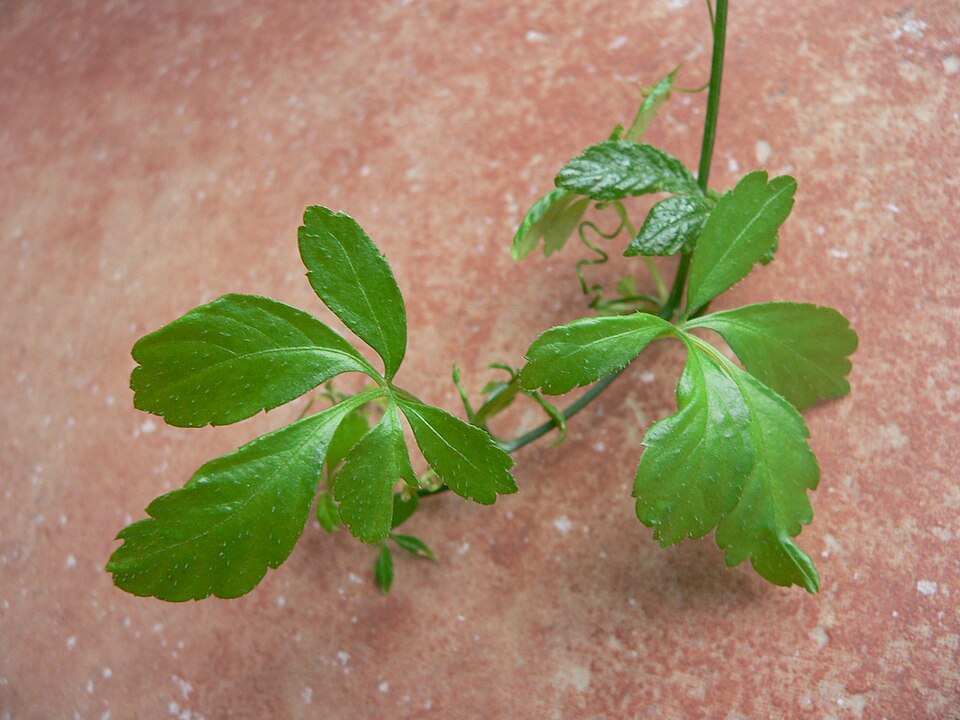
Photograph on Wikimedia Commons (CC BY 2.0 de).
Plant habit
Safety — read before use
For this herb it is important to check warnings, mix-ups and cautions. Start with the Safety section.
Quick overview
A practical summary; details are in the sections below.
- Safety grade
- Caution details
- Scientific sources on the card
- Yes — sources are listed with claims Science section
- When and what to harvest
- Leaf — July–September
- Processing methods
Herbal infusion (tea), Capsules
All methods and recipes on the card- Topics and symptoms
Fatigue and low energy, Metabolism - gentle support, Topic
Topics section, Symptoms overview
Identification and mix-ups
Dioecious herbaceous climbing vine in Cucurbitaceae, climbing by tendrils. Leaves usually palmately (pedately) compound with 5 (sometimes 3–7) glossy, oval, serrate leaflets 5–10 cm long. Flowers tiny, greenish-yellow, in panicles (male inflorescences 15–20 cm), blooming in late summer. Fruit a small (about 6 mm) blackish-purple inedible berry.
Possible mix-ups and risks
A documented lookalike is bushkiller (Cayratia japonica, syn. Causonis japonica) of the grape family (Vitaceae). It differs in its pedately compound leaves with petiolules on the individual leaflets, whitish lower leaf surface and grape-like 2–4-seeded berries; it lacks the cucurbit tendril and flower structure. Its toxicity to humans is not well-documented (the species is used in TCM). Confusion is also possible with other Gynostemma and Hemsleya species.
Similar herbs
No related herbs are linked yet.
Topics and symptoms
More topics are in the symptoms and topics overview.
- Fatigue and low energyTraditional· Traditional / cultural framing
- Metabolism - gentle supportScientific· Preliminary or weaker scientific findingsTraditional· Traditional / cultural framing
- TopicTraditional· Traditional / cultural framing
Sources
Geographic occurrence
Viet Nam
Occasional (garden, cultivation, or fringe of the range)
Harvest
- LeafJuly–September
summer
Region: Viet NamNotes: Leaves and young shoots during flowering; hand-picked from the climbing stems.
Storage
- Drying(Leaf)
Dried leaves and tendrils keep 1–2 years in an airtight jar; often processed like green tea (steaming, rolling, drying).
- Light:
- Out of light.
- Moisture:
- Protect from moisture.
Processing methods on this herb card
Infusion or brief extraction in hot water; usually without long boiling.
Full method description (from the catalogue)
Here, herbal tea is prepared as an infusion: pour freshly boiling water over dried herbs or a herbal blend and steep for at least 5 minutes. BfR gives this as a hygiene rule, not a medicinal dose. Follow the specific product instructions, including a longer steeping time when stated. This rule for herbal infusions is not a general preparation guide for true tea (Camellia sinensis). Temperature, steep time, and the herb-to-water ratio change both flavour and what dissolves into the liquid.
Compared with a decoction, heat exposure is shorter and gentler; tender leaves and flowers are often better as an infusion than with prolonged simmering. For each herb, always follow the plant card for suitable plant part, preparation, and safety notes — general rules never replace species-level judgement.
Traditional context for this method: yes·Scientific context for this method: yes
Filling capsules with dried herb or powder; home and industrial variants.
Full method description (from the catalogue)
A capsule is a container; it may hold plant powder or a dry extract. Equal fill weights do not mean equal constituent levels or effects. Filling capsules with powder at home is therefore not equivalent to a standardized extract.
The word "standardized" alone does not guarantee product quality. A product sold in capsules may differ from the preparation used in a study.
This page is a guide to processing forms, not a universal dosing procedure. For each herb, distinguish the plant part, powder and extract; the list below does not by itself establish suitability for home filling.
Traditional context for this method: no·Scientific context for this method: no
Extracts standardised to gypenosides are not clinically verified; the only human trial (Huyen et al. 2010) used tea. Do not buy products promising 'immortality' or a cure for diabetes.
Traditional / spiritual use
Kept separate from science — entries are cultural or symbolic, not medical advice.
The herb of immortality — a legend from the mountains of southern China
General
Folk beliefFolk useHerbal loreIn the mountain regions of Guizhou and Guangxi jiaogulan was drunk instead of tea, and the nickname xiancao, 'herb of immortality', is tied to folk tales of long-lived villagers; the plant's first mention is in Zhu Xiao's Materia Medica for Famine Relief (Jiuhuang bencao, 1406) as an emergency vegetable. In Japan it is called amachazuru, 'sweet tea vine', and was studied in the 1970s as a sweetener. In Vietnam giao co lam is a modern herbal tea. A record of folk belief, not proof of longevity.
- Form:
- "herb of immortality" from the mountains of Guizhou; amachazuru in Japan
- Claim strength:
- Tradition
- Source note:
- Li Y et al. (2025), J Funct Foods 124:106651 (historical introduction); Zhu Xiao: Jiuhuang bencao (1406).
Scientific notes
Each claim lists a study type and a source (URL or DOI) where available. Dose notes from the literature are informational only.
How to read evidence strength and study type labels
Labels summarise how the catalogue entry is tagged — they are not a medical verdict on efficacy. For every row, read the summary, limitations and source link.
Evidence strength
- Evidence level not specified
- The author did not grade the record; judge from the summary, limitations and source link.
- Narrative / orientational literature
- Descriptive or expert literature without controlled group comparison — context rather than proof of effect.
- Weak evidence
- Study or conclusion with major methodological limits; treat only as a pointer for further reading.
- Preliminary findings
- First or smaller studies — interesting direction, not the final word on efficacy or safety.
- Moderate strength of evidence
- Moderate strength by study design; sample and context limits still apply.
- Stronger evidence
- Stronger design or consistency of results within the study's stated limits.
- Review article
- A review summarises multiple sources; quality depends on review method and field.
Study type
- Narrative / expert text
- Expert text or overview without a classical study design.
- In vitro study
- Cell culture or test-tube experiment — does not show an effect in the body.
- Animal study
- Animal model — transfer to humans is not automatic.
- Observational study
- Observing groups without random treatment assignment; confounding is possible.
- Clinical trial
- Human clinical trial; sample size and control group matter.
- Randomised controlled trial
- Randomised controlled trials are among the stronger designs when well conducted.
- Review study
- A review aggregates multiple papers — quality depends on selection rules.
- Systematic review
- Systematic review with explicit search and selection methodology.
- Meta-analysis
- Statistical pooling of studies; outcome depends on input data and heterogeneity.
- Regulatory assessment / monograph (EMA, WHO…)
- Regulatory body summary for a herbal product — different context from a single RCT; often about products, not home tea.
- Expert monograph (herbal preparations)
- Structured literature summary for a plant or drug — quality depends on author and edition year.
A randomised trial in 24 drug-naive type 2 diabetics in Vietnam: 6 g of jiaogulan tea daily for 12 weeks lowered fasting glucose by about 3 mmol/l and HbA1c by about 2 percentage points versus placebo tea and improved insulin resistance; no serious adverse effects.
Preliminary findingsClinical trialYear: 2010Limitations: Very small sample, single centre, short duration; the result has not been independently replicated.
Huyen VTT, Phan DV, Thang P, Hoa NK, Östenson CG — Hormone and Metabolic Research
Antidiabetic Effect of Gynostemma pentaphyllum Tea in Randomly Assigned Type 2 Diabetic Patients
The review summarises traditional uses of jiaogulan, more than 300 isolated gypenosides and flavonoids, and laboratory and animal data on antidiabetic, lipid-lowering, antioxidant and adaptogenic activity; human studies are few and small.
Narrative / orientational literatureReview studyYear: 2025Limitations: Mostly preclinical data; heterogeneous extracts; a review without meta-analysis.
Li Y et al. — Journal of Functional Foods
Gynostemma pentaphyllum: A review on its traditional uses, phytochemistry and pharmacology
Images
The main photo is in the card header. More images will appear here when available.
Safety
What the warning types mean
The type on each warning helps group themes — it does not replace the separate severity badge.
- Internal use
- Risks from swallowing, extracts, duration of use or concentration for internal use.
- Interactions / medicines
- Possible effect on medicines or concurrent treatment — check sources and a professional.
- Raw plant parts
- Raw, unripe or poorly prepared plant parts can be dangerous.
- Toxins and regulation
- Toxic constituents or regulated compounds (e.g. in distillates).
- Contact with the plant
- Skin or mucosa irritation from contact with fresh plant or sap.
- Allergy
- Allergic reactions, often linked to family sensitisation.
- Harvesting and contamination
- Contamination, species mix-ups or harvesting from unsuitable places.
- Possible interactions and blood pressureLow severityInteractions / medicines
Jiaogulan is mildly hypotensive; consult a doctor when on antihypertensives or immunosuppressants.
- Blood-glucose drop with antidiabetic drugsModerate severityInteractions / medicines
In the trial by Huyen et al. 2010 jiaogulan tea lowered fasting glucose in diabetics by about 3 mmol/l. Combined with insulin or oral antidiabetics there is a risk of hypoglycaemia — regular drinking only in agreement with a doctor and with glucose monitoring.