Opuntia ficus-indica
Prickly pear
Generally recognised as safeOther names: Prickly pear
A Mexican cactus with sweet fruits and edible young pads.
A succulent, shrub-like cactus with flat pads and sweet purple-to-orange fruits; both the young pads (nopalitos) and the fruit (tuna) are common ingredients in Mexican cuisine.
- Family
- Cactaceae
- Plant type
- Succulent shrub
What the safety levels mean (expand legend)
- Generally recognised as safe. Often a common herb with reasonable harvest and use; still read the specific warnings on the card.
- Information. Primarily informational — details in the text and warnings below matter most.
- Caution. Needs extra care (dose, duration, sensitive groups, interactions).
- Risky. Significant risks — verify sources, contraindications and professional guidance.
- Not for home experimentation. Not suitable to experiment with at home without knowledge and certainty.
- High risk for internal use. Particular risk with internal use (e.g. alkaloids); avoid prolonged or irresponsible dosing.
- Not specified. Level not filled in yet — rely on individual warnings and links below.
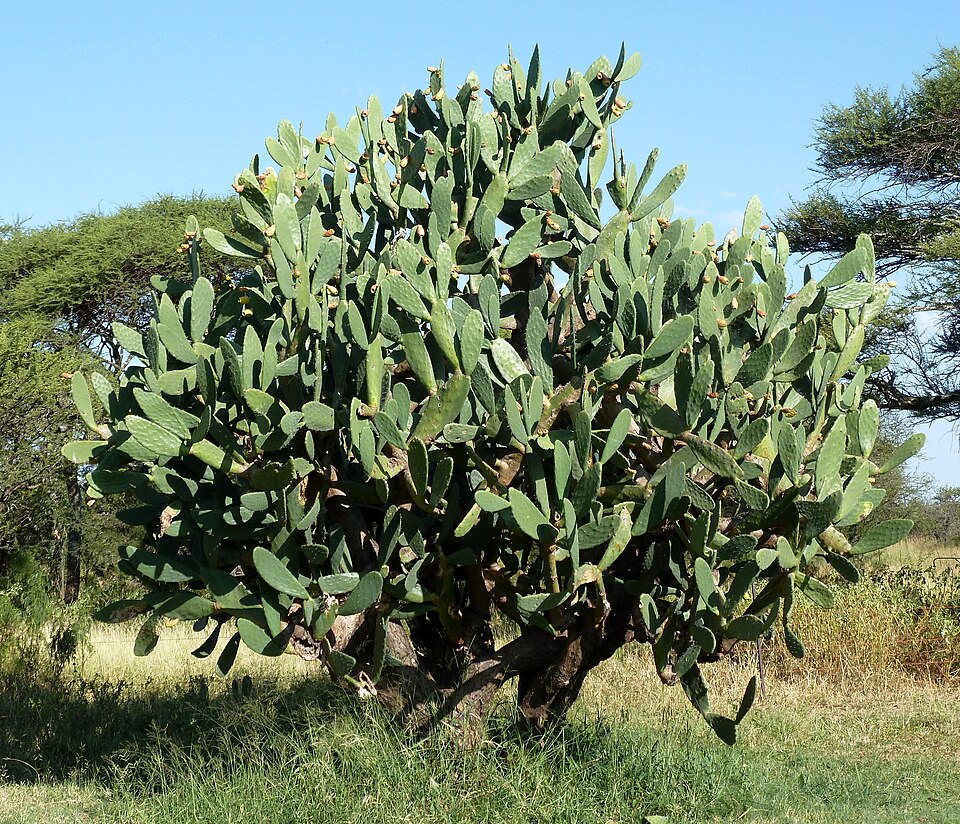
Photograph on Wikimedia Commons (CC BY-SA 3.0).
Plant habit
Quick overview
A practical summary; details are in the sections below.
- Safety grade
- Generally recognised as safe details
- Scientific sources on the card
- Yes — sources are listed with claims Science section
- When and what to harvest
- Leaf — July–September
- Fruit — August–October
- Processing methods
Culinary use, Syrup and more
All methods and recipes on the card- Topics and symptoms
Constipation, Digestion, Metabolism - gentle support
Topics section, Symptoms overview
Identification and mix-ups
Succulent shrub to small tree in Cactaceae usually 1.5–3 m tall. Flattened cladodes (pads) oblong to obovate, dull grey-green, to 60 × 20 cm; areoles with few or no large spines (cultivars are often nearly spineless) but always bearing tiny barbed glochids. Flowers 5–7 cm, yellow to orange (sometimes red), opening in late morning. Fruit an ellipsoid reddish berry (to 7.5 cm) with edible sweet pulp.
Possible mix-ups and risks
Most often confused with erect prickly pear (Opuntia stricta), which is lower (0.5–1 m), with smaller cladodes and notably smaller fruit (about 20–50 mm) unsuitable for eating. It is not toxic to humans but is aggressively invasive; the glochids of all Opuntia cause mechanical injury to skin and mucous membranes. No acutely poisonous lookalike is documented.
Similar herbs
No related herbs are linked yet.
Topics and symptoms
More topics are in the symptoms and topics overview.
- ConstipationTraditional· Traditional / cultural framing
- DigestionTraditional· Traditional / cultural framing
- Metabolism - gentle supportTraditional· Traditional / cultural framing
Sources
Geographic occurrence
Mexico
Common (expected wild occurrence in the region)
Harvest
- LeafJuly–September
summer
Region: MexicoNotes: Young pads (nopalitos) in the early morning; fruits (tuna) at full ripeness.
- FruitAugust–October
summer
Region: MexicoNotes: The fruits (tuna) ripen from August to October; they are picked with tongs or gloves, the glochids brushed off and the skin cut away. Young pads (nopalitos) are cut early in the morning all year, best in spring.
Storage
- Refrigeration(Leaf)
Cleaned nopalitos keep a week in the fridge in a bag; tuna fruits 1–2 weeks in the fridge, 2 days once peeled.
- Moisture:
- Cleaned pads turn slimy in damp.
- Safety:
- Glochids (tiny barbed spines) lodge in skin and mucosa — clean with gloves under running water.
Processing methods on this herb card
Cooking, baking, seasoning as food — general category without therapeutic claims.
Full method description (from the catalogue)
Culinary use covers herbs as ingredients in dishes, drinks, or spice mixes. This overview does not evaluate medicinal effects — only reminds you about species intent, allergies, and heat treatment where needed (e.g. some fruits or plant parts).
Combining with alcohol, sugar, or long cooking changes outcomes; verify culinary sources.
Traditional context for this method: yes·Scientific context for this method: no
Decoction or infusion with sweetener and reduction; shelf life depends on sugar and storage.
Full method description (from the catalogue)
Syrups combine a herbal base with sugar or honey and often a short boil to concentrate and improve hygiene. Preservation depends strongly on water content, sugar level, and bottling practice.
Home syrups may fall under food rules; store in the fridge after opening per recipe.
Traditional context for this method: yes·Scientific context for this method: no
Traditional / spiritual use
Kept separate from science — entries are cultural or symbolic, not medical advice.
The eagle on the cactus — the sign of where to build a city
Symbolism
Spiritual useMythologySymbolismAccording to the Mexican founding legend the god Huitzilopochtli led the Aztecs until they saw an eagle perched on a nopal devouring a snake; there in 1325 they founded Tenochtitlan, today's Mexico City, and the nopal with the eagle has been on Mexico's coat of arms since 1821. The very name Tenochtitlan contains nōchtli, the nopal fruit. A record of myth and state symbolism.
- Form:
- eagle on a nopal cactus in the national coat of arms, founding of Tenochtitlan
- Claim strength:
- Tradition
- Source note:
- Codex Mendoza (fol. 2r, founding of Tenochtitlan); Codex Boturini; coat of arms of Mexico.
Scientific notes
Each claim lists a study type and a source (URL or DOI) where available. Dose notes from the literature are informational only.
How to read evidence strength and study type labels
Labels summarise how the catalogue entry is tagged — they are not a medical verdict on efficacy. For every row, read the summary, limitations and source link.
Evidence strength
- Evidence level not specified
- The author did not grade the record; judge from the summary, limitations and source link.
- Narrative / orientational literature
- Descriptive or expert literature without controlled group comparison — context rather than proof of effect.
- Weak evidence
- Study or conclusion with major methodological limits; treat only as a pointer for further reading.
- Preliminary findings
- First or smaller studies — interesting direction, not the final word on efficacy or safety.
- Moderate strength of evidence
- Moderate strength by study design; sample and context limits still apply.
- Stronger evidence
- Stronger design or consistency of results within the study's stated limits.
- Review article
- A review summarises multiple sources; quality depends on review method and field.
Study type
- Narrative / expert text
- Expert text or overview without a classical study design.
- In vitro study
- Cell culture or test-tube experiment — does not show an effect in the body.
- Animal study
- Animal model — transfer to humans is not automatic.
- Observational study
- Observing groups without random treatment assignment; confounding is possible.
- Clinical trial
- Human clinical trial; sample size and control group matter.
- Randomised controlled trial
- Randomised controlled trials are among the stronger designs when well conducted.
- Review study
- A review aggregates multiple papers — quality depends on selection rules.
- Systematic review
- Systematic review with explicit search and selection methodology.
- Meta-analysis
- Statistical pooling of studies; outcome depends on input data and heterogeneity.
- Regulatory assessment / monograph (EMA, WHO…)
- Regulatory body summary for a herbal product — different context from a single RCT; often about products, not home tea.
- Expert monograph (herbal preparations)
- Structured literature summary for a plant or drug — quality depends on author and edition year.
The systematic review summarises the composition of prickly pear fruit (betalains, flavonoids, vitamin C, fibre) and studies of antioxidant, anti-inflammatory and hypoglycaemic activity; most data come from cell and animal models, human studies are few and small.
Review articleSystematic reviewYear: 2023Limitations: Mostly preclinical evidence; heterogeneous extracts; clinical relevance not established.
Giraldo-Silva L, Ferreira B, Rosa E, Dias ACP — Plants
Opuntia ficus-indica Fruit: A Systematic Review of Its Phytochemicals and Pharmacological Activities
Images
The main photo is in the card header. More images will appear here when available.
Safety
What the warning types mean
The type on each warning helps group themes — it does not replace the separate severity badge.
- Internal use
- Risks from swallowing, extracts, duration of use or concentration for internal use.
- Interactions / medicines
- Possible effect on medicines or concurrent treatment — check sources and a professional.
- Raw plant parts
- Raw, unripe or poorly prepared plant parts can be dangerous.
- Toxins and regulation
- Toxic constituents or regulated compounds (e.g. in distillates).
- Contact with the plant
- Skin or mucosa irritation from contact with fresh plant or sap.
- Allergy
- Allergic reactions, often linked to family sensitisation.
- Harvesting and contamination
- Contamination, species mix-ups or harvesting from unsuitable places.
No structured safety records yet.