Lamium album
White dead-nettle
Generally recognised as safeCommon white dead-nettle; nitrophilous.
Square stem.
- Family
- Lamiaceae
- Plant type
- Perennial herb
What the safety levels mean (expand legend)
- Generally recognised as safe. Often a common herb with reasonable harvest and use; still read the specific warnings on the card.
- Information. Primarily informational — details in the text and warnings below matter most.
- Caution. Needs extra care (dose, duration, sensitive groups, interactions).
- Risky. Significant risks — verify sources, contraindications and professional guidance.
- Not for home experimentation. Not suitable to experiment with at home without knowledge and certainty.
- High risk for internal use. Particular risk with internal use (e.g. alkaloids); avoid prolonged or irresponsible dosing.
- Not specified. Level not filled in yet — rely on individual warnings and links below.
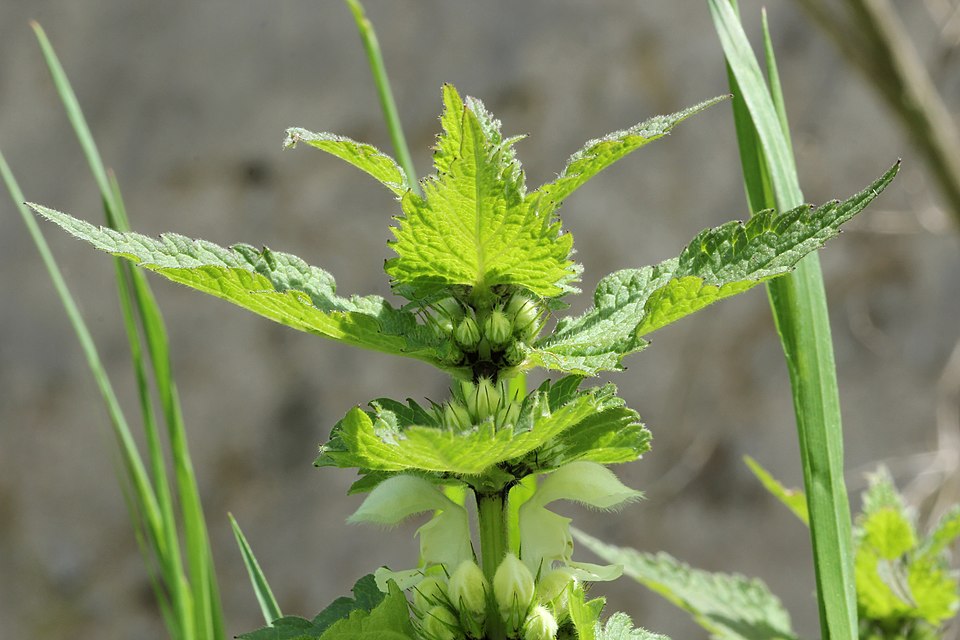
Photograph on Wikimedia Commons (CC BY-SA 3.0).
Plant habit
Quick overview
A practical summary; details are in the sections below.
- Safety grade
- Generally recognised as safe details
- Scientific sources on the card
- Yes — sources are listed with claims Science section
- When and what to harvest
- Flower — May–September
- Processing methods
Herbal infusion (tea), Honey macerate, Syrup
All methods and recipes on the card- Topics and symptoms
Complexion and local blemishes, Digestion, Immunity - informational context…
Topics section, Symptoms overview
Identification and mix-ups
Two-lipped white flowers.
Possible mix-ups and risks
Related dead-nettles look similar.
Similar herbs
- Lemon balm
Same botanical family; when foraging leaves always verify the species — confusion is common for beginners.
Topics and symptoms
More topics are in the symptoms and topics overview.
- Complexion and local blemishesTraditional· Traditional / cultural framing
- DigestionTraditional· Traditional / cultural framing
- Immunity - informational contextTraditional· Traditional / cultural framing
- Insect bites (topical)Traditional· Traditional / cultural framing
Geographic occurrence
Czechia
Common (expected wild occurrence in the region)
Widespread occurrence in the Czech Republic in suitable habitats.
Austria
Common (expected wild occurrence in the region)
Germany
Common (expected wild occurrence in the region)
Hungary
Common (expected wild occurrence in the region)
Poland
Common (expected wild occurrence in the region)
Slovakia
Common (expected wild occurrence in the region)
Harvest
- FlowerMay–September
léto
Region: CzechiaNotes: Flowering aerial parts.
Storage
- Drying(Leaf)
Keep dried plant material in a sealed container.
- Light:
- Out of direct UV.
- Moisture:
- Low relative humidity.
Processing methods on this herb card
Infusion or brief extraction in hot water; usually without long boiling.
Full method description (from the catalogue)
In the narrow sense, "tea" often means an infusion: you pour water just off the boil over the dried plant matter and let it steep for a few minutes. Temperature, steep time, and the herb-to-water ratio change both flavour and what dissolves into the liquid.
Compared with a decoction, heat exposure is shorter and gentler; tender leaves and flowers are often better as an infusion than with prolonged simmering. For each herb, always follow the plant card for suitable plant part, preparation, and safety notes — general rules never replace species-level judgement.
Traditional context for this method: yes·Scientific context for this method: no
Macerating plant material in honey (a honey conserve).
Full method description (from the catalogue)
Honey as a maceration medium creates a viscous mixture with its own biochemistry: water activity, acidity, and enzymes influence shelf life and flavour. Traditionally it is used with delicate flowers or herbs when you want aroma bound into honey.
Infant botulism guidance for honey and honey safety in general sit outside a single herb page; maceration time, ratios, and storage must follow a vetted recipe and source, not this general overview alone.
Traditional context for this method: yes·Scientific context for this method: no
Decoction or infusion with sweetener and reduction; shelf life depends on sugar and storage.
Full method description (from the catalogue)
Syrups combine a herbal base with sugar or honey and often a short boil to concentrate and improve hygiene. Preservation depends strongly on water content, sugar level, and bottling practice.
Home syrups may fall under food rules; store in the fridge after opening per recipe.
Traditional context for this method: yes·Scientific context for this method: no
Traditional / spiritual use
Kept separate from science — entries are cultural or symbolic, not medical advice.
Related guides in the library
White dead-nettle whorls at the garden edge
General
Traditional useFolk useHerbal loreWhite dead-nettle favours richer edges and gardens; white whorled flowers suggest insects and a summer day. The layer is landscape and garden aesthetics — any tea tradition still demands confident species ID.
- Form:
- čaj z natě v lokální praxi
- Claim strength:
- Tradition
- Source note:
- Landscape-forward image rather than magic — not a therapeutic indication.
Scientific notes
Each claim lists a study type and a source (URL or DOI) where available. Dose notes from the literature are informational only.
How to read evidence strength and study type labels
Labels summarise how the catalogue entry is tagged — they are not a medical verdict on efficacy. For every row, read the summary, limitations and source link.
Evidence strength
- Evidence level not specified
- The author did not grade the record; judge from the summary, limitations and source link.
- Narrative / orientational literature
- Descriptive or expert literature without controlled group comparison — context rather than proof of effect.
- Weak evidence
- Study or conclusion with major methodological limits; treat only as a pointer for further reading.
- Preliminary findings
- First or smaller studies — interesting direction, not the final word on efficacy or safety.
- Moderate strength of evidence
- Moderate strength by study design; sample and context limits still apply.
- Stronger evidence
- Stronger design or consistency of results within the study's stated limits.
- Review article
- A review summarises multiple sources; quality depends on review method and field.
Study type
- Narrative / expert text
- Expert text or overview without a classical study design.
- In vitro study
- Cell culture or test-tube experiment — does not show an effect in the body.
- Animal study
- Animal model — transfer to humans is not automatic.
- Observational study
- Observing groups without random treatment assignment; confounding is possible.
- Clinical trial
- Human clinical trial; sample size and control group matter.
- Randomised controlled trial
- Randomised controlled trials are among the stronger designs when well conducted.
- Review study
- A review aggregates multiple papers — quality depends on selection rules.
- Systematic review
- Systematic review with explicit search and selection methodology.
- Meta-analysis
- Statistical pooling of studies; outcome depends on input data and heterogeneity.
- Regulatory assessment / monograph (EMA, WHO…)
- Regulatory body summary for a herbal product — different context from a single RCT; often about products, not home tea.
- Expert monograph (herbal preparations)
- Structured literature summary for a plant or drug — quality depends on author and edition year.
White dead-nettle is comparatively little represented in modern clinical series; traditional use overlaps with related Lamiaceae herbs and must be separated from firm efficacy claims.
Evidence level not specifiedNarrative / expert textLimitations: Species identification matters; confusion with stinging nettle or other mints changes risk; robust RCT evidence for specific indications is limited.
Images
The main photo is in the card header. More images will appear here when available.
Safety
What the warning types mean
The type on each warning helps group themes — it does not replace the separate severity badge.
- Internal use
- Risks from swallowing, extracts, duration of use or concentration for internal use.
- Interactions / medicines
- Possible effect on medicines or concurrent treatment — check sources and a professional.
- Raw plant parts
- Raw, unripe or poorly prepared plant parts can be dangerous.
- Toxins and regulation
- Toxic constituents or regulated compounds (e.g. in distillates).
- Contact with the plant
- Skin or mucosa irritation from contact with fresh plant or sap.
- Allergy
- Allergic reactions, often linked to family sensitisation.
- Harvesting and contamination
- Contamination, species mix-ups or harvesting from unsuitable places.
No structured safety records yet.